Chikugo River
Kyushu's largest river runs along the town's western side and widens toward the Ariake Sea, forming a broad, clear edge on the map.
Fakatino mape mukamuka · Japan
33.2057° N / 130.3753° E
A flat delta town at the mouth of the Chikugo River, crossed by creeks and famous for its furniture workshops.


Taha e taone, lima e onoonoaga
Tapaki e taha puhala ke kitia ai ki luga he puipui. Kua tatai e totogi he tau puhala oti — pete he lolomi, poloka, po ke faila HD.
 Tau pikselo mooli · faila lolomi 24 × 36″
Maama mitaki ke lolomi
Ko e 100% e fahi mooli mai he faila lolomi. Ko e tau poster oti — pete kua lolomi, poloka, po ke utu hifo — kua taute ke he ha mautolu a tau tokoluga (server) ke he 300 DPI, hokotia ke he 7,200 × 10,800 piksela, ke maeke ai e tau ala ikiiki tote ke maaliali fakamitaki he lolomi 24 × 36″.
He Pā


Ko e mape
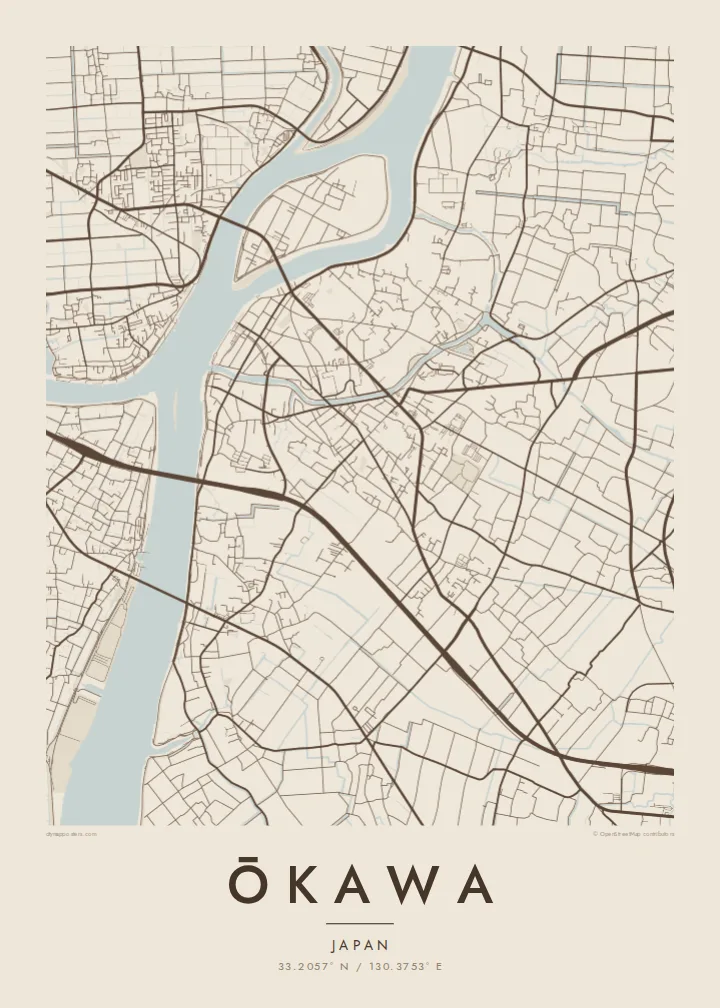
Ōkawa lies at the southwestern corner of Fukuoka Prefecture, where the Chikugo River, the largest river in Kyushu, flows into the Ariake Sea. The land here is flat, low and crossed by a dense network of drainage channels called creeks, used for centuries to irrigate rice fields and control water. On a map, the town looks like a lacework of fine waterways threaded between streets and fields.
Ōkawa is one of Japan's best-known furniture towns, with a woodworking tradition going back several centuries, and furniture shops and workshops still line many of its streets. The town is also home to the Chikugo River Lift Bridge, a steel vertical-lift railway bridge from the 1930s, now preserved as a pedestrian bridge and listed as an Important Cultural Property.
An Ōkawa map poster shows the delta in detail. The wide Chikugo River forms the town's western edge, and branching creeks create a pattern of fine, curving lines running through the grid of streets and fields. The low, level land means water, not hills, defines the shape of the town, and the result is a delicate, intricate map.
Kyushu's largest river runs along the town's western side and widens toward the Ariake Sea, forming a broad, clear edge on the map.
A network of narrow irrigation channels threads through the town and its fields, giving the map a fine, intricate pattern of water lines.
The historic Chikugo River Lift Bridge crosses the river to the west, a rare vertical-lift structure now open to walkers.
Taute ke ha hau
Lafi e aho, taha higoa po ke taha kupu haau, hiki e fakatino, lahi po ke tuaga.
Ko e kitiaaga nakai totogi kua tote e maaliali mo e fakamailoga vai. Ko e tau lolomi mo e tau faila HD kua taute ke he 300 DPI, hokotia ke he 7,200 × 10,800 px, nakai fai fakamailoga vai.
Ko e ha Ōkawa
Ōkawa is a place of craft, rivers and quiet streets. The poster suits someone from the town, a woodworker or designer who admires its furniture tradition, or a traveller who crossed the old lift bridge.
Personalise the title, subtitle and coordinates line, for example with the town name in Japanese and an important date. Choose one of five styles: Classic black & white, Noir, Paper, Blueprint or Sand.
Talaage e poster Ōkawa| Lahi he lolomi | Maama | Tau faila |
|---|---|---|
| 30 × 40 cm11.8 × 15.7″ | 3,543 × 4,724 px | PNG · PDF |
| 29.7 × 42 cm (A3)11.7 × 16.5″ | 3,508 × 4,961 px | PNG · PDF |
| 42 × 59.4 cm (A2)16.5 × 23.4″ | 4,961 × 7,016 px | PNG · PDF |
| 45.7 × 61 cm18 × 24″ | 5,400 × 7,200 px | PNG · PDF |
| 50 × 70 cm19.7 × 27.6″ | 5,906 × 8,268 px | PNG · PDF |
| 61 × 91.4 cm24 × 36″ | 7,200 × 10,800 px | PNG · PDF |
Ke fakatatai, ko e fakatino noa kua 900 px e laulahi, fai fakamailoga mo e mo e tau mata komipiuta ni. Ko e tau faila HD kua ato hoko ke he 8× e maama ke he tau faahi takitaha mo e lolomi mitaki he lahi katoa he fakatino.
Fifili e taha puhala i luga he kupega, ti fifili e Poster Lolomi — e lahi mo e, kaeke ke manako ai koe, taha poloka — po ke Tau Faila HD Fakaeletonika. Ko e fakaotiaga totogi ko e taha gahua ni, ti ko e kupega he hau a talaaga ka fakafou fakahaga i mua he fakaotiaga e totogi.
Kua lolomi ai ke he pepa mitaki 200 gsm matte he taha he tau lahi ono, mai he 30 × 40 cm ke hoko ke he 24 × 36″. Kamata e tau poster lolomi mai he $39, kua putoia ai e utaaga.
E. Fifili e poloka akau malolō ke he lanu uli, tea, akau oki mooli, po ke akau pouli. Kua fakalataha mo e sioga malolō nakai malepe ti kua mautali ke tautau. Kamata e tau poster poloka mai he $99, kua putoia ai e utaaga.
Nakai totogi e fakafano ke he motu 60+. Ko e fakatino taha kua lolomi he fenoga lolomi ha mautolu kua tata mo e tau motu 30+, kua hoko mai he tau aho gahua 3–7. Maeke ia koe ke kikite e tuaga mo e fakamuitua he lalo he Haku Tau Fakatonu. Ke he falu motu kua 2–5 e tau tapu, ti ka nakai fakafano a mautolu ki ai, to fakaha he api tupe ia ki mua he totogi.
Fakafano mai e taha ata ki a mautolu he loto he 14 e tau aho tali mai he hokoaga, ti to lolomi foki e mautolu nakai totogi po ke liu atu e totogi ki a koe.
E. He editor i luga he kupega nei, hikihiki e matakupu, e matakupu lalo mo e laini coordinates ke he taha mena kua manako a koe ki ai, ti fifili e puhala mo e lahi. Ko e tau talaaga lolomi, poloka mo e fakaeletonika oti kua fakaaoga tonu e hau a fakatino.
Ma e $9 ka moua e koe e tau faila PNG 300 DPI mo e PDF kua mautali ke lolomi he tau lahi ono oti, nakai fai fakamailoga vai, ke lolomi i fe mena. Nakai maopoopo agaia? Utu hifo fakamua e kitiaaga nakai totogi ne fai fakamailoga vai.
Tata mai
