Compact town centre
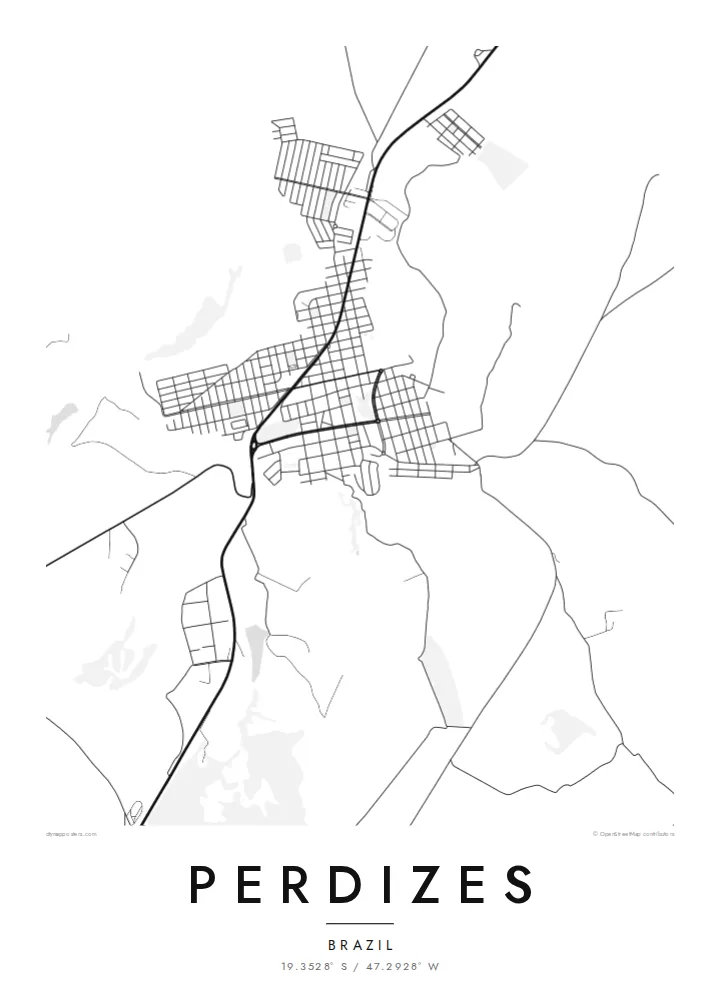
The streets of Perdizes gather into a tight, readable core, small enough that the whole town fits comfortably on a single poster with room to spare around it.
Fakatino mape mukamuka · Brazil
19.3528° S / 47.2928° W
A small upland town in western Minas Gerais, its street grid ringed by broad farmland and rural roads.



Taha e taone, lima e onoonoaga
Tapaki e taha puhala ke kitia ai ki luga he puipui. Kua tatai e totogi he tau puhala oti — pete he lolomi, poloka, po ke faila HD.
 Tau pikselo mooli · faila lolomi 24 × 36″
Maama mitaki ke lolomi
Ko e 100% e fahi mooli mai he faila lolomi. Ko e tau poster oti — pete kua lolomi, poloka, po ke utu hifo — kua taute ke he ha mautolu a tau tokoluga (server) ke he 300 DPI, hokotia ke he 7,200 × 10,800 piksela, ke maeke ai e tau ala ikiiki tote ke maaliali fakamitaki he lolomi 24 × 36″.
He Pā


Ko e mape
Perdizes lies on the high ground of western Minas Gerais, in the agricultural country of the Alto Paranaíba. On a map the town is a compact knot of streets surrounded by a wide landscape of fields, with rural roads spreading out in several directions. The urban area is modest, so its shape reads clearly against the open terrain that surrounds it on every side.
The name is the Portuguese word for partridges, birds of open grassland much like the country around the town. Farming shapes the region, and from above the municipality is a patchwork of large plots, tracks and small watercourses running through shallow valleys. The town works as a service centre for this rural hinterland, and its practical layout reflects that role.
A Perdizes map poster works best with some of that surrounding land left in the frame. The streets form a dense centre, while the lines leading away from it hint at the farms and neighbouring towns beyond. Drawn in monochrome, the contrast between the settled core and the open plateau becomes the main subject of the print.
The streets of Perdizes gather into a tight, readable core, small enough that the whole town fits comfortably on a single poster with room to spare around it.
Rural roads leave the town in several directions toward farms and neighbouring municipalities, drawing fine lines across the paper like spokes from a hub.
Around the town the map is shaped by field boundaries, tracks and small streams on the high ground of the Alto Paranaíba, giving the print a quiet, open texture.
Taute ke ha hau
Lafi e aho, taha higoa po ke taha kupu haau, hiki e fakatino, lahi po ke tuaga.
Ko e kitiaaga nakai totogi kua tote e maaliali mo e fakamailoga vai. Ko e tau lolomi mo e tau faila HD kua taute ke he 300 DPI, hokotia ke he 7,200 × 10,800 px, nakai fai fakamailoga vai.
Ko e ha Perdizes
A map of Perdizes speaks to people with roots in the interior of Minas Gerais: those who grew up there, moved away for study or work, or still return for family gatherings. It is a way of keeping a small, specific place on the wall of a new home.
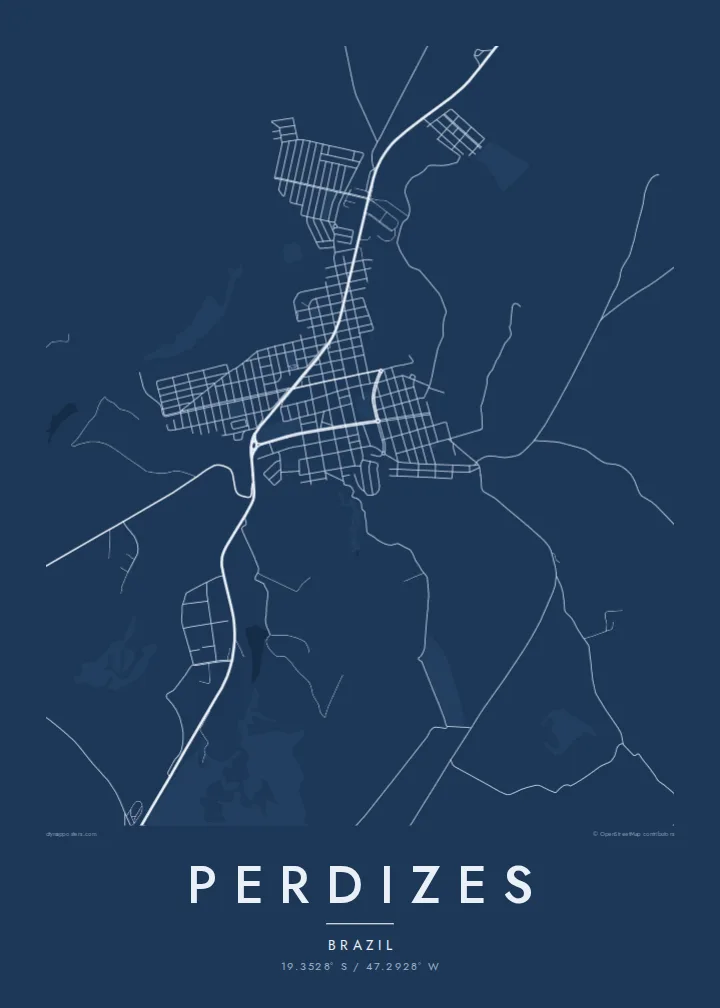
Personalise the title, subtitle and coordinates line, and pick from Classic black & white, Noir, Paper, Blueprint or Sand. Start with a free 900 px watermarked preview, then choose HD files for $9 in six sizes or a printed matte poster with an optional frame.
Talaage e poster Perdizes| Lahi he lolomi | Maama | Tau faila |
|---|---|---|
| 30 × 40 cm11.8 × 15.7″ | 3,543 × 4,724 px | PNG · PDF |
| 29.7 × 42 cm (A3)11.7 × 16.5″ | 3,508 × 4,961 px | PNG · PDF |
| 42 × 59.4 cm (A2)16.5 × 23.4″ | 4,961 × 7,016 px | PNG · PDF |
| 45.7 × 61 cm18 × 24″ | 5,400 × 7,200 px | PNG · PDF |
| 50 × 70 cm19.7 × 27.6″ | 5,906 × 8,268 px | PNG · PDF |
| 61 × 91.4 cm24 × 36″ | 7,200 × 10,800 px | PNG · PDF |
Ke fakatatai, ko e fakatino noa kua 900 px e laulahi, fai fakamailoga mo e mo e tau mata komipiuta ni. Ko e tau faila HD kua ato hoko ke he 8× e maama ke he tau faahi takitaha mo e lolomi mitaki he lahi katoa he fakatino.
Fifili e taha puhala i luga he kupega, ti fifili e Poster Lolomi — e lahi mo e, kaeke ke manako ai koe, taha poloka — po ke Tau Faila HD Fakaeletonika. Ko e fakaotiaga totogi ko e taha gahua ni, ti ko e kupega he hau a talaaga ka fakafou fakahaga i mua he fakaotiaga e totogi.
Kua lolomi ai ke he pepa mitaki 200 gsm matte he taha he tau lahi ono, mai he 30 × 40 cm ke hoko ke he 24 × 36″. Kamata e tau poster lolomi mai he $39, kua putoia ai e utaaga.
E. Fifili e poloka akau malolō ke he lanu uli, tea, akau oki mooli, po ke akau pouli. Kua fakalataha mo e sioga malolō nakai malepe ti kua mautali ke tautau. Kamata e tau poster poloka mai he $99, kua putoia ai e utaaga.
Nakai totogi e fakafano ke he motu 60+. Ko e fakatino taha kua lolomi he fenoga lolomi ha mautolu kua tata mo e tau motu 30+, kua hoko mai he tau aho gahua 3–7. Maeke ia koe ke kikite e tuaga mo e fakamuitua he lalo he Haku Tau Fakatonu. Ke he falu motu kua 2–5 e tau tapu, ti ka nakai fakafano a mautolu ki ai, to fakaha he api tupe ia ki mua he totogi.
Fakafano mai e taha ata ki a mautolu he loto he 14 e tau aho tali mai he hokoaga, ti to lolomi foki e mautolu nakai totogi po ke liu atu e totogi ki a koe.
E. He editor i luga he kupega nei, hikihiki e matakupu, e matakupu lalo mo e laini coordinates ke he taha mena kua manako a koe ki ai, ti fifili e puhala mo e lahi. Ko e tau talaaga lolomi, poloka mo e fakaeletonika oti kua fakaaoga tonu e hau a fakatino.
Ma e $9 ka moua e koe e tau faila PNG 300 DPI mo e PDF kua mautali ke lolomi he tau lahi ono oti, nakai fai fakamailoga vai, ke lolomi i fe mena. Nakai maopoopo agaia? Utu hifo fakamua e kitiaaga nakai totogi ne fai fakamailoga vai.
Tata mai
