Town grid
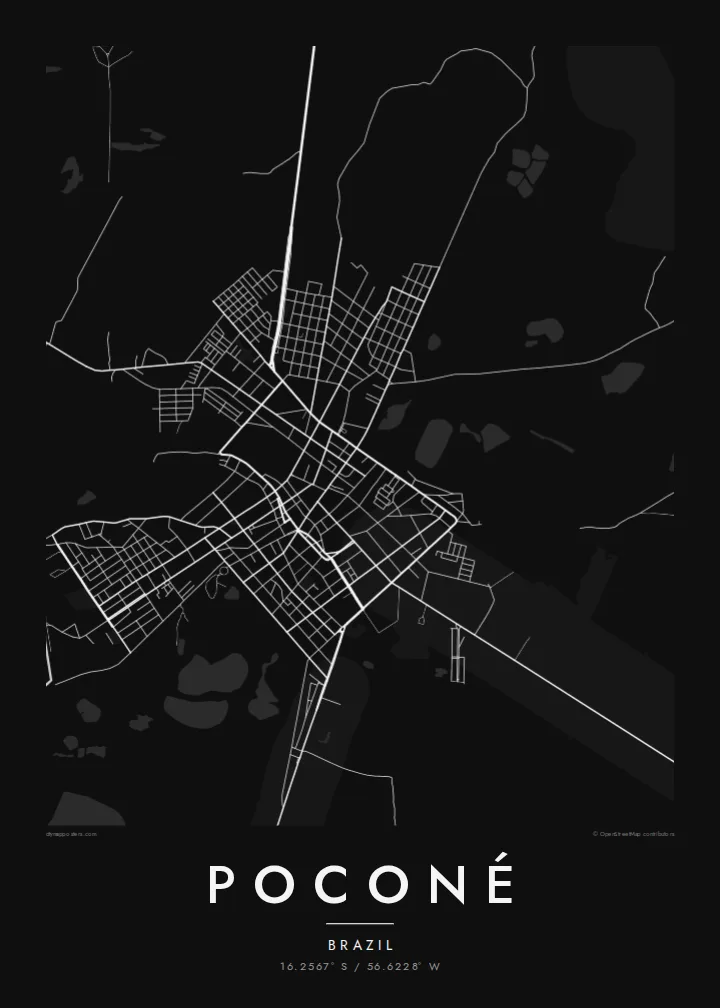
The central streets form a tidy pattern of blocks on flat ground. It is a compact, orderly core that stands out against the open landscape.
Fakatino mape mukamuka · Brazil
16.2567° S / 56.6228° W
A historic Mato Grosso town at the northern gateway to the Pantanal, where the Transpantaneira road begins.



Taha e taone, lima e onoonoaga
Tapaki e taha puhala ke kitia ai ki luga he puipui. Kua tatai e totogi he tau puhala oti — pete he lolomi, poloka, po ke faila HD.
 Tau pikselo mooli · faila lolomi 24 × 36″
Maama mitaki ke lolomi
Ko e 100% e fahi mooli mai he faila lolomi. Ko e tau poster oti — pete kua lolomi, poloka, po ke utu hifo — kua taute ke he ha mautolu a tau tokoluga (server) ke he 300 DPI, hokotia ke he 7,200 × 10,800 piksela, ke maeke ai e tau ala ikiiki tote ke maaliali fakamitaki he lolomi 24 × 36″.
He Pā


Ko e mape
Poconé is in Mato Grosso, southwest of Cuiabá, on the northern edge of the Pantanal, the vast tropical wetland shared by Brazil, Bolivia and Paraguay. The town dates from the late eighteenth century and grew with gold mining, which still marks parts of the landscape. Today it is best known as the starting point of the Transpantaneira, the long road that runs south into the wetlands.
From above, the town is a compact grid of streets on flat ground. It is surrounded by pastures and the scars of old and current mining. To the south the landscape changes, and the dry land gives way to a mosaic of seasonal lakes, marshes and wooded patches. The straight line of the Transpantaneira heads directly into that wetland.
A Poconé map poster captures a threshold between two worlds: an ordered colonial-era town and the wide, watery Pantanal beyond. In black and white, the grid and the long road south make a clear, graphic composition, and the scattered ponds and marshes add a softer, irregular edge.
The central streets form a tidy pattern of blocks on flat ground. It is a compact, orderly core that stands out against the open landscape.
The famous road begins near Poconé and runs south in a long straight line. It leads the eye out of the town and into the wetlands.
To the south, the land breaks into seasonal lakes and marshes. The pale irregular shapes make a striking contrast with the streets.
Taute ke ha hau
Lafi e aho, taha higoa po ke taha kupu haau, hiki e fakatino, lahi po ke tuaga.
Ko e kitiaaga nakai totogi kua tote e maaliali mo e fakamailoga vai. Ko e tau lolomi mo e tau faila HD kua taute ke he 300 DPI, hokotia ke he 7,200 × 10,800 px, nakai fai fakamailoga vai.
Ko e ha Poconé
Poconé appeals to people from Mato Grosso, and to travellers who began a Pantanal journey on the Transpantaneira here. A map of the town is a fitting souvenir of wildlife trips, family roots or a long-remembered road south.
Personalise the title, subtitle and coordinates, for example with the date of a trip, and choose from Classic black & white, Noir, Paper, Blueprint and Sand. HD files cost $9 in six print sizes, and matte posters with optional wooden frames ship from partners in over 30 countries.
Talaage e poster Poconé| Lahi he lolomi | Maama | Tau faila |
|---|---|---|
| 30 × 40 cm11.8 × 15.7″ | 3,543 × 4,724 px | PNG · PDF |
| 29.7 × 42 cm (A3)11.7 × 16.5″ | 3,508 × 4,961 px | PNG · PDF |
| 42 × 59.4 cm (A2)16.5 × 23.4″ | 4,961 × 7,016 px | PNG · PDF |
| 45.7 × 61 cm18 × 24″ | 5,400 × 7,200 px | PNG · PDF |
| 50 × 70 cm19.7 × 27.6″ | 5,906 × 8,268 px | PNG · PDF |
| 61 × 91.4 cm24 × 36″ | 7,200 × 10,800 px | PNG · PDF |
Ke fakatatai, ko e fakatino noa kua 900 px e laulahi, fai fakamailoga mo e mo e tau mata komipiuta ni. Ko e tau faila HD kua ato hoko ke he 8× e maama ke he tau faahi takitaha mo e lolomi mitaki he lahi katoa he fakatino.
Fifili e taha puhala i luga he kupega, ti fifili e Poster Lolomi — e lahi mo e, kaeke ke manako ai koe, taha poloka — po ke Tau Faila HD Fakaeletonika. Ko e fakaotiaga totogi ko e taha gahua ni, ti ko e kupega he hau a talaaga ka fakafou fakahaga i mua he fakaotiaga e totogi.
Kua lolomi ai ke he pepa mitaki 200 gsm matte he taha he tau lahi ono, mai he 30 × 40 cm ke hoko ke he 24 × 36″. Kamata e tau poster lolomi mai he $39, kua putoia ai e utaaga.
E. Fifili e poloka akau malolō ke he lanu uli, tea, akau oki mooli, po ke akau pouli. Kua fakalataha mo e sioga malolō nakai malepe ti kua mautali ke tautau. Kamata e tau poster poloka mai he $99, kua putoia ai e utaaga.
Nakai totogi e fakafano ke he motu 60+. Ko e fakatino taha kua lolomi he fenoga lolomi ha mautolu kua tata mo e tau motu 30+, kua hoko mai he tau aho gahua 3–7. Maeke ia koe ke kikite e tuaga mo e fakamuitua he lalo he Haku Tau Fakatonu. Ke he falu motu kua 2–5 e tau tapu, ti ka nakai fakafano a mautolu ki ai, to fakaha he api tupe ia ki mua he totogi.
Fakafano mai e taha ata ki a mautolu he loto he 14 e tau aho tali mai he hokoaga, ti to lolomi foki e mautolu nakai totogi po ke liu atu e totogi ki a koe.
E. He editor i luga he kupega nei, hikihiki e matakupu, e matakupu lalo mo e laini coordinates ke he taha mena kua manako a koe ki ai, ti fifili e puhala mo e lahi. Ko e tau talaaga lolomi, poloka mo e fakaeletonika oti kua fakaaoga tonu e hau a fakatino.
Ma e $9 ka moua e koe e tau faila PNG 300 DPI mo e PDF kua mautali ke lolomi he tau lahi ono oti, nakai fai fakamailoga vai, ke lolomi i fe mena. Nakai maopoopo agaia? Utu hifo fakamua e kitiaaga nakai totogi ne fai fakamailoga vai.
