The Plateau
The historic centre sits on a flat-topped rise above the harbour, laid out in a neat grid. On the map it is a compact, well-defined block with steep edges.
Fakatino mape mukamuka · Cape Verde
14.9315° N / 23.5125° W
An Atlantic capital built across flat-topped plateaus and valleys, with its historic centre perched above the harbour


Taha e taone, lima e onoonoaga
Tapaki e taha puhala ke kitia ai ki luga he puipui. Kua tatai e totogi he tau puhala oti — pete he lolomi, poloka, po ke faila HD.
 Tau pikselo mooli · faila lolomi 24 × 36″
Maama mitaki ke lolomi
Ko e 100% e fahi mooli mai he faila lolomi. Ko e tau poster oti — pete kua lolomi, poloka, po ke utu hifo — kua taute ke he ha mautolu a tau tokoluga (server) ke he 300 DPI, hokotia ke he 7,200 × 10,800 piksela, ke maeke ai e tau ala ikiiki tote ke maaliali fakamitaki he lolomi 24 × 36″.
He Pā


Ko e mape
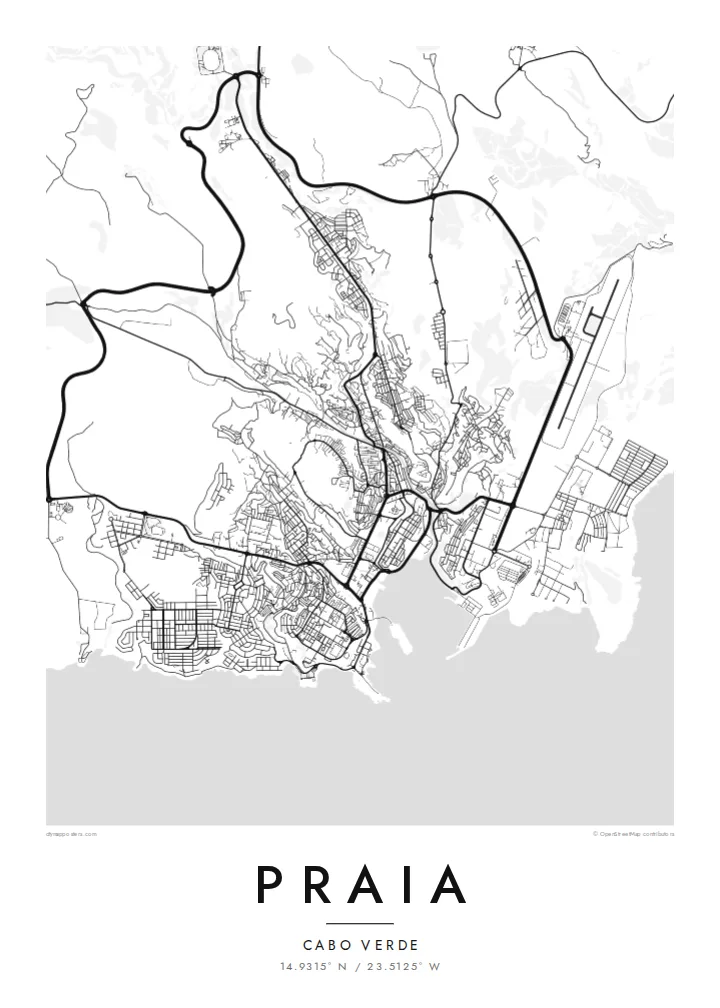
Praia, the capital of Cabo Verde, lies on the southern coast of Santiago, the largest island in the archipelago. The map shows a city shaped by terrain. Neighbourhoods sit on a series of flat-topped plateaus separated by dry valleys, and roads snake between them. The coastline breaks into small bays and beaches, and the harbour tucks into one of them, just below the old centre.
The historic core, known as the Plateau, occupies a raised tableland above the port, laid out with straight streets, squares and colonial-era buildings. A short drive west is Cidade Velha, the island's first capital. It was founded in the fifteenth century and is now a UNESCO World Heritage Site, one of the earliest European colonial towns in the tropics.
A Praia map poster brings the plateau city into focus. It shows the orderly grid of the Plateau, the looser districts spread across neighbouring heights and the jagged coastline below. Rendered in black and white, the pattern of high ground and valleys gives the capital a striking, layered look.
The historic centre sits on a flat-topped rise above the harbour, laid out in a neat grid. On the map it is a compact, well-defined block with steep edges.
The coastline breaks into small bays, beaches and headlands along the city's southern edge. The port lies close beneath the Plateau, framing the old town from the sea.
Dry valleys separate the city's plateaus, so neighbourhoods appear as distinct islands of streets. Roads wind through the gaps, giving the map a fragmented, highly readable structure.
Taute ke ha hau
Lafi e aho, taha higoa po ke taha kupu haau, hiki e fakatino, lahi po ke tuaga.
Ko e kitiaaga nakai totogi kua tote e maaliali mo e fakamailoga vai. Ko e tau lolomi mo e tau faila HD kua taute ke he 300 DPI, hokotia ke he 7,200 × 10,800 px, nakai fai fakamailoga vai.
Ko e ha Praia
Praia matters to Cabo Verdeans across the diaspora, from Lisbon to Boston, and to anyone who has passed through on the way to the islands. A map of the capital is a clear, dignified way to mark that connection.
The title, subtitle and coordinates line can all be personalised, in Portuguese, Kriolu or English. Pick one of five styles: Classic black & white, Noir, Paper, Blueprint or Sand. Printed posters are available on matte paper with an optional wooden frame.
Talaage e poster Praia| Lahi he lolomi | Maama | Tau faila |
|---|---|---|
| 30 × 40 cm11.8 × 15.7″ | 3,543 × 4,724 px | PNG · PDF |
| 29.7 × 42 cm (A3)11.7 × 16.5″ | 3,508 × 4,961 px | PNG · PDF |
| 42 × 59.4 cm (A2)16.5 × 23.4″ | 4,961 × 7,016 px | PNG · PDF |
| 45.7 × 61 cm18 × 24″ | 5,400 × 7,200 px | PNG · PDF |
| 50 × 70 cm19.7 × 27.6″ | 5,906 × 8,268 px | PNG · PDF |
| 61 × 91.4 cm24 × 36″ | 7,200 × 10,800 px | PNG · PDF |
Ke fakatatai, ko e fakatino noa kua 900 px e laulahi, fai fakamailoga mo e mo e tau mata komipiuta ni. Ko e tau faila HD kua ato hoko ke he 8× e maama ke he tau faahi takitaha mo e lolomi mitaki he lahi katoa he fakatino.
Fifili e taha puhala i luga he kupega, ti fifili e Poster Lolomi — e lahi mo e, kaeke ke manako ai koe, taha poloka — po ke Tau Faila HD Fakaeletonika. Ko e fakaotiaga totogi ko e taha gahua ni, ti ko e kupega he hau a talaaga ka fakafou fakahaga i mua he fakaotiaga e totogi.
Kua lolomi ai ke he pepa mitaki 200 gsm matte he taha he tau lahi ono, mai he 30 × 40 cm ke hoko ke he 24 × 36″. Kamata e tau poster lolomi mai he $39, kua putoia ai e utaaga.
E. Fifili e poloka akau malolō ke he lanu uli, tea, akau oki mooli, po ke akau pouli. Kua fakalataha mo e sioga malolō nakai malepe ti kua mautali ke tautau. Kamata e tau poster poloka mai he $99, kua putoia ai e utaaga.
Nakai totogi e fakafano ke he motu 60+. Ko e fakatino taha kua lolomi he fenoga lolomi ha mautolu kua tata mo e tau motu 30+, kua hoko mai he tau aho gahua 3–7. Maeke ia koe ke kikite e tuaga mo e fakamuitua he lalo he Haku Tau Fakatonu. Ke he falu motu kua 2–5 e tau tapu, ti ka nakai fakafano a mautolu ki ai, to fakaha he api tupe ia ki mua he totogi.
Fakafano mai e taha ata ki a mautolu he loto he 14 e tau aho tali mai he hokoaga, ti to lolomi foki e mautolu nakai totogi po ke liu atu e totogi ki a koe.
E. He editor i luga he kupega nei, hikihiki e matakupu, e matakupu lalo mo e laini coordinates ke he taha mena kua manako a koe ki ai, ti fifili e puhala mo e lahi. Ko e tau talaaga lolomi, poloka mo e fakaeletonika oti kua fakaaoga tonu e hau a fakatino.
Ma e $9 ka moua e koe e tau faila PNG 300 DPI mo e PDF kua mautali ke lolomi he tau lahi ono oti, nakai fai fakamailoga vai, ke lolomi i fe mena. Nakai maopoopo agaia? Utu hifo fakamua e kitiaaga nakai totogi ne fai fakamailoga vai.
Tata mai
