Santo António
The capital sits at the head of a sheltered bay on the northeast coast. Its handful of streets is the only real town grid on the island, small enough to take in at a glance.
Fakatino mape mukamuka · São Tomé & Príncipe
1.6103° N / 7.3951° E
A small volcanic island in the Gulf of Guinea, settled in the north, with forested peaks and rock spires to the south.



Taha e taone, lima e onoonoaga
Tapaki e taha puhala ke kitia ai ki luga he puipui. Kua tatai e totogi he tau puhala oti — pete he lolomi, poloka, po ke faila HD.
 Tau pikselo mooli · faila lolomi 24 × 36″
Maama mitaki ke lolomi
Ko e 100% e fahi mooli mai he faila lolomi. Ko e tau poster oti — pete kua lolomi, poloka, po ke utu hifo — kua taute ke he ha mautolu a tau tokoluga (server) ke he 300 DPI, hokotia ke he 7,200 × 10,800 piksela, ke maeke ai e tau ala ikiiki tote ke maaliali fakamitaki he lolomi 24 × 36″.
He Pā


Ko e mape
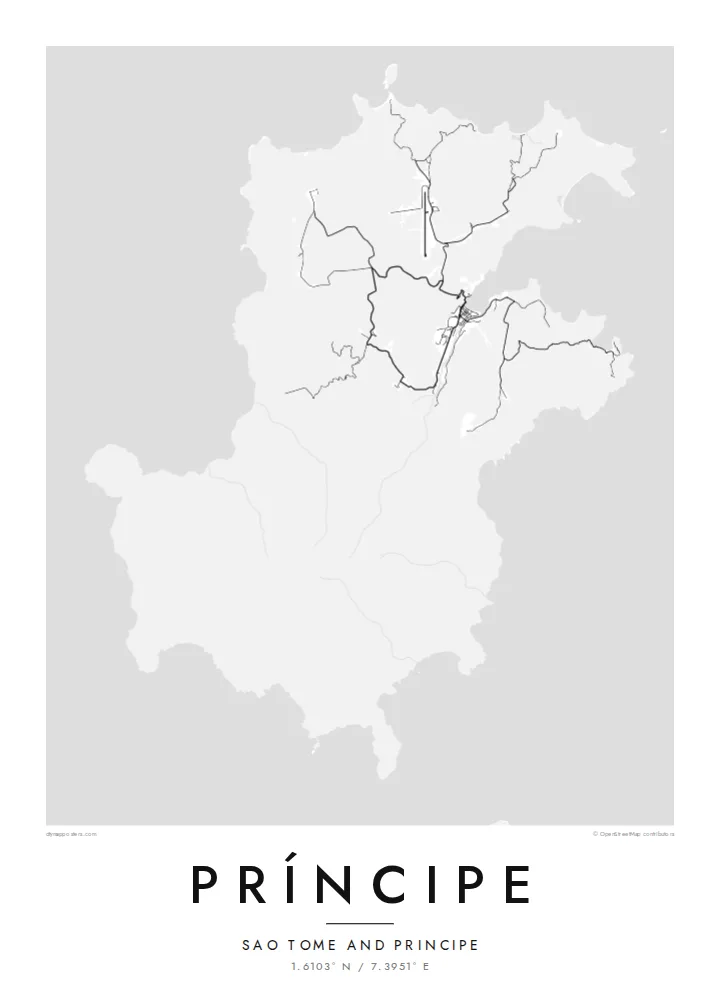
Príncipe is the smaller of the two main islands of São Tomé and Príncipe, in the Gulf of Guinea off Central Africa. It is roughly rectangular, with an indented coastline of bays and headlands. Roads and villages cluster in the flatter northern half. The south rises steeply into rainforest and is left almost empty on the map.
The island is a UNESCO biosphere reserve, known for its forest and birdlife. In 1919, astronomers led by Arthur Eddington watched a total solar eclipse from Roça Sundy, and their measurements helped confirm Einstein's general theory of relativity. Former cocoa plantations, known as roças, still show up as small clusters of buildings linked by tracks.
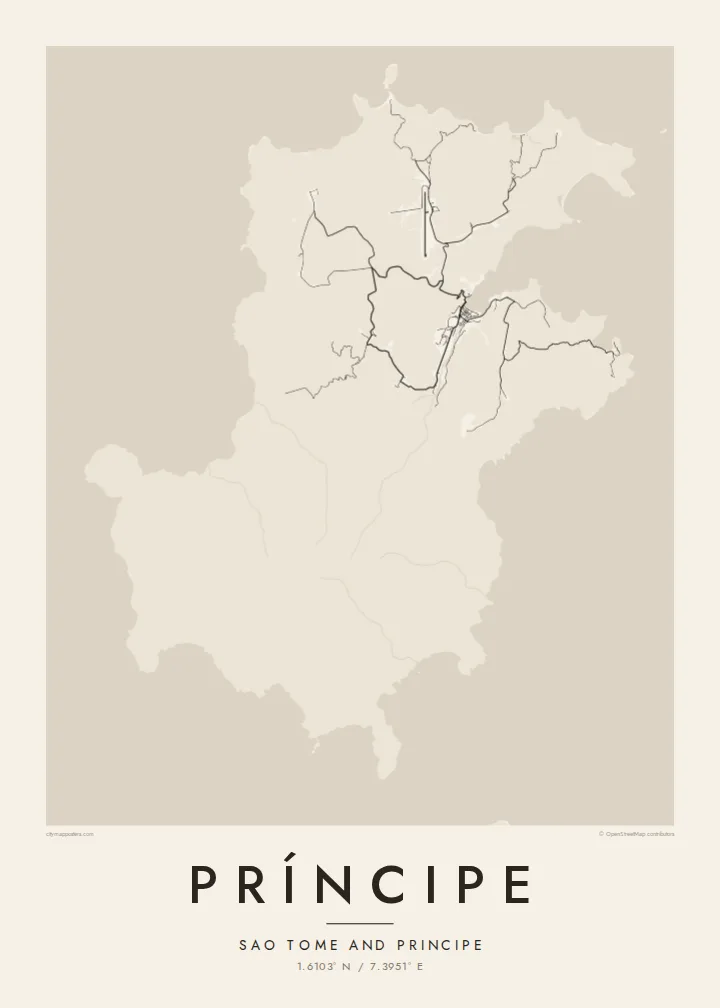
A Príncipe map poster centres on Santo António, the small capital on a bay on the northeast coast, with a few short streets beside a river mouth. Beyond it, a thin network of roads reaches out to the plantations. The southern peaks, including tall volcanic spires, leave a wide, quiet space.
The capital sits at the head of a sheltered bay on the northeast coast. Its handful of streets is the only real town grid on the island, small enough to take in at a glance.
The southern half is mountainous and covered in rainforest, with volcanic spires rising above the trees. Few roads go into it, so the poster leaves this area almost untouched.
The former plantation where the 1919 eclipse was observed shows as a small cluster at the end of a road in the north. It is a modest mark with a remarkable scientific story.
Taute ke ha hau
Lafi e aho, taha higoa po ke taha kupu haau, hiki e fakatino, lahi po ke tuaga.
Ko e kitiaaga nakai totogi kua tote e maaliali mo e fakamailoga vai. Ko e tau lolomi mo e tau faila HD kua taute ke he 300 DPI, hokotia ke he 7,200 × 10,800 px, nakai fai fakamailoga vai.
Ko e ha Príncipe
Príncipe suits travellers who remember its quiet forest and beaches, people with family ties to the islands, and anyone intrigued by its place in the history of physics. Its compact shape fits well in smaller frames.
Personalise the title and subtitle, perhaps with 1919 or a date of your own, and edit the coordinates line. Choose from five styles, Classic black & white, Noir, Paper, Blueprint and Sand. Buy it as $9 HD files or as a printed poster.
Talaage e poster Príncipe| Lahi he lolomi | Maama | Tau faila |
|---|---|---|
| 30 × 40 cm11.8 × 15.7″ | 3,543 × 4,724 px | PNG · PDF |
| 29.7 × 42 cm (A3)11.7 × 16.5″ | 3,508 × 4,961 px | PNG · PDF |
| 42 × 59.4 cm (A2)16.5 × 23.4″ | 4,961 × 7,016 px | PNG · PDF |
| 45.7 × 61 cm18 × 24″ | 5,400 × 7,200 px | PNG · PDF |
| 50 × 70 cm19.7 × 27.6″ | 5,906 × 8,268 px | PNG · PDF |
| 61 × 91.4 cm24 × 36″ | 7,200 × 10,800 px | PNG · PDF |
Ke fakatatai, ko e fakatino noa kua 900 px e laulahi, fai fakamailoga mo e mo e tau mata komipiuta ni. Ko e tau faila HD kua ato hoko ke he 8× e maama ke he tau faahi takitaha mo e lolomi mitaki he lahi katoa he fakatino.
Fifili e taha puhala i luga he kupega, ti fifili e Poster Lolomi — e lahi mo e, kaeke ke manako ai koe, taha poloka — po ke Tau Faila HD Fakaeletonika. Ko e fakaotiaga totogi ko e taha gahua ni, ti ko e kupega he hau a talaaga ka fakafou fakahaga i mua he fakaotiaga e totogi.
Kua lolomi ai ke he pepa mitaki 200 gsm matte he taha he tau lahi ono, mai he 30 × 40 cm ke hoko ke he 24 × 36″. Kamata e tau poster lolomi mai he $39, kua putoia ai e utaaga.
E. Fifili e poloka akau malolō ke he lanu uli, tea, akau oki mooli, po ke akau pouli. Kua fakalataha mo e sioga malolō nakai malepe ti kua mautali ke tautau. Kamata e tau poster poloka mai he $99, kua putoia ai e utaaga.
Nakai totogi e fakafano ke he motu 60+. Ko e fakatino taha kua lolomi he fenoga lolomi ha mautolu kua tata mo e tau motu 30+, kua hoko mai he tau aho gahua 3–7. Maeke ia koe ke kikite e tuaga mo e fakamuitua he lalo he Haku Tau Fakatonu. Ke he falu motu kua 2–5 e tau tapu, ti ka nakai fakafano a mautolu ki ai, to fakaha he api tupe ia ki mua he totogi.
Fakafano mai e taha ata ki a mautolu he loto he 14 e tau aho tali mai he hokoaga, ti to lolomi foki e mautolu nakai totogi po ke liu atu e totogi ki a koe.
E. He editor i luga he kupega nei, hikihiki e matakupu, e matakupu lalo mo e laini coordinates ke he taha mena kua manako a koe ki ai, ti fifili e puhala mo e lahi. Ko e tau talaaga lolomi, poloka mo e fakaeletonika oti kua fakaaoga tonu e hau a fakatino.
Ma e $9 ka moua e koe e tau faila PNG 300 DPI mo e PDF kua mautali ke lolomi he tau lahi ono oti, nakai fai fakamailoga vai, ke lolomi i fe mena. Nakai maopoopo agaia? Utu hifo fakamua e kitiaaga nakai totogi ne fai fakamailoga vai.
