Westward corridors
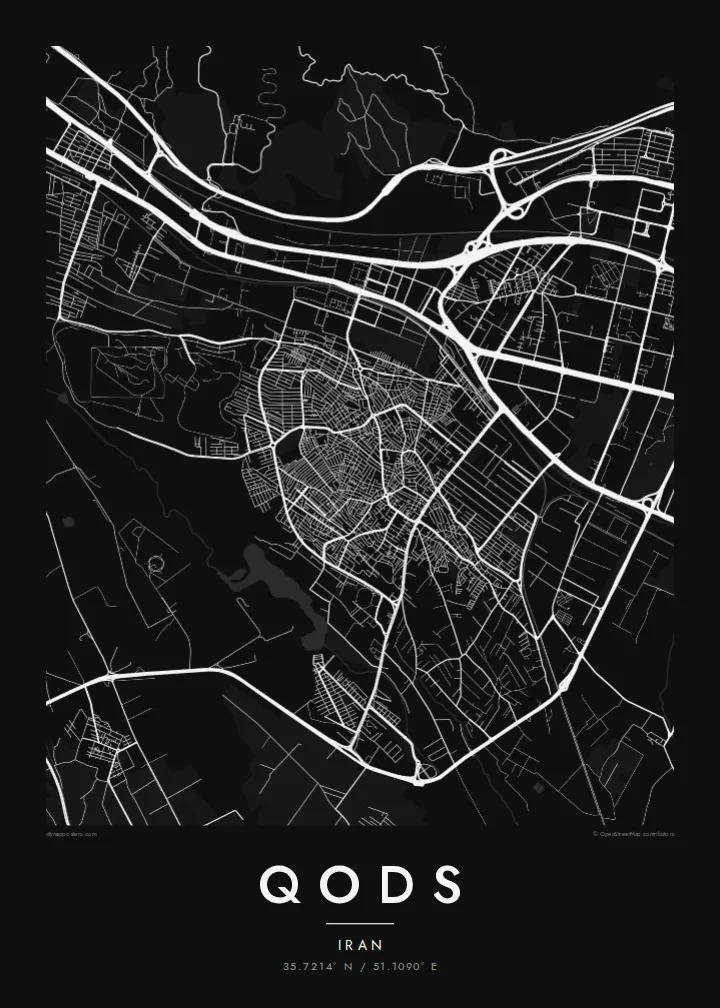
Major roads linking Tehran and Karaj pass along the city, and on the map they read as long, confident lines that anchor the whole composition.
Fakatino mape mukamuka · Iran
35.7214° N / 51.1090° E
A dense grid of workshops and homes on the dry plain west of Tehran, crossed by highways running toward Karaj



Taha e taone, lima e onoonoaga
Tapaki e taha puhala ke kitia ai ki luga he puipui. Kua tatai e totogi he tau puhala oti — pete he lolomi, poloka, po ke faila HD.
 Tau pikselo mooli · faila lolomi 24 × 36″
Maama mitaki ke lolomi
Ko e 100% e fahi mooli mai he faila lolomi. Ko e tau poster oti — pete kua lolomi, poloka, po ke utu hifo — kua taute ke he ha mautolu a tau tokoluga (server) ke he 300 DPI, hokotia ke he 7,200 × 10,800 piksela, ke maeke ai e tau ala ikiiki tote ke maaliali fakamitaki he lolomi 24 × 36″.
He Pā


Ko e mape
Qods sits on the flat, arid plain between Tehran and Karaj, where the capital's western edge turns into a separate city. From above it shows a tight street pattern of blocks and courtyards, broken up by wide arterial roads and the large rectangular plots of industrial zones. Its edges are hard to see on the map, because the city runs into its neighbours along the main traffic corridors.
The town grew quickly in the second half of the twentieth century from a small settlement once known as Qaleh Hasan Khan. Much of that growth came from Tehran's industrial spread westward, and the map still shows it: warehouses and factory compounds sit beside residential districts, with smaller lanes filling the space between the main roads. Nothing about the layout is decorative. It is plainly a working city.
A Qods map poster shows that practical geometry clearly. Printed in black and white, the long highways become strong horizontal strokes and the residential blocks turn into fine texture, with larger industrial parcels standing out as pale rectangles. The mountains to the north are left off the frame, so the composition stays on the city itself: a plain, well-organised street network on the high plateau.
Major roads linking Tehran and Karaj pass along the city, and on the map they read as long, confident lines that anchor the whole composition.
Large factory and warehouse plots appear as broad, quiet shapes among the finer residential streets, which gives the print a clear contrast in scale.
The residential districts are made of small blocks and narrow lanes, so parts of the city show up as dense, even hatching when printed.
Taute ke ha hau
Lafi e aho, taha higoa po ke taha kupu haau, hiki e fakatino, lahi po ke tuaga.
Ko e kitiaaga nakai totogi kua tote e maaliali mo e fakamailoga vai. Ko e tau lolomi mo e tau faila HD kua taute ke he 300 DPI, hokotia ke he 7,200 × 10,800 px, nakai fai fakamailoga vai.
Ko e ha Qods
People who grew up in Qods, or who once worked in its factories and offices, often want a record of the place as it actually is rather than a postcard view. A street map gives them that, and a personalised title, date or coordinates line can tie it to a family home or a first job.
The design is available in five styles: Classic black & white, Noir, Paper, Blueprint and Sand. Blueprint suits the city's industrial character, and Paper gives it a softer look. The digital HD files cost $9, and printed posters on matte paper are shipped from partners in more than 30 countries.
Talaage e poster Qods| Lahi he lolomi | Maama | Tau faila |
|---|---|---|
| 30 × 40 cm11.8 × 15.7″ | 3,543 × 4,724 px | PNG · PDF |
| 29.7 × 42 cm (A3)11.7 × 16.5″ | 3,508 × 4,961 px | PNG · PDF |
| 42 × 59.4 cm (A2)16.5 × 23.4″ | 4,961 × 7,016 px | PNG · PDF |
| 45.7 × 61 cm18 × 24″ | 5,400 × 7,200 px | PNG · PDF |
| 50 × 70 cm19.7 × 27.6″ | 5,906 × 8,268 px | PNG · PDF |
| 61 × 91.4 cm24 × 36″ | 7,200 × 10,800 px | PNG · PDF |
Ke fakatatai, ko e fakatino noa kua 900 px e laulahi, fai fakamailoga mo e mo e tau mata komipiuta ni. Ko e tau faila HD kua ato hoko ke he 8× e maama ke he tau faahi takitaha mo e lolomi mitaki he lahi katoa he fakatino.
Fifili e taha puhala i luga he kupega, ti fifili e Poster Lolomi — e lahi mo e, kaeke ke manako ai koe, taha poloka — po ke Tau Faila HD Fakaeletonika. Ko e fakaotiaga totogi ko e taha gahua ni, ti ko e kupega he hau a talaaga ka fakafou fakahaga i mua he fakaotiaga e totogi.
Kua lolomi ai ke he pepa mitaki 200 gsm matte he taha he tau lahi ono, mai he 30 × 40 cm ke hoko ke he 24 × 36″. Kamata e tau poster lolomi mai he $39, kua putoia ai e utaaga.
E. Fifili e poloka akau malolō ke he lanu uli, tea, akau oki mooli, po ke akau pouli. Kua fakalataha mo e sioga malolō nakai malepe ti kua mautali ke tautau. Kamata e tau poster poloka mai he $99, kua putoia ai e utaaga.
Nakai totogi e fakafano ke he motu 60+. Ko e fakatino taha kua lolomi he fenoga lolomi ha mautolu kua tata mo e tau motu 30+, kua hoko mai he tau aho gahua 3–7. Maeke ia koe ke kikite e tuaga mo e fakamuitua he lalo he Haku Tau Fakatonu. Ke he falu motu kua 2–5 e tau tapu, ti ka nakai fakafano a mautolu ki ai, to fakaha he api tupe ia ki mua he totogi.
Fakafano mai e taha ata ki a mautolu he loto he 14 e tau aho tali mai he hokoaga, ti to lolomi foki e mautolu nakai totogi po ke liu atu e totogi ki a koe.
E. He editor i luga he kupega nei, hikihiki e matakupu, e matakupu lalo mo e laini coordinates ke he taha mena kua manako a koe ki ai, ti fifili e puhala mo e lahi. Ko e tau talaaga lolomi, poloka mo e fakaeletonika oti kua fakaaoga tonu e hau a fakatino.
Ma e $9 ka moua e koe e tau faila PNG 300 DPI mo e PDF kua mautali ke lolomi he tau lahi ono oti, nakai fai fakamailoga vai, ke lolomi i fe mena. Nakai maopoopo agaia? Utu hifo fakamua e kitiaaga nakai totogi ne fai fakamailoga vai.
