Village ponds
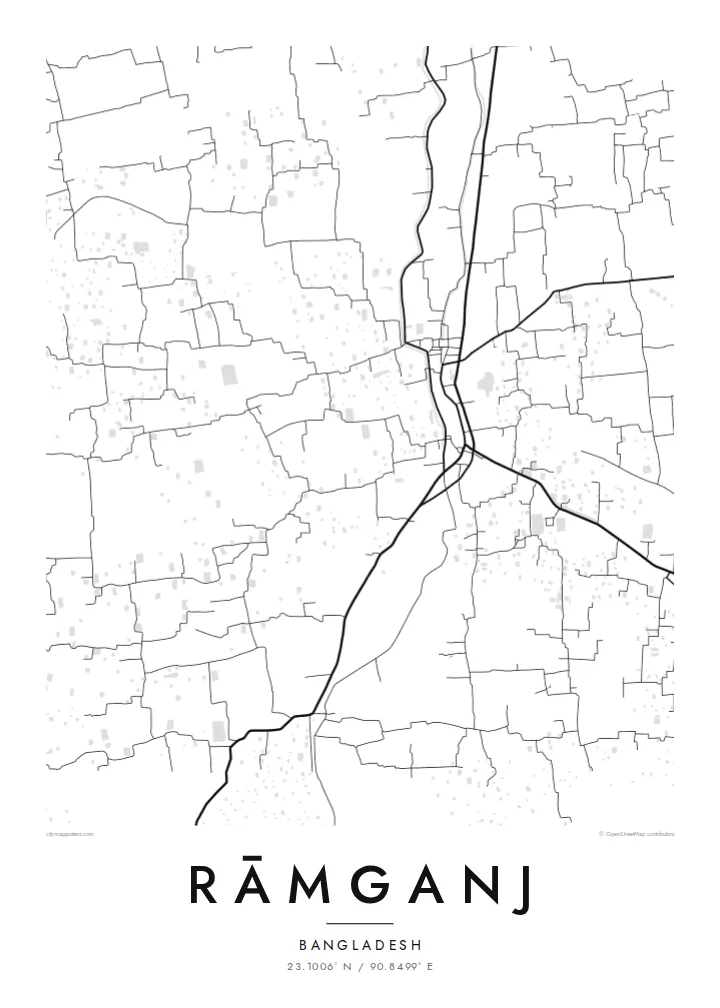
Countless ponds, many of them rectangular, dot the land around the town, each one beside a homestead and together forming a distinctive, finely scattered pattern.
Fakatino mape mukamuka · Bangladesh
23.1006° N / 90.8499° E
A delta town in Lakshmipur District, where roads, canals and village ponds weave through the green, low-lying plain.
Taha e taone, lima e onoonoaga
Tapaki e taha puhala ke kitia ai ki luga he puipui. Kua tatai e totogi he tau puhala oti — pete he lolomi, poloka, po ke faila HD.
 Tau pikselo mooli · faila lolomi 24 × 36″
Maama mitaki ke lolomi
Ko e 100% e fahi mooli mai he faila lolomi. Ko e tau poster oti — pete kua lolomi, poloka, po ke utu hifo — kua taute ke he ha mautolu a tau tokoluga (server) ke he 300 DPI, hokotia ke he 7,200 × 10,800 piksela, ke maeke ai e tau ala ikiiki tote ke maaliali fakamitaki he lolomi 24 × 36″.
He Pā



Ko e mape
Rāmganj is an upazila town in Lakshmipur District, in the Chittagong Division of south-eastern Bangladesh, on the flat, low-lying land of the Meghna delta. From above, the town centre is a compact cluster of lanes and market streets, while the surrounding countryside is a dense pattern of villages, each marked by trees, ponds and homesteads raised slightly above the paddy fields.
Water shapes everything here. Canals and small rivers wind across the plain, and nearly every village has its own ponds, dug to provide water and earth for raised house plots. On a map, these ponds appear as small, sharp shapes scattered across the landscape, and the roads between villages follow embankments that curve and branch in response to the waterways.
A Rāmganj map poster shows this intricate pattern of water and settlement, a landscape that looks quiet from a distance and rich in detail up close. It is a meaningful gift for families from the area, wherever they now live, and it pairs well with maps of other towns in the region such as Lakshmipur or Noakhali.
Countless ponds, many of them rectangular, dot the land around the town, each one beside a homestead and together forming a distinctive, finely scattered pattern.
Waterways cross the plain in winding lines, guiding the shape of roads and settlements and giving the poster its sense of flow.
The town's core gathers into a tight network of lanes and shops, the densest part of the map and the natural focus of the composition.
Taute ke ha hau
Lafi e aho, taha higoa po ke taha kupu haau, hiki e fakatino, lahi po ke tuaga.
Ko e kitiaaga nakai totogi kua tote e maaliali mo e fakamailoga vai. Ko e tau lolomi mo e tau faila HD kua taute ke he 300 DPI, hokotia ke he 7,200 × 10,800 px, nakai fai fakamailoga vai.
Ko e ha Rāmganj
For families from Rāmganj, a map of the area is a way to keep the home village close, from the family pond to the road into town. It turns a familiar landscape into something that can hang on a wall anywhere.
Personalise the title and subtitle with a family name, a village or a date, and set the coordinates. Choose Classic black & white, Noir, Paper, Blueprint or Sand, and download the HD files without watermark or order a printed matte poster.
Talaage e poster Rāmganj| Lahi he lolomi | Maama | Tau faila |
|---|---|---|
| 30 × 40 cm11.8 × 15.7″ | 3,543 × 4,724 px | PNG · PDF |
| 29.7 × 42 cm (A3)11.7 × 16.5″ | 3,508 × 4,961 px | PNG · PDF |
| 42 × 59.4 cm (A2)16.5 × 23.4″ | 4,961 × 7,016 px | PNG · PDF |
| 45.7 × 61 cm18 × 24″ | 5,400 × 7,200 px | PNG · PDF |
| 50 × 70 cm19.7 × 27.6″ | 5,906 × 8,268 px | PNG · PDF |
| 61 × 91.4 cm24 × 36″ | 7,200 × 10,800 px | PNG · PDF |
Ke fakatatai, ko e fakatino noa kua 900 px e laulahi, fai fakamailoga mo e mo e tau mata komipiuta ni. Ko e tau faila HD kua ato hoko ke he 8× e maama ke he tau faahi takitaha mo e lolomi mitaki he lahi katoa he fakatino.
Fifili e taha puhala i luga he kupega, ti fifili e Poster Lolomi — e lahi mo e, kaeke ke manako ai koe, taha poloka — po ke Tau Faila HD Fakaeletonika. Ko e fakaotiaga totogi ko e taha gahua ni, ti ko e kupega he hau a talaaga ka fakafou fakahaga i mua he fakaotiaga e totogi.
Kua lolomi ai ke he pepa mitaki 200 gsm matte he taha he tau lahi ono, mai he 30 × 40 cm ke hoko ke he 24 × 36″. Kamata e tau poster lolomi mai he $39, kua putoia ai e utaaga.
E. Fifili e poloka akau malolō ke he lanu uli, tea, akau oki mooli, po ke akau pouli. Kua fakalataha mo e sioga malolō nakai malepe ti kua mautali ke tautau. Kamata e tau poster poloka mai he $99, kua putoia ai e utaaga.
Nakai totogi e fakafano ke he motu 60+. Ko e fakatino taha kua lolomi he fenoga lolomi ha mautolu kua tata mo e tau motu 30+, kua hoko mai he tau aho gahua 3–7. Maeke ia koe ke kikite e tuaga mo e fakamuitua he lalo he Haku Tau Fakatonu. Ke he falu motu kua 2–5 e tau tapu, ti ka nakai fakafano a mautolu ki ai, to fakaha he api tupe ia ki mua he totogi.
Fakafano mai e taha ata ki a mautolu he loto he 14 e tau aho tali mai he hokoaga, ti to lolomi foki e mautolu nakai totogi po ke liu atu e totogi ki a koe.
E. He editor i luga he kupega nei, hikihiki e matakupu, e matakupu lalo mo e laini coordinates ke he taha mena kua manako a koe ki ai, ti fifili e puhala mo e lahi. Ko e tau talaaga lolomi, poloka mo e fakaeletonika oti kua fakaaoga tonu e hau a fakatino.
Ma e $9 ka moua e koe e tau faila PNG 300 DPI mo e PDF kua mautali ke lolomi he tau lahi ono oti, nakai fai fakamailoga vai, ke lolomi i fe mena. Nakai maopoopo agaia? Utu hifo fakamua e kitiaaga nakai totogi ne fai fakamailoga vai.
Tata mai
