L'Assomption River bends
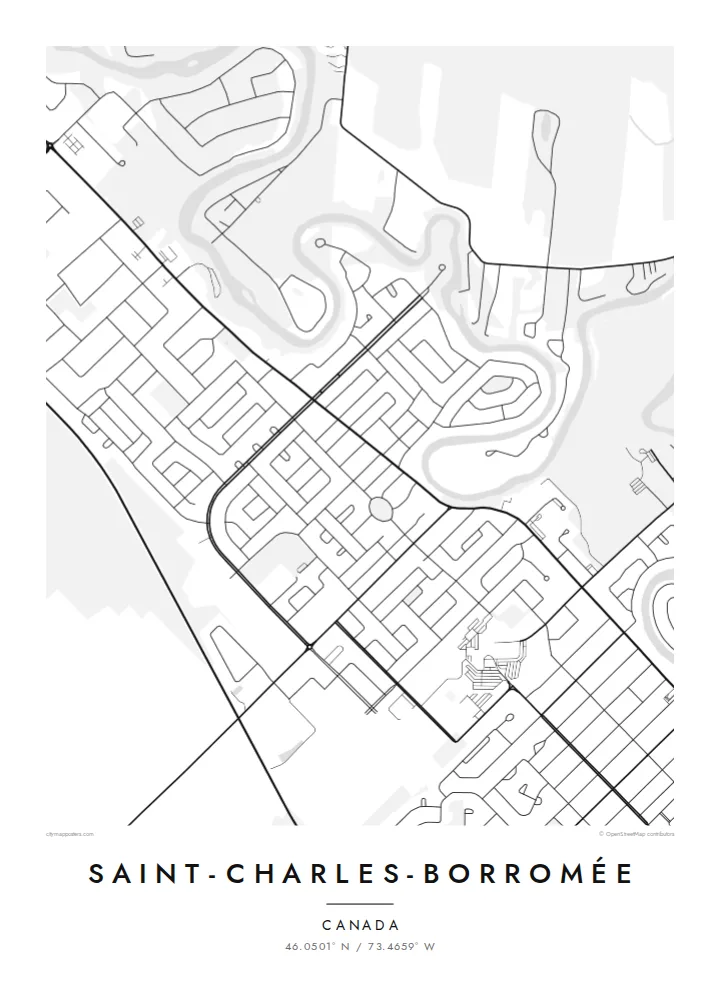
The river loops through the area in broad curves. It is the strongest natural line on the poster and the feature around which the neighbourhoods on both banks are arranged.
Fakatino mape mukamuka · Canada
46.0501° N / 73.4659° W
A residential neighbour of Joliette, curving along the L'Assomption River in Quebec's Lanaudière region.


Taha e taone, lima e onoonoaga
Tapaki e taha puhala ke kitia ai ki luga he puipui. Kua tatai e totogi he tau puhala oti — pete he lolomi, poloka, po ke faila HD.
 Tau pikselo mooli · faila lolomi 24 × 36″
Maama mitaki ke lolomi
Ko e 100% e fahi mooli mai he faila lolomi. Ko e tau poster oti — pete kua lolomi, poloka, po ke utu hifo — kua taute ke he ha mautolu a tau tokoluga (server) ke he 300 DPI, hokotia ke he 7,200 × 10,800 piksela, ke maeke ai e tau ala ikiiki tote ke maaliali fakamitaki he lolomi 24 × 36″.
He Pā


Ko e mape
Saint-Charles-Borromée is a municipality in Quebec's Lanaudière region, directly beside the city of Joliette. The two have grown together, and on a map their streets merge with no obvious break. What separates them visually is the L'Assomption River, which winds through the area in wide bends and gives the local street pattern much of its shape.
Most of the municipality is residential. Suburban crescents and short streets fill the land between the river and the main roads leading north toward the Laurentian foothills. The municipality is also home to the region's main hospital, a large institutional site that stands out among the smaller blocks of houses. Wooded strips along the riverbanks add softer lines to the map.
The name honours Charles Borromeo, the sixteenth-century archbishop of Milan, a dedication shared by many Quebec parishes. A Saint-Charles-Borromée map poster shows the municipality at the scale people experience it: the river bends, the quiet residential streets and the roads into Joliette. It is a close, personal kind of map for a place most people know from the inside.
The river loops through the area in broad curves. It is the strongest natural line on the poster and the feature around which the neighbourhoods on both banks are arranged.
Streets run continuously into Joliette, so the poster shows the municipality as part of a larger urban area. Only the river and a few main roads mark the shared edge.
Curving residential streets and cul-de-sacs fill much of the municipality. Drawn in fine lines, they give the map a soft, rounded texture next to the older grid nearby.
Taute ke ha hau
Lafi e aho, taha higoa po ke taha kupu haau, hiki e fakatino, lahi po ke tuaga.
Ko e kitiaaga nakai totogi kua tote e maaliali mo e fakamailoga vai. Ko e tau lolomi mo e tau faila HD kua taute ke he 300 DPI, hokotia ke he 7,200 × 10,800 px, nakai fai fakamailoga vai.
Ko e ha Saint-Charles-Borromée
People hang this map to remember a first house, a childhood street near the river or the place a family settled. The title, subtitle and coordinates line can be changed, so the poster can carry a name, a wedding date or a line in French.
Five styles are available: Classic black & white, Noir, Paper, Blueprint and Sand. Download the HD files for $9, or order a printed matte poster with an optional wooden frame. Sizes include 50×70 cm, A2 and 18×24″.
Talaage e poster Saint-Charles-Borromée| Lahi he lolomi | Maama | Tau faila |
|---|---|---|
| 30 × 40 cm11.8 × 15.7″ | 3,543 × 4,724 px | PNG · PDF |
| 29.7 × 42 cm (A3)11.7 × 16.5″ | 3,508 × 4,961 px | PNG · PDF |
| 42 × 59.4 cm (A2)16.5 × 23.4″ | 4,961 × 7,016 px | PNG · PDF |
| 45.7 × 61 cm18 × 24″ | 5,400 × 7,200 px | PNG · PDF |
| 50 × 70 cm19.7 × 27.6″ | 5,906 × 8,268 px | PNG · PDF |
| 61 × 91.4 cm24 × 36″ | 7,200 × 10,800 px | PNG · PDF |
Ke fakatatai, ko e fakatino noa kua 900 px e laulahi, fai fakamailoga mo e mo e tau mata komipiuta ni. Ko e tau faila HD kua ato hoko ke he 8× e maama ke he tau faahi takitaha mo e lolomi mitaki he lahi katoa he fakatino.
Fifili e taha puhala i luga he kupega, ti fifili e Poster Lolomi — e lahi mo e, kaeke ke manako ai koe, taha poloka — po ke Tau Faila HD Fakaeletonika. Ko e fakaotiaga totogi ko e taha gahua ni, ti ko e kupega he hau a talaaga ka fakafou fakahaga i mua he fakaotiaga e totogi.
Kua lolomi ai ke he pepa mitaki 200 gsm matte he taha he tau lahi ono, mai he 30 × 40 cm ke hoko ke he 24 × 36″. Kamata e tau poster lolomi mai he $39, kua putoia ai e utaaga.
E. Fifili e poloka akau malolō ke he lanu uli, tea, akau oki mooli, po ke akau pouli. Kua fakalataha mo e sioga malolō nakai malepe ti kua mautali ke tautau. Kamata e tau poster poloka mai he $99, kua putoia ai e utaaga.
Nakai totogi e fakafano ke he motu 60+. Ko e fakatino taha kua lolomi he fenoga lolomi ha mautolu kua tata mo e tau motu 30+, kua hoko mai he tau aho gahua 3–7. Maeke ia koe ke kikite e tuaga mo e fakamuitua he lalo he Haku Tau Fakatonu. Ke he falu motu kua 2–5 e tau tapu, ti ka nakai fakafano a mautolu ki ai, to fakaha he api tupe ia ki mua he totogi.
Fakafano mai e taha ata ki a mautolu he loto he 14 e tau aho tali mai he hokoaga, ti to lolomi foki e mautolu nakai totogi po ke liu atu e totogi ki a koe.
E. He editor i luga he kupega nei, hikihiki e matakupu, e matakupu lalo mo e laini coordinates ke he taha mena kua manako a koe ki ai, ti fifili e puhala mo e lahi. Ko e tau talaaga lolomi, poloka mo e fakaeletonika oti kua fakaaoga tonu e hau a fakatino.
Ma e $9 ka moua e koe e tau faila PNG 300 DPI mo e PDF kua mautali ke lolomi he tau lahi ono oti, nakai fai fakamailoga vai, ke lolomi i fe mena. Nakai maopoopo agaia? Utu hifo fakamua e kitiaaga nakai totogi ne fai fakamailoga vai.
Tata mai
