Torbes River valley
The river runs along the valley floor below the city, and the terraces above it determine where the main avenues and neighbourhoods could be laid out.
Fakatino mape mukamuka · Venezuela
7.7659° N / 72.2358° W
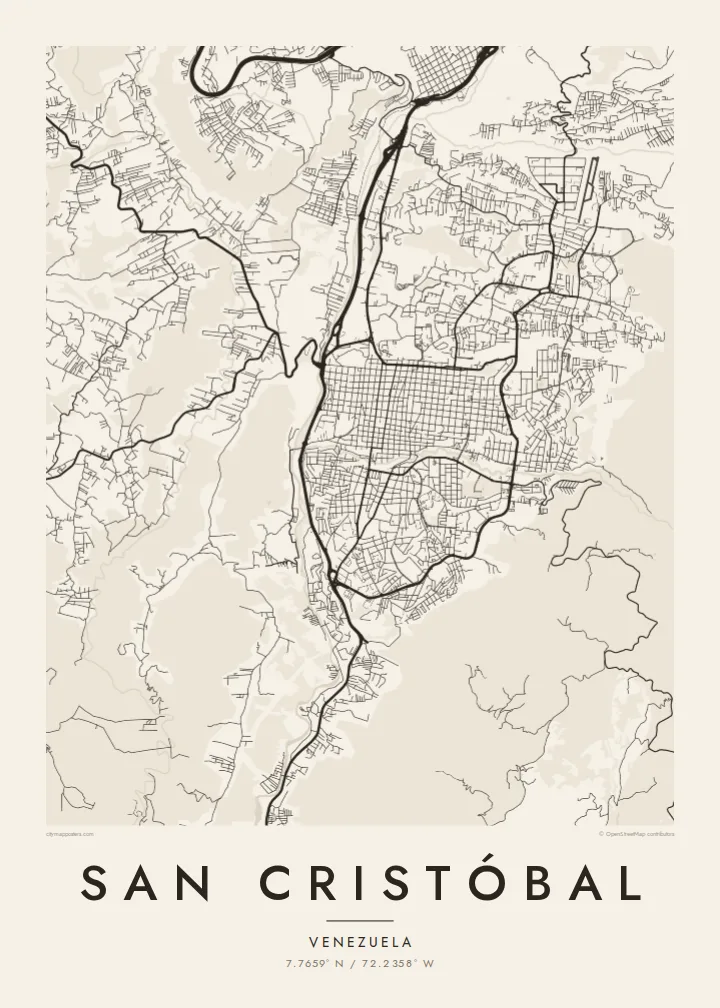
An Andean city climbing the terraces of the Torbes valley, close to the Colombian border in western Venezuela




Taha e taone, lima e onoonoaga
Tapaki e taha puhala ke kitia ai ki luga he puipui. Kua tatai e totogi he tau puhala oti — pete he lolomi, poloka, po ke faila HD.
 Tau pikselo mooli · faila lolomi 24 × 36″
Maama mitaki ke lolomi
Ko e 100% e fahi mooli mai he faila lolomi. Ko e tau poster oti — pete kua lolomi, poloka, po ke utu hifo — kua taute ke he ha mautolu a tau tokoluga (server) ke he 300 DPI, hokotia ke he 7,200 × 10,800 piksela, ke maeke ai e tau ala ikiiki tote ke maaliali fakamitaki he lolomi 24 × 36″.
He Pā


Ko e mape
San Cristóbal, capital of Táchira state, sits in a valley of the Venezuelan Andes at a little over 800 metres above sea level. The city is built on a series of river terraces above the Torbes River, so its streets follow the land. The older centre is a regular core of blocks, and beyond it roads twist and climb as the neighbourhoods reach up the surrounding slopes.
Founded in 1561, San Cristóbal is often called the city of cordiality. It has long been a commercial link between Venezuela and Colombia, with the border crossing at San Antonio del Táchira and the city of Cúcuta a short drive away. The mild mountain climate and the steep green hills around the valley are part of daily life here.
A San Cristóbal map poster has more movement than most city prints. The dense central grid is held inside a frame of ravines and ridges, and roads switch back and forth up the hillsides, leaving pale gaps where the ground is too steep to build on. In monochrome, the valley's shape is unmistakable.
The river runs along the valley floor below the city, and the terraces above it determine where the main avenues and neighbourhoods could be laid out.
The historic centre keeps the regular block pattern of a colonial founding, set on the flatter ground of the terrace in the middle of the map.
On the valley sides, streets curve and switch back to follow the slope. They create looser, organic patterns, with empty ravines between neighbourhoods.
Taute ke ha hau
Lafi e aho, taha higoa po ke taha kupu haau, hiki e fakatino, lahi po ke tuaga.
Ko e kitiaaga nakai totogi kua tote e maaliali mo e fakamailoga vai. Ko e tau lolomi mo e tau faila HD kua taute ke he 300 DPI, hokotia ke he 7,200 × 10,800 px, nakai fai fakamailoga vai.
Ko e ha San Cristóbal
Many Tachirenses now live far from the Andes, in Caracas, Bogotá, Madrid or Miami, and a map of the city's valley is an understated way to keep it close. It also makes a meaningful gift for parents or grandparents who remember the streets well.
The title, subtitle and coordinates line can all be personalised with a family name, a neighbourhood or a year. Choose from five styles, download the $9 HD files for home or local printing, or order a finished poster shipped from partners in 30+ countries.
Talaage e poster San Cristóbal| Lahi he lolomi | Maama | Tau faila |
|---|---|---|
| 30 × 40 cm11.8 × 15.7″ | 3,543 × 4,724 px | PNG · PDF |
| 29.7 × 42 cm (A3)11.7 × 16.5″ | 3,508 × 4,961 px | PNG · PDF |
| 42 × 59.4 cm (A2)16.5 × 23.4″ | 4,961 × 7,016 px | PNG · PDF |
| 45.7 × 61 cm18 × 24″ | 5,400 × 7,200 px | PNG · PDF |
| 50 × 70 cm19.7 × 27.6″ | 5,906 × 8,268 px | PNG · PDF |
| 61 × 91.4 cm24 × 36″ | 7,200 × 10,800 px | PNG · PDF |
Ke fakatatai, ko e fakatino noa kua 900 px e laulahi, fai fakamailoga mo e mo e tau mata komipiuta ni. Ko e tau faila HD kua ato hoko ke he 8× e maama ke he tau faahi takitaha mo e lolomi mitaki he lahi katoa he fakatino.
Fifili e taha puhala i luga he kupega, ti fifili e Poster Lolomi — e lahi mo e, kaeke ke manako ai koe, taha poloka — po ke Tau Faila HD Fakaeletonika. Ko e fakaotiaga totogi ko e taha gahua ni, ti ko e kupega he hau a talaaga ka fakafou fakahaga i mua he fakaotiaga e totogi.
Kua lolomi ai ke he pepa mitaki 200 gsm matte he taha he tau lahi ono, mai he 30 × 40 cm ke hoko ke he 24 × 36″. Kamata e tau poster lolomi mai he $39, kua putoia ai e utaaga.
E. Fifili e poloka akau malolō ke he lanu uli, tea, akau oki mooli, po ke akau pouli. Kua fakalataha mo e sioga malolō nakai malepe ti kua mautali ke tautau. Kamata e tau poster poloka mai he $99, kua putoia ai e utaaga.
Nakai totogi e fakafano ke he motu 60+. Ko e fakatino taha kua lolomi he fenoga lolomi ha mautolu kua tata mo e tau motu 30+, kua hoko mai he tau aho gahua 3–7. Maeke ia koe ke kikite e tuaga mo e fakamuitua he lalo he Haku Tau Fakatonu. Ke he falu motu kua 2–5 e tau tapu, ti ka nakai fakafano a mautolu ki ai, to fakaha he api tupe ia ki mua he totogi.
Fakafano mai e taha ata ki a mautolu he loto he 14 e tau aho tali mai he hokoaga, ti to lolomi foki e mautolu nakai totogi po ke liu atu e totogi ki a koe.
E. He editor i luga he kupega nei, hikihiki e matakupu, e matakupu lalo mo e laini coordinates ke he taha mena kua manako a koe ki ai, ti fifili e puhala mo e lahi. Ko e tau talaaga lolomi, poloka mo e fakaeletonika oti kua fakaaoga tonu e hau a fakatino.
Ma e $9 ka moua e koe e tau faila PNG 300 DPI mo e PDF kua mautali ke lolomi he tau lahi ono oti, nakai fai fakamailoga vai, ke lolomi i fe mena. Nakai maopoopo agaia? Utu hifo fakamua e kitiaaga nakai totogi ne fai fakamailoga vai.
Tata mai
