Higuamo estuary
The river widens as it reaches the sea along the western side of town, a broad curve of water crossed by the highway bridge toward Santo Domingo.
Fakatino mape mukamuka · Dominican Republic
18.4539° N / 69.3086° W
A Caribbean port at the mouth of the Higuamo River, with a seafront boulevard and a compact grid of sugar-era streets.
Taha e taone, lima e onoonoaga
Tapaki e taha puhala ke kitia ai ki luga he puipui. Kua tatai e totogi he tau puhala oti — pete he lolomi, poloka, po ke faila HD.
 Tau pikselo mooli · faila lolomi 24 × 36″
Maama mitaki ke lolomi
Ko e 100% e fahi mooli mai he faila lolomi. Ko e tau poster oti — pete kua lolomi, poloka, po ke utu hifo — kua taute ke he ha mautolu a tau tokoluga (server) ke he 300 DPI, hokotia ke he 7,200 × 10,800 piksela, ke maeke ai e tau ala ikiiki tote ke maaliali fakamitaki he lolomi 24 × 36″.
He Pā


Ko e mape
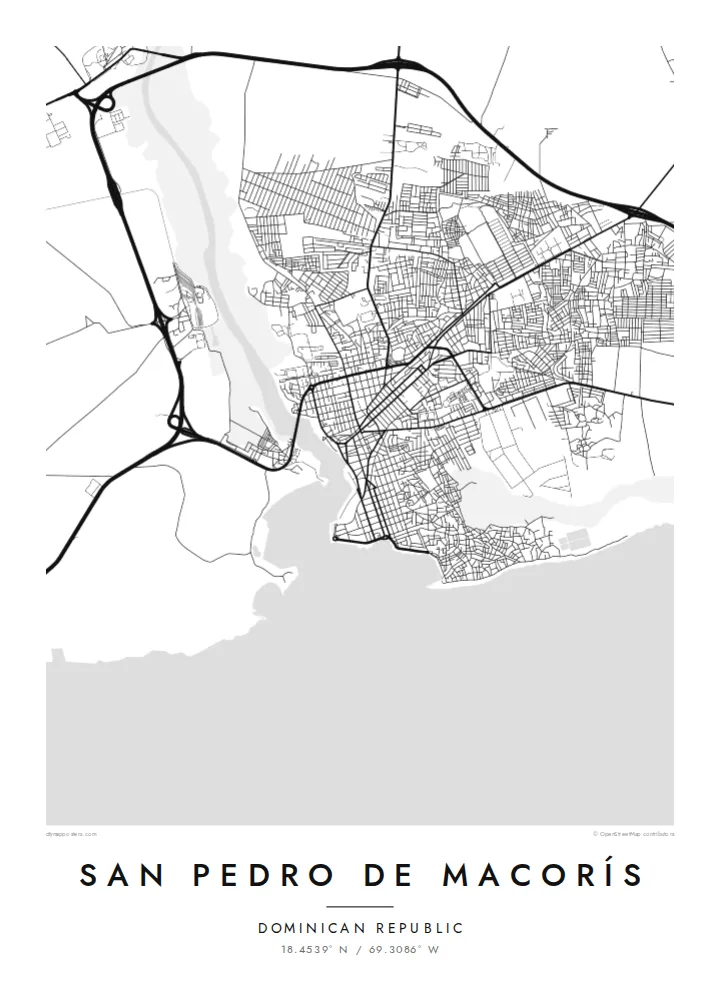
San Pedro de Macorís grew where the Higuamo River meets the Caribbean Sea on the south-east coast of the Dominican Republic. On the map the river runs down to the coast along the city's western edge, the historic grid fills the corner between river and sea, and a long malecón follows the shoreline eastward. A bridge carries the coastal highway over the estuary toward Santo Domingo.
The town prospered from sugar in the late nineteenth and early twentieth centuries, drawing workers from across the Caribbean, and that period left elegant civic buildings and a neo-Gothic church near the river. Beyond the centre, newer neighbourhoods spread inland in looser blocks, with cane land and industrial sites on the fringes of the city.
The city is also famous for baseball: an unusually large number of major-league players have come from here, and the game is part of daily life. A San Pedro de Macorís map poster pairs the clean line of the coast with the curve of the estuary, a strong, simple composition that recalls sea breezes, cane fields and evening games.
The river widens as it reaches the sea along the western side of town, a broad curve of water crossed by the highway bridge toward Santo Domingo.
A seafront avenue follows the Caribbean shore, giving the map a long, clean edge where the street grid meets open water.
Blocks laid out during the sugar boom sit between river and sea, a compact grid anchored by the neo-Gothic church of San Pedro Apóstol near the waterfront.
Taute ke ha hau
Lafi e aho, taha higoa po ke taha kupu haau, hiki e fakatino, lahi po ke tuaga.
Ko e kitiaaga nakai totogi kua tote e maaliali mo e fakamailoga vai. Ko e tau lolomi mo e tau faila HD kua taute ke he 300 DPI, hokotia ke he 7,200 × 10,800 px, nakai fai fakamailoga vai.
Ko e ha San Pedro de Macorís
Families with roots in San Pedro, baseball fans and anyone who has walked the malecón at sunset recognise this outline instantly. The meeting of river and sea gives the poster a natural frame, so it reads well even from across a room.
Personalise the title and subtitle, for example with a neighbourhood, a team or a date, and keep or edit the coordinates line. Choose Classic black & white, Noir, Paper, Blueprint or Sand. The $9 download includes six sizes as 300 DPI PNG and print-ready PDF.
Talaage e poster San Pedro de Macorís| Lahi he lolomi | Maama | Tau faila |
|---|---|---|
| 30 × 40 cm11.8 × 15.7″ | 3,543 × 4,724 px | PNG · PDF |
| 29.7 × 42 cm (A3)11.7 × 16.5″ | 3,508 × 4,961 px | PNG · PDF |
| 42 × 59.4 cm (A2)16.5 × 23.4″ | 4,961 × 7,016 px | PNG · PDF |
| 45.7 × 61 cm18 × 24″ | 5,400 × 7,200 px | PNG · PDF |
| 50 × 70 cm19.7 × 27.6″ | 5,906 × 8,268 px | PNG · PDF |
| 61 × 91.4 cm24 × 36″ | 7,200 × 10,800 px | PNG · PDF |
Ke fakatatai, ko e fakatino noa kua 900 px e laulahi, fai fakamailoga mo e mo e tau mata komipiuta ni. Ko e tau faila HD kua ato hoko ke he 8× e maama ke he tau faahi takitaha mo e lolomi mitaki he lahi katoa he fakatino.
Fifili e taha puhala i luga he kupega, ti fifili e Poster Lolomi — e lahi mo e, kaeke ke manako ai koe, taha poloka — po ke Tau Faila HD Fakaeletonika. Ko e fakaotiaga totogi ko e taha gahua ni, ti ko e kupega he hau a talaaga ka fakafou fakahaga i mua he fakaotiaga e totogi.
Kua lolomi ai ke he pepa mitaki 200 gsm matte he taha he tau lahi ono, mai he 30 × 40 cm ke hoko ke he 24 × 36″. Kamata e tau poster lolomi mai he $39, kua putoia ai e utaaga.
E. Fifili e poloka akau malolō ke he lanu uli, tea, akau oki mooli, po ke akau pouli. Kua fakalataha mo e sioga malolō nakai malepe ti kua mautali ke tautau. Kamata e tau poster poloka mai he $99, kua putoia ai e utaaga.
Nakai totogi e fakafano ke he motu 60+. Ko e fakatino taha kua lolomi he fenoga lolomi ha mautolu kua tata mo e tau motu 30+, kua hoko mai he tau aho gahua 3–7. Maeke ia koe ke kikite e tuaga mo e fakamuitua he lalo he Haku Tau Fakatonu. Ke he falu motu kua 2–5 e tau tapu, ti ka nakai fakafano a mautolu ki ai, to fakaha he api tupe ia ki mua he totogi.
Fakafano mai e taha ata ki a mautolu he loto he 14 e tau aho tali mai he hokoaga, ti to lolomi foki e mautolu nakai totogi po ke liu atu e totogi ki a koe.
E. He editor i luga he kupega nei, hikihiki e matakupu, e matakupu lalo mo e laini coordinates ke he taha mena kua manako a koe ki ai, ti fifili e puhala mo e lahi. Ko e tau talaaga lolomi, poloka mo e fakaeletonika oti kua fakaaoga tonu e hau a fakatino.
Ma e $9 ka moua e koe e tau faila PNG 300 DPI mo e PDF kua mautali ke lolomi he tau lahi ono oti, nakai fai fakamailoga vai, ke lolomi i fe mena. Nakai maopoopo agaia? Utu hifo fakamua e kitiaaga nakai totogi ne fai fakamailoga vai.
Tata mai
