Railway junction
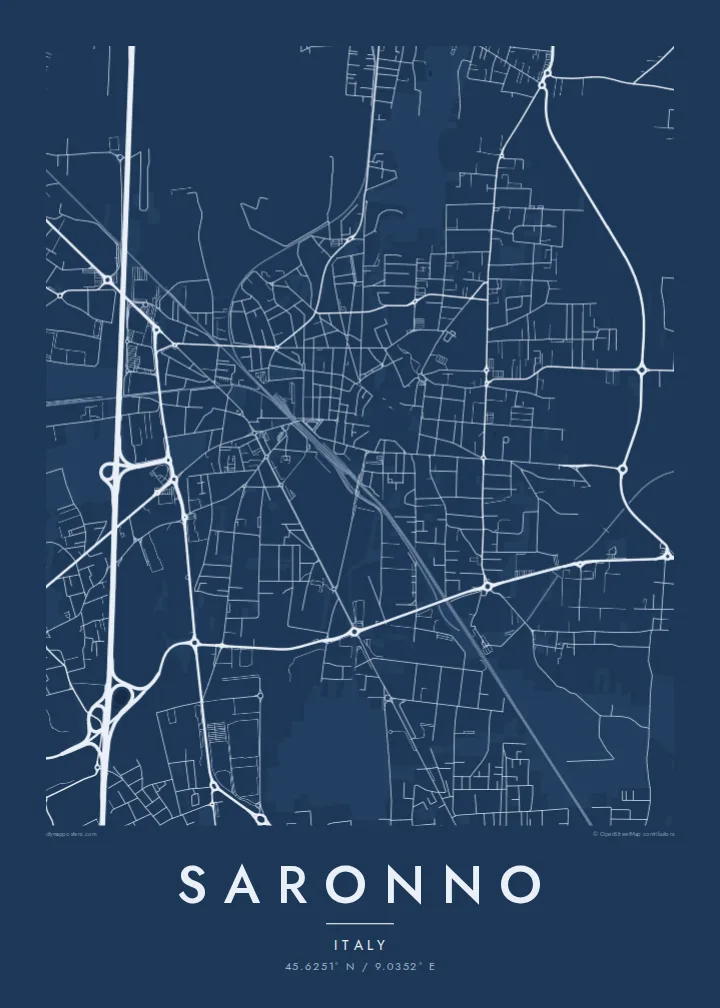
Rail lines converge on Saronno and branch out again, drawing strong curved strokes through the town that divide it into clearly separated districts.
Fakatino mape mukamuka · Italy
45.6251° N / 9.0352° E
A Lombard town where railway lines fan out from a dense centre, north of Milan on the edge of the Brianza plain.



Taha e taone, lima e onoonoaga
Tapaki e taha puhala ke kitia ai ki luga he puipui. Kua tatai e totogi he tau puhala oti — pete he lolomi, poloka, po ke faila HD.
 Tau pikselo mooli · faila lolomi 24 × 36″
Maama mitaki ke lolomi
Ko e 100% e fahi mooli mai he faila lolomi. Ko e tau poster oti — pete kua lolomi, poloka, po ke utu hifo — kua taute ke he ha mautolu a tau tokoluga (server) ke he 300 DPI, hokotia ke he 7,200 × 10,800 piksela, ke maeke ai e tau ala ikiiki tote ke maaliali fakamitaki he lolomi 24 × 36″.
He Pā


Ko e mape
Saronno lies in Lombardy, northwest of Milan, on the busy plain between the city and the lakes. Around the world, its name is linked to amaretti biscuits and the almond liqueur named after the town. On the map, though, Saronno's identity is shaped by railways. Several lines of the Ferrovienord network meet here and spread outward in different directions.
The historic centre is compact and irregular, with narrow streets and small squares. Around it, later neighbourhoods fill the spaces between the railway lines, so the town divides into distinct wedges. The small Lura stream passes through, and main roads leave toward Milan, Como and Varese, tying Saronno into the region's dense urban network.
The Santuario della Beata Vergine dei Miracoli, with frescoes by Bernardino Luini and a dome painted by Gaudenzio Ferrari, is the town's best-known monument. A Saronno map poster shows it all as structure: the close-knit centre, the radiating tracks and the neighbourhoods between them, forming a graphic pattern that reads clearly in black and white.
Rail lines converge on Saronno and branch out again, drawing strong curved strokes through the town that divide it into clearly separated districts.
Narrow, irregular streets and small squares form a tight historic core, clearly distinct from the more regular neighbourhoods built around it later.
The Renaissance sanctuary of the Beata Vergine dei Miracoli, known for its Luini frescoes, anchors the historic side of the town on the map.
Taute ke ha hau
Lafi e aho, taha higoa po ke taha kupu haau, hiki e fakatino, lahi po ke tuaga.
Ko e kitiaaga nakai totogi kua tote e maaliali mo e fakamailoga vai. Ko e tau lolomi mo e tau faila HD kua taute ke he 300 DPI, hokotia ke he 7,200 × 10,800 px, nakai fai fakamailoga vai.
Ko e ha Saronno
Commuters, former residents and anyone who loves Lombard towns will recognise the pattern of tracks and streets at once. It is a thoughtful gift for someone who grew up here or travelled through daily.
Set the title and subtitle in Italian or English and add your own coordinates line. Blueprint suits the railway geometry, while Classic keeps it crisp. Each $9 download includes 30×40 cm, 50×70 cm, A3, A2, 18×24″ and 24×36″ files.
Talaage e poster Saronno| Lahi he lolomi | Maama | Tau faila |
|---|---|---|
| 30 × 40 cm11.8 × 15.7″ | 3,543 × 4,724 px | PNG · PDF |
| 29.7 × 42 cm (A3)11.7 × 16.5″ | 3,508 × 4,961 px | PNG · PDF |
| 42 × 59.4 cm (A2)16.5 × 23.4″ | 4,961 × 7,016 px | PNG · PDF |
| 45.7 × 61 cm18 × 24″ | 5,400 × 7,200 px | PNG · PDF |
| 50 × 70 cm19.7 × 27.6″ | 5,906 × 8,268 px | PNG · PDF |
| 61 × 91.4 cm24 × 36″ | 7,200 × 10,800 px | PNG · PDF |
Ke fakatatai, ko e fakatino noa kua 900 px e laulahi, fai fakamailoga mo e mo e tau mata komipiuta ni. Ko e tau faila HD kua ato hoko ke he 8× e maama ke he tau faahi takitaha mo e lolomi mitaki he lahi katoa he fakatino.
Fifili e taha puhala i luga he kupega, ti fifili e Poster Lolomi — e lahi mo e, kaeke ke manako ai koe, taha poloka — po ke Tau Faila HD Fakaeletonika. Ko e fakaotiaga totogi ko e taha gahua ni, ti ko e kupega he hau a talaaga ka fakafou fakahaga i mua he fakaotiaga e totogi.
Kua lolomi ai ke he pepa mitaki 200 gsm matte he taha he tau lahi ono, mai he 30 × 40 cm ke hoko ke he 24 × 36″. Kamata e tau poster lolomi mai he $39, kua putoia ai e utaaga.
E. Fifili e poloka akau malolō ke he lanu uli, tea, akau oki mooli, po ke akau pouli. Kua fakalataha mo e sioga malolō nakai malepe ti kua mautali ke tautau. Kamata e tau poster poloka mai he $99, kua putoia ai e utaaga.
Nakai totogi e fakafano ke he motu 60+. Ko e fakatino taha kua lolomi he fenoga lolomi ha mautolu kua tata mo e tau motu 30+, kua hoko mai he tau aho gahua 3–7. Maeke ia koe ke kikite e tuaga mo e fakamuitua he lalo he Haku Tau Fakatonu. Ke he falu motu kua 2–5 e tau tapu, ti ka nakai fakafano a mautolu ki ai, to fakaha he api tupe ia ki mua he totogi.
Fakafano mai e taha ata ki a mautolu he loto he 14 e tau aho tali mai he hokoaga, ti to lolomi foki e mautolu nakai totogi po ke liu atu e totogi ki a koe.
E. He editor i luga he kupega nei, hikihiki e matakupu, e matakupu lalo mo e laini coordinates ke he taha mena kua manako a koe ki ai, ti fifili e puhala mo e lahi. Ko e tau talaaga lolomi, poloka mo e fakaeletonika oti kua fakaaoga tonu e hau a fakatino.
Ma e $9 ka moua e koe e tau faila PNG 300 DPI mo e PDF kua mautali ke lolomi he tau lahi ono oti, nakai fai fakamailoga vai, ke lolomi i fe mena. Nakai maopoopo agaia? Utu hifo fakamua e kitiaaga nakai totogi ne fai fakamailoga vai.
Tata mai
