Oasis remnants
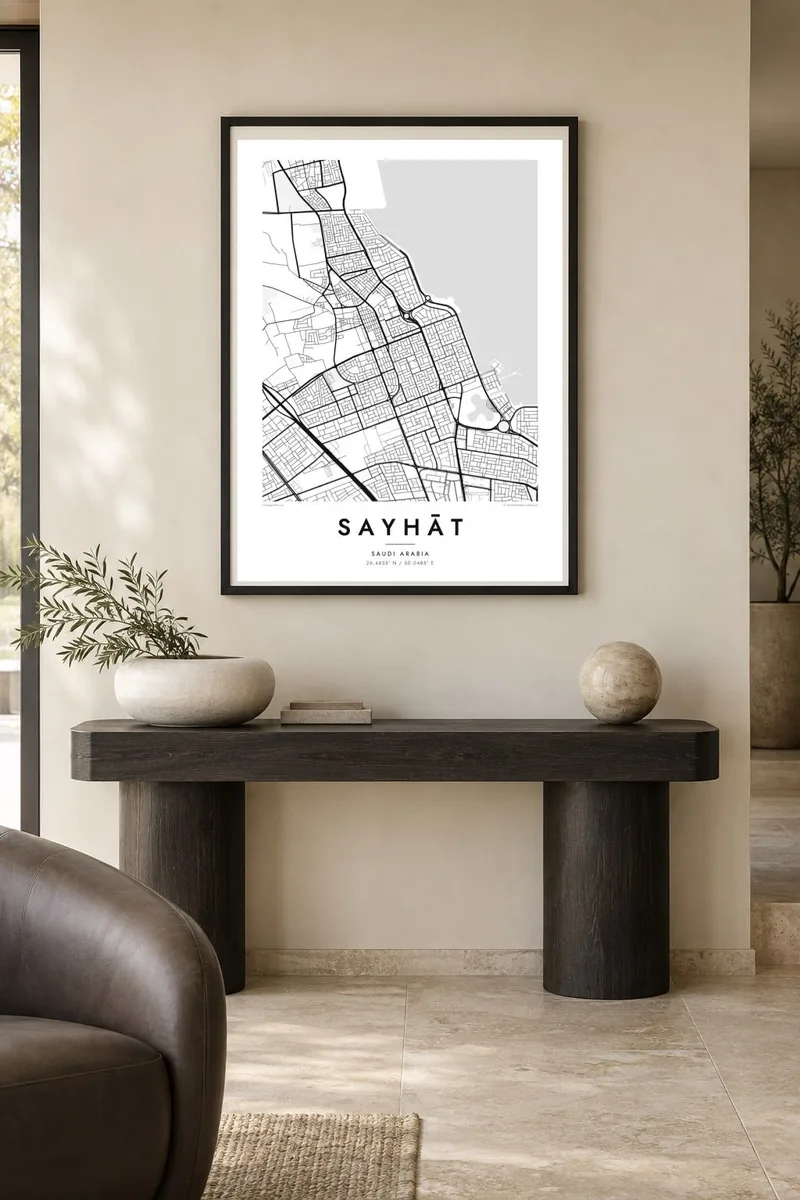
Patches of palm gardens between neighbourhoods interrupt the street grid, leaving irregular open spaces that recall the town's agricultural past in the Qatif oasis.
Fakatino mape mukamuka · Saudi Arabia
26.4835° N / 50.0485° E
A town on the Gulf coast between Dammam and Qatif, where older palm gardens meet the straight streets of newer districts.


Taha e taone, lima e onoonoaga
Tapaki e taha puhala ke kitia ai ki luga he puipui. Kua tatai e totogi he tau puhala oti — pete he lolomi, poloka, po ke faila HD.
 Tau pikselo mooli · faila lolomi 24 × 36″
Maama mitaki ke lolomi
Ko e 100% e fahi mooli mai he faila lolomi. Ko e tau poster oti — pete kua lolomi, poloka, po ke utu hifo — kua taute ke he ha mautolu a tau tokoluga (server) ke he 300 DPI, hokotia ke he 7,200 × 10,800 piksela, ke maeke ai e tau ala ikiiki tote ke maaliali fakamitaki he lolomi 24 × 36″.
He Pā


Ko e mape
Sayhāt lies on the western shore of the Gulf in Saudi Arabia's Eastern Province, between the cities of Dammam and Qatif. It belongs to the Qatif oasis, one of the oldest settled areas on the Arabian coast, and on a map it forms part of an almost continuous urban strip running north along the shore from Dammam.
The street pattern tells two stories. Older parts of town keep irregular lanes and plots that follow the edges of former palm groves and farms, while newer districts are laid out in large rectangular blocks with wide roads, typical of Saudi planning since the oil era. Remaining date gardens show up as soft patches of open space between the built-up areas.
To the east, the coast gives the composition a firm edge, with shoreline roads running along the water. A Sayhāt map poster brings the oasis and the grid together in a single frame, a clear picture of how an old farming community on the Gulf has grown into a modern town while keeping traces of its gardens.
Patches of palm gardens between neighbourhoods interrupt the street grid, leaving irregular open spaces that recall the town's agricultural past in the Qatif oasis.
Newer residential areas are laid out in long, regular blocks along wide roads, giving large parts of the map a strong geometric rhythm.
The coast on the eastern side of town draws a clean boundary against the open water, anchoring the whole composition of the poster.
Taute ke ha hau
Lafi e aho, taha higoa po ke taha kupu haau, hiki e fakatino, lahi po ke tuaga.
Ko e kitiaaga nakai totogi kua tote e maaliali mo e fakamailoga vai. Ko e tau lolomi mo e tau faila HD kua taute ke he 300 DPI, hokotia ke he 7,200 × 10,800 px, nakai fai fakamailoga vai.
Ko e ha Sayhāt
For families rooted in Sayhāt and the wider Qatif area, a map is a respectful and modern way to keep the hometown on display. It also suits people who lived in the Eastern Province for work and want a lasting reminder of the place.
The title, subtitle and coordinates line are fully editable, so the print can carry a name or a meaningful date. Choose Noir for a dramatic look or Sand for warm tones that suit the coast, and download 300 DPI files in six sizes for $9.
Talaage e poster Sayhāt| Lahi he lolomi | Maama | Tau faila |
|---|---|---|
| 30 × 40 cm11.8 × 15.7″ | 3,543 × 4,724 px | PNG · PDF |
| 29.7 × 42 cm (A3)11.7 × 16.5″ | 3,508 × 4,961 px | PNG · PDF |
| 42 × 59.4 cm (A2)16.5 × 23.4″ | 4,961 × 7,016 px | PNG · PDF |
| 45.7 × 61 cm18 × 24″ | 5,400 × 7,200 px | PNG · PDF |
| 50 × 70 cm19.7 × 27.6″ | 5,906 × 8,268 px | PNG · PDF |
| 61 × 91.4 cm24 × 36″ | 7,200 × 10,800 px | PNG · PDF |
Ke fakatatai, ko e fakatino noa kua 900 px e laulahi, fai fakamailoga mo e mo e tau mata komipiuta ni. Ko e tau faila HD kua ato hoko ke he 8× e maama ke he tau faahi takitaha mo e lolomi mitaki he lahi katoa he fakatino.
Fifili e taha puhala i luga he kupega, ti fifili e Poster Lolomi — e lahi mo e, kaeke ke manako ai koe, taha poloka — po ke Tau Faila HD Fakaeletonika. Ko e fakaotiaga totogi ko e taha gahua ni, ti ko e kupega he hau a talaaga ka fakafou fakahaga i mua he fakaotiaga e totogi.
Kua lolomi ai ke he pepa mitaki 200 gsm matte he taha he tau lahi ono, mai he 30 × 40 cm ke hoko ke he 24 × 36″. Kamata e tau poster lolomi mai he $39, kua putoia ai e utaaga.
E. Fifili e poloka akau malolō ke he lanu uli, tea, akau oki mooli, po ke akau pouli. Kua fakalataha mo e sioga malolō nakai malepe ti kua mautali ke tautau. Kamata e tau poster poloka mai he $99, kua putoia ai e utaaga.
Nakai totogi e fakafano ke he motu 60+. Ko e fakatino taha kua lolomi he fenoga lolomi ha mautolu kua tata mo e tau motu 30+, kua hoko mai he tau aho gahua 3–7. Maeke ia koe ke kikite e tuaga mo e fakamuitua he lalo he Haku Tau Fakatonu. Ke he falu motu kua 2–5 e tau tapu, ti ka nakai fakafano a mautolu ki ai, to fakaha he api tupe ia ki mua he totogi.
Fakafano mai e taha ata ki a mautolu he loto he 14 e tau aho tali mai he hokoaga, ti to lolomi foki e mautolu nakai totogi po ke liu atu e totogi ki a koe.
E. He editor i luga he kupega nei, hikihiki e matakupu, e matakupu lalo mo e laini coordinates ke he taha mena kua manako a koe ki ai, ti fifili e puhala mo e lahi. Ko e tau talaaga lolomi, poloka mo e fakaeletonika oti kua fakaaoga tonu e hau a fakatino.
Ma e $9 ka moua e koe e tau faila PNG 300 DPI mo e PDF kua mautali ke lolomi he tau lahi ono oti, nakai fai fakamailoga vai, ke lolomi i fe mena. Nakai maopoopo agaia? Utu hifo fakamua e kitiaaga nakai totogi ne fai fakamailoga vai.
Tata mai
