Hooghly waterfront
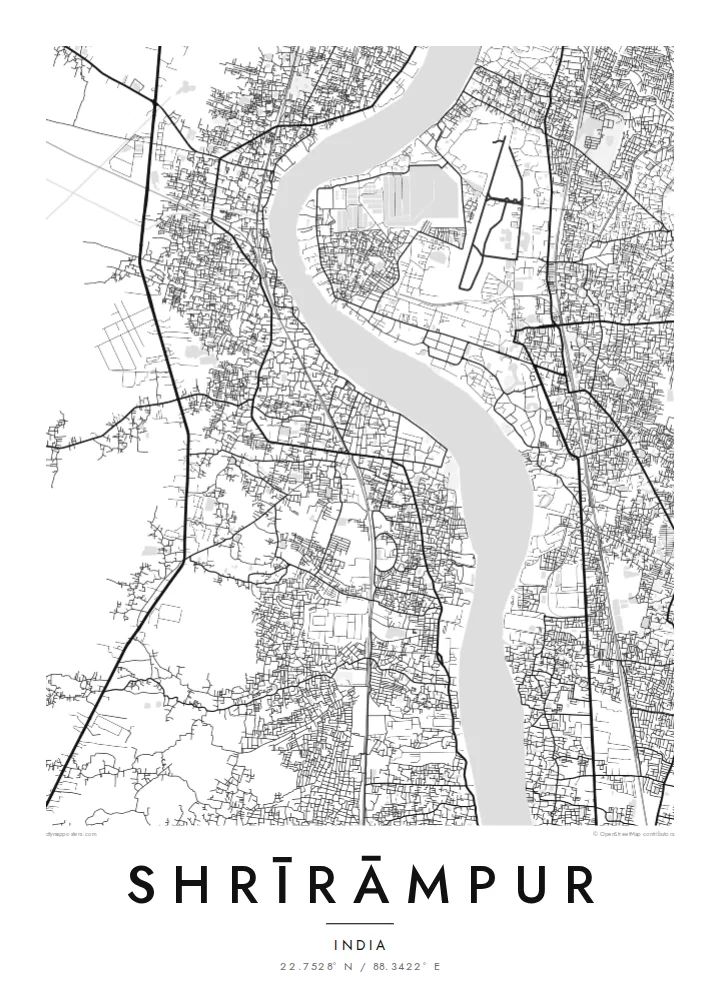
The river forms the eastern edge of the town, a wide pale band on the poster. Ghats and lanes meet it at regular intervals along the bank.
Fakatino mape mukamuka · India
22.7528° N / 88.3422° E
A long riverside town on the west bank of the Hooghly, its old Danish quarter facing Barrackpore across the water.


Taha e taone, lima e onoonoaga
Tapaki e taha puhala ke kitia ai ki luga he puipui. Kua tatai e totogi he tau puhala oti — pete he lolomi, poloka, po ke faila HD.
 Tau pikselo mooli · faila lolomi 24 × 36″
Maama mitaki ke lolomi
Ko e 100% e fahi mooli mai he faila lolomi. Ko e tau poster oti — pete kua lolomi, poloka, po ke utu hifo — kua taute ke he ha mautolu a tau tokoluga (server) ke he 300 DPI, hokotia ke he 7,200 × 10,800 piksela, ke maeke ai e tau ala ikiiki tote ke maaliali fakamitaki he lolomi 24 × 36″.
He Pā


Ko e mape
Shrīrāmpur stretches along the western bank of the Hooghly River, north of Kolkata, and the river defines its map. The town is a narrow ribbon between the water and the railway line that runs parallel to it inland, with lanes leading down to ghats on the riverfront. On the opposite bank lies Barrackpore, and the broad band of the river separates the two like a wide avenue.
From 1755 to 1845 the town was a Danish trading settlement called Frederiksnagore, and traces of that period remain, including St Olav's Church and the old Government House. Serampore College, founded in 1818 by the missionaries William Carey, Joshua Marshman and William Ward, stands by the river and is among the oldest colleges in India.
A Shrīrāmpur map poster frames the relationship between town and river: the dense lanes along the bank, the straight rail line inland, and the empty width of the Hooghly with its gentle bends. It is a map about edges and crossings, a reminder of the town's long role as a port, a college town and a quiet neighbour to Kolkata.
The river forms the eastern edge of the town, a wide pale band on the poster. Ghats and lanes meet it at regular intervals along the bank.
Near the riverfront, the older core from the Danish period, with its church and former Government House, sits among a tighter pattern of streets than the newer districts inland.
Serampore College occupies a riverside site, a larger open plot among the lanes that recalls the town's long history as a centre of learning and printing.
Taute ke ha hau
Lafi e aho, taha higoa po ke taha kupu haau, hiki e fakatino, lahi po ke tuaga.
Ko e kitiaaga nakai totogi kua tote e maaliali mo e fakamailoga vai. Ko e tau lolomi mo e tau faila HD kua taute ke he 300 DPI, hokotia ke he 7,200 × 10,800 px, nakai fai fakamailoga vai.
Ko e ha Shrīrāmpur
Shrīrāmpur has deep roots for Bengali families, for alumni of its college and for anyone interested in the colonial history of the Hooghly settlements. A map of the riverbank makes a thoughtful gift and sits well in a study or reading room.
Add a name, an alumni year or a family address to the title and subtitle, and choose one of five styles, from the warm Paper and Sand to the crisp Classic black & white, Noir and Blueprint. Order it printed on matte paper or download the HD files.
Talaage e poster Shrīrāmpur| Lahi he lolomi | Maama | Tau faila |
|---|---|---|
| 30 × 40 cm11.8 × 15.7″ | 3,543 × 4,724 px | PNG · PDF |
| 29.7 × 42 cm (A3)11.7 × 16.5″ | 3,508 × 4,961 px | PNG · PDF |
| 42 × 59.4 cm (A2)16.5 × 23.4″ | 4,961 × 7,016 px | PNG · PDF |
| 45.7 × 61 cm18 × 24″ | 5,400 × 7,200 px | PNG · PDF |
| 50 × 70 cm19.7 × 27.6″ | 5,906 × 8,268 px | PNG · PDF |
| 61 × 91.4 cm24 × 36″ | 7,200 × 10,800 px | PNG · PDF |
Ke fakatatai, ko e fakatino noa kua 900 px e laulahi, fai fakamailoga mo e mo e tau mata komipiuta ni. Ko e tau faila HD kua ato hoko ke he 8× e maama ke he tau faahi takitaha mo e lolomi mitaki he lahi katoa he fakatino.
Fifili e taha puhala i luga he kupega, ti fifili e Poster Lolomi — e lahi mo e, kaeke ke manako ai koe, taha poloka — po ke Tau Faila HD Fakaeletonika. Ko e fakaotiaga totogi ko e taha gahua ni, ti ko e kupega he hau a talaaga ka fakafou fakahaga i mua he fakaotiaga e totogi.
Kua lolomi ai ke he pepa mitaki 200 gsm matte he taha he tau lahi ono, mai he 30 × 40 cm ke hoko ke he 24 × 36″. Kamata e tau poster lolomi mai he $39, kua putoia ai e utaaga.
E. Fifili e poloka akau malolō ke he lanu uli, tea, akau oki mooli, po ke akau pouli. Kua fakalataha mo e sioga malolō nakai malepe ti kua mautali ke tautau. Kamata e tau poster poloka mai he $99, kua putoia ai e utaaga.
Nakai totogi e fakafano ke he motu 60+. Ko e fakatino taha kua lolomi he fenoga lolomi ha mautolu kua tata mo e tau motu 30+, kua hoko mai he tau aho gahua 3–7. Maeke ia koe ke kikite e tuaga mo e fakamuitua he lalo he Haku Tau Fakatonu. Ke he falu motu kua 2–5 e tau tapu, ti ka nakai fakafano a mautolu ki ai, to fakaha he api tupe ia ki mua he totogi.
Fakafano mai e taha ata ki a mautolu he loto he 14 e tau aho tali mai he hokoaga, ti to lolomi foki e mautolu nakai totogi po ke liu atu e totogi ki a koe.
E. He editor i luga he kupega nei, hikihiki e matakupu, e matakupu lalo mo e laini coordinates ke he taha mena kua manako a koe ki ai, ti fifili e puhala mo e lahi. Ko e tau talaaga lolomi, poloka mo e fakaeletonika oti kua fakaaoga tonu e hau a fakatino.
Ma e $9 ka moua e koe e tau faila PNG 300 DPI mo e PDF kua mautali ke lolomi he tau lahi ono oti, nakai fai fakamailoga vai, ke lolomi i fe mena. Nakai maopoopo agaia? Utu hifo fakamua e kitiaaga nakai totogi ne fai fakamailoga vai.
Tata mai
