Orthogonal town plan
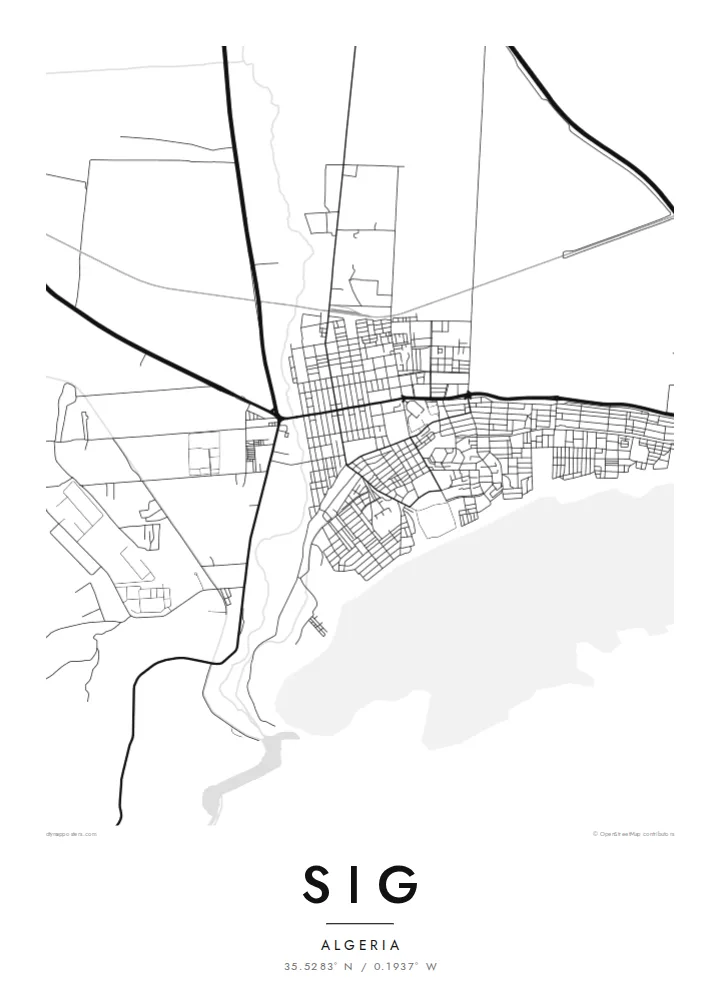
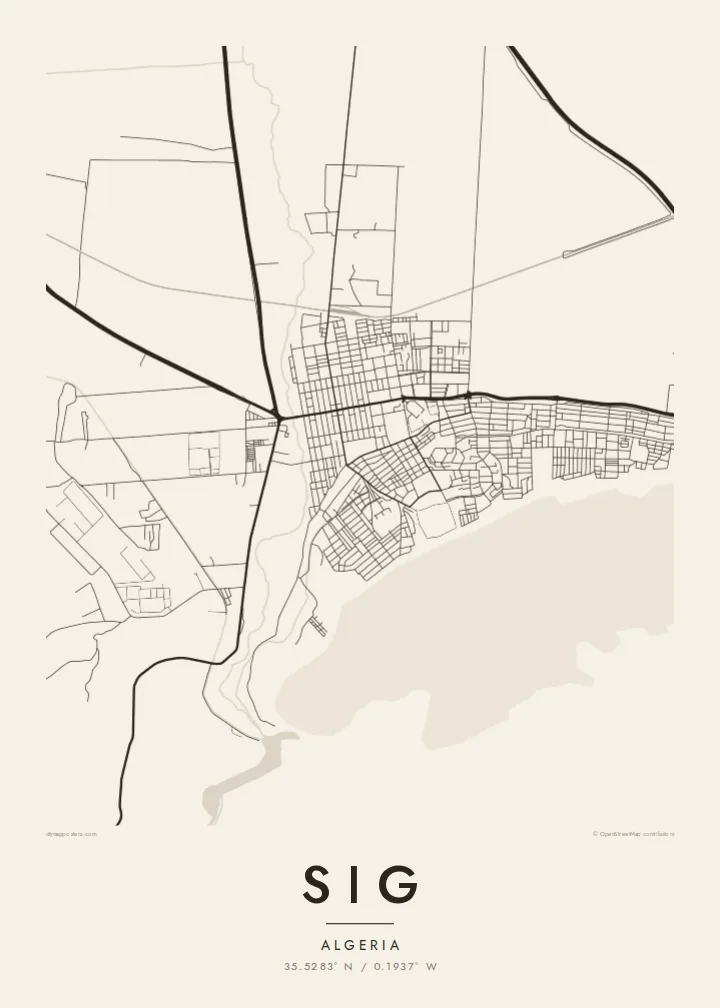
The historic centre is a near-perfect grid of equal blocks, one of the most legible colonial-era street plans in the region, and it prints with unusual crispness.
Fakatino mape mukamuka · Algeria
35.5283° N / 0.1937° W
A nineteenth-century grid town on the Oued Sig, set out with a ruler across a flat, irrigated plain in western Algeria.



Taha e taone, lima e onoonoaga
Tapaki e taha puhala ke kitia ai ki luga he puipui. Kua tatai e totogi he tau puhala oti — pete he lolomi, poloka, po ke faila HD.
 Tau pikselo mooli · faila lolomi 24 × 36″
Maama mitaki ke lolomi
Ko e 100% e fahi mooli mai he faila lolomi. Ko e tau poster oti — pete kua lolomi, poloka, po ke utu hifo — kua taute ke he ha mautolu a tau tokoluga (server) ke he 300 DPI, hokotia ke he 7,200 × 10,800 piksela, ke maeke ai e tau ala ikiiki tote ke maaliali fakamitaki he lolomi 24 × 36″.
He Pā


Ko e mape
Sig stands on the river of the same name, the Oued Sig, in Mascara province in northwestern Algeria. It was founded in the mid-nineteenth century as Saint-Denis-du-Sig during the French colonial period, and the plan still shows it clearly: a regular grid of straight streets and rectangular blocks around a central square, with later districts added less strictly around the edges.
The land around the town is flat and agricultural, part of the wide plain that stretches inland from the Oran coast. Irrigation has shaped the area since the colonial era, when a dam was built upstream on the Sig to water the surrounding fields, and on a map the long, straight field divisions echo the geometry of the town itself.
A Sig map poster is appealing mostly for that clarity. The orthogonal streets, the river running past and the roads leading out toward Oran, Mascara and neighbouring towns make a composition that looks almost drafted by hand. In black and white it reads like a planning document, a record of how a nineteenth-century town was set down on an open plain.
The historic centre is a near-perfect grid of equal blocks, one of the most legible colonial-era street plans in the region, and it prints with unusual crispness.
The river passes along the town and gives the rigid street pattern its only natural line, a gentle meander through otherwise straight geometry.
Around the town, fields are divided into long rectangles by channels and farm roads, extending the logic of the grid far into the countryside.
Taute ke ha hau
Lafi e aho, taha higoa po ke taha kupu haau, hiki e fakatino, lahi po ke tuaga.
Ko e kitiaaga nakai totogi kua tote e maaliali mo e fakamailoga vai. Ko e tau lolomi mo e tau faila HD kua taute ke he 300 DPI, hokotia ke he 7,200 × 10,800 px, nakai fai fakamailoga vai.
Ko e ha Sig
For families from Sig, now living in Oran, Algiers or abroad, the grid of the old town is instantly recognisable. A clean map keeps that familiarity on the wall without any decoration getting in the way.
Add your own title, a subtitle with a family name or year, and edit the coordinates line. Five styles are available, from Classic black and white to Paper and Sand, as $9 HD files in six print sizes or as a matte poster shipped by a print partner.
Talaage e poster Sig| Lahi he lolomi | Maama | Tau faila |
|---|---|---|
| 30 × 40 cm11.8 × 15.7″ | 3,543 × 4,724 px | PNG · PDF |
| 29.7 × 42 cm (A3)11.7 × 16.5″ | 3,508 × 4,961 px | PNG · PDF |
| 42 × 59.4 cm (A2)16.5 × 23.4″ | 4,961 × 7,016 px | PNG · PDF |
| 45.7 × 61 cm18 × 24″ | 5,400 × 7,200 px | PNG · PDF |
| 50 × 70 cm19.7 × 27.6″ | 5,906 × 8,268 px | PNG · PDF |
| 61 × 91.4 cm24 × 36″ | 7,200 × 10,800 px | PNG · PDF |
Ke fakatatai, ko e fakatino noa kua 900 px e laulahi, fai fakamailoga mo e mo e tau mata komipiuta ni. Ko e tau faila HD kua ato hoko ke he 8× e maama ke he tau faahi takitaha mo e lolomi mitaki he lahi katoa he fakatino.
Fifili e taha puhala i luga he kupega, ti fifili e Poster Lolomi — e lahi mo e, kaeke ke manako ai koe, taha poloka — po ke Tau Faila HD Fakaeletonika. Ko e fakaotiaga totogi ko e taha gahua ni, ti ko e kupega he hau a talaaga ka fakafou fakahaga i mua he fakaotiaga e totogi.
Kua lolomi ai ke he pepa mitaki 200 gsm matte he taha he tau lahi ono, mai he 30 × 40 cm ke hoko ke he 24 × 36″. Kamata e tau poster lolomi mai he $39, kua putoia ai e utaaga.
E. Fifili e poloka akau malolō ke he lanu uli, tea, akau oki mooli, po ke akau pouli. Kua fakalataha mo e sioga malolō nakai malepe ti kua mautali ke tautau. Kamata e tau poster poloka mai he $99, kua putoia ai e utaaga.
Nakai totogi e fakafano ke he motu 60+. Ko e fakatino taha kua lolomi he fenoga lolomi ha mautolu kua tata mo e tau motu 30+, kua hoko mai he tau aho gahua 3–7. Maeke ia koe ke kikite e tuaga mo e fakamuitua he lalo he Haku Tau Fakatonu. Ke he falu motu kua 2–5 e tau tapu, ti ka nakai fakafano a mautolu ki ai, to fakaha he api tupe ia ki mua he totogi.
Fakafano mai e taha ata ki a mautolu he loto he 14 e tau aho tali mai he hokoaga, ti to lolomi foki e mautolu nakai totogi po ke liu atu e totogi ki a koe.
E. He editor i luga he kupega nei, hikihiki e matakupu, e matakupu lalo mo e laini coordinates ke he taha mena kua manako a koe ki ai, ti fifili e puhala mo e lahi. Ko e tau talaaga lolomi, poloka mo e fakaeletonika oti kua fakaaoga tonu e hau a fakatino.
Ma e $9 ka moua e koe e tau faila PNG 300 DPI mo e PDF kua mautali ke lolomi he tau lahi ono oti, nakai fai fakamailoga vai, ke lolomi i fe mena. Nakai maopoopo agaia? Utu hifo fakamua e kitiaaga nakai totogi ne fai fakamailoga vai.
Tata mai
