Tisza–Zagyva confluence
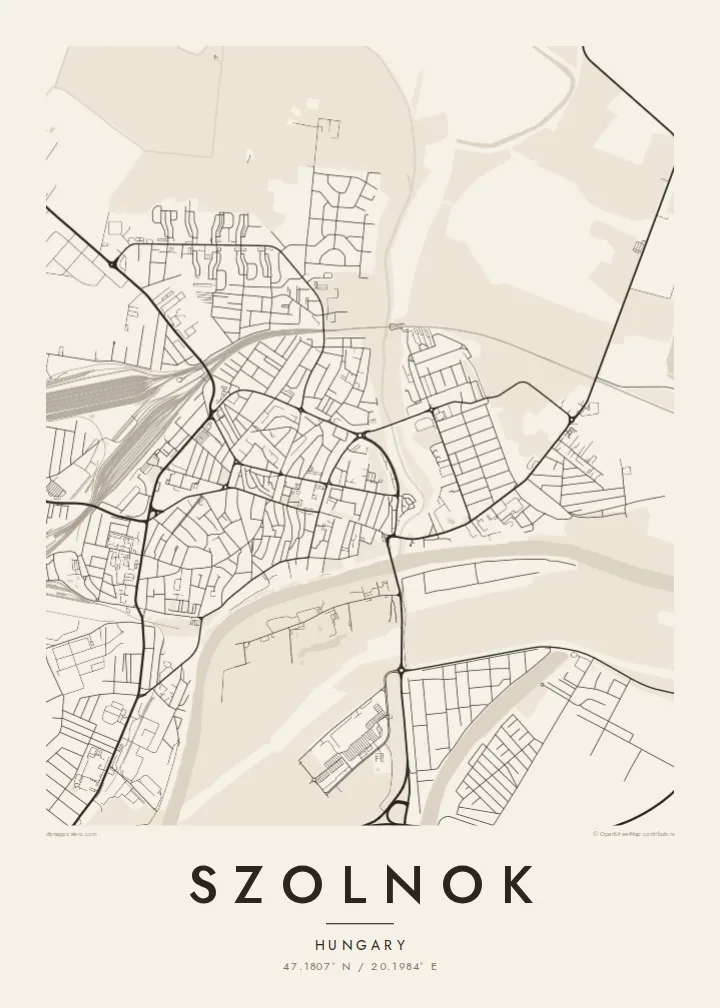
The Zagyva joins the Tisza beside the historic centre. The meeting of the two channels forms the strongest shape on the map and explains why the city was founded here.
Fakatino mape mukamuka · Hungary
47.1807° N / 20.1984° E
A river city where the Zagyva meets the Tisza, its streets fanning out across the flat Great Hungarian Plain




Taha e taone, lima e onoonoaga
Tapaki e taha puhala ke kitia ai ki luga he puipui. Kua tatai e totogi he tau puhala oti — pete he lolomi, poloka, po ke faila HD.
 Tau pikselo mooli · faila lolomi 24 × 36″
Maama mitaki ke lolomi
Ko e 100% e fahi mooli mai he faila lolomi. Ko e tau poster oti — pete kua lolomi, poloka, po ke utu hifo — kua taute ke he ha mautolu a tau tokoluga (server) ke he 300 DPI, hokotia ke he 7,200 × 10,800 piksela, ke maeke ai e tau ala ikiiki tote ke maaliali fakamitaki he lolomi 24 × 36″.
He Pā


Ko e mape
Szolnok grew up at a river crossing on the Great Hungarian Plain, where the Zagyva flows into the Tisza. That confluence is still the key to the map. The Tisza bends past the centre in a broad curve, and the smaller Zagyva comes in from the north. Around them, the city spreads over flat land in a mix of older blocks, housing estates and long radial roads.
The riverbanks give the city its character. Embankments and promenades follow the Tisza, bridges tie the two banks together, and the old core sits close to the water where a castle once guarded the crossing. Szolnok is also known for its artists' colony, founded in the early twentieth century and drawn by the light and landscape of the plain.
A Szolnok map poster reads almost like a hydrological diagram set in a city. The two rivers form a Y-shaped junction, the bridges cross them as fine stitches, and the streets spread outward with no hills to interrupt them. It is a calm, open print that suits the flat landscape it comes from.
The Zagyva joins the Tisza beside the historic centre. The meeting of the two channels forms the strongest shape on the map and explains why the city was founded here.
The Tisza curves in wide loops past Szolnok, edged by embankments and floodplain. On paper its sweep gives the composition a slow, horizontal rhythm.
With no relief to steer them, main roads leave the centre in long straight lines across the plain, linking Szolnok with Budapest, Debrecen and the surrounding towns.
Taute ke ha hau
Lafi e aho, taha higoa po ke taha kupu haau, hiki e fakatino, lahi po ke tuaga.
Ko e kitiaaga nakai totogi kua tote e maaliali mo e fakamailoga vai. Ko e tau lolomi mo e tau faila HD kua taute ke he 300 DPI, hokotia ke he 7,200 × 10,800 px, nakai fai fakamailoga vai.
Ko e ha Szolnok
Szolnok is a city defined by its rivers, and a map print shows that more honestly than a photograph could. It suits anyone who grew up by the Tisza, studied here or remembers crossing its bridges, and it works well in a quiet, minimal interior.
The title, subtitle and coordinates line are editable, so you can add a name or a date that matters to you. Choose from five styles, including Blueprint and Sand. HD files come as 300 DPI PNGs and print-ready PDFs in six sizes, with no watermark.
Talaage e poster Szolnok| Lahi he lolomi | Maama | Tau faila |
|---|---|---|
| 30 × 40 cm11.8 × 15.7″ | 3,543 × 4,724 px | PNG · PDF |
| 29.7 × 42 cm (A3)11.7 × 16.5″ | 3,508 × 4,961 px | PNG · PDF |
| 42 × 59.4 cm (A2)16.5 × 23.4″ | 4,961 × 7,016 px | PNG · PDF |
| 45.7 × 61 cm18 × 24″ | 5,400 × 7,200 px | PNG · PDF |
| 50 × 70 cm19.7 × 27.6″ | 5,906 × 8,268 px | PNG · PDF |
| 61 × 91.4 cm24 × 36″ | 7,200 × 10,800 px | PNG · PDF |
Ke fakatatai, ko e fakatino noa kua 900 px e laulahi, fai fakamailoga mo e mo e tau mata komipiuta ni. Ko e tau faila HD kua ato hoko ke he 8× e maama ke he tau faahi takitaha mo e lolomi mitaki he lahi katoa he fakatino.
Fifili e taha puhala i luga he kupega, ti fifili e Poster Lolomi — e lahi mo e, kaeke ke manako ai koe, taha poloka — po ke Tau Faila HD Fakaeletonika. Ko e fakaotiaga totogi ko e taha gahua ni, ti ko e kupega he hau a talaaga ka fakafou fakahaga i mua he fakaotiaga e totogi.
Kua lolomi ai ke he pepa mitaki 200 gsm matte he taha he tau lahi ono, mai he 30 × 40 cm ke hoko ke he 24 × 36″. Kamata e tau poster lolomi mai he $39, kua putoia ai e utaaga.
E. Fifili e poloka akau malolō ke he lanu uli, tea, akau oki mooli, po ke akau pouli. Kua fakalataha mo e sioga malolō nakai malepe ti kua mautali ke tautau. Kamata e tau poster poloka mai he $99, kua putoia ai e utaaga.
Nakai totogi e fakafano ke he motu 60+. Ko e fakatino taha kua lolomi he fenoga lolomi ha mautolu kua tata mo e tau motu 30+, kua hoko mai he tau aho gahua 3–7. Maeke ia koe ke kikite e tuaga mo e fakamuitua he lalo he Haku Tau Fakatonu. Ke he falu motu kua 2–5 e tau tapu, ti ka nakai fakafano a mautolu ki ai, to fakaha he api tupe ia ki mua he totogi.
Fakafano mai e taha ata ki a mautolu he loto he 14 e tau aho tali mai he hokoaga, ti to lolomi foki e mautolu nakai totogi po ke liu atu e totogi ki a koe.
E. He editor i luga he kupega nei, hikihiki e matakupu, e matakupu lalo mo e laini coordinates ke he taha mena kua manako a koe ki ai, ti fifili e puhala mo e lahi. Ko e tau talaaga lolomi, poloka mo e fakaeletonika oti kua fakaaoga tonu e hau a fakatino.
Ma e $9 ka moua e koe e tau faila PNG 300 DPI mo e PDF kua mautali ke lolomi he tau lahi ono oti, nakai fai fakamailoga vai, ke lolomi i fe mena. Nakai maopoopo agaia? Utu hifo fakamua e kitiaaga nakai totogi ne fai fakamailoga vai.
Tata mai
