Paddy patterns
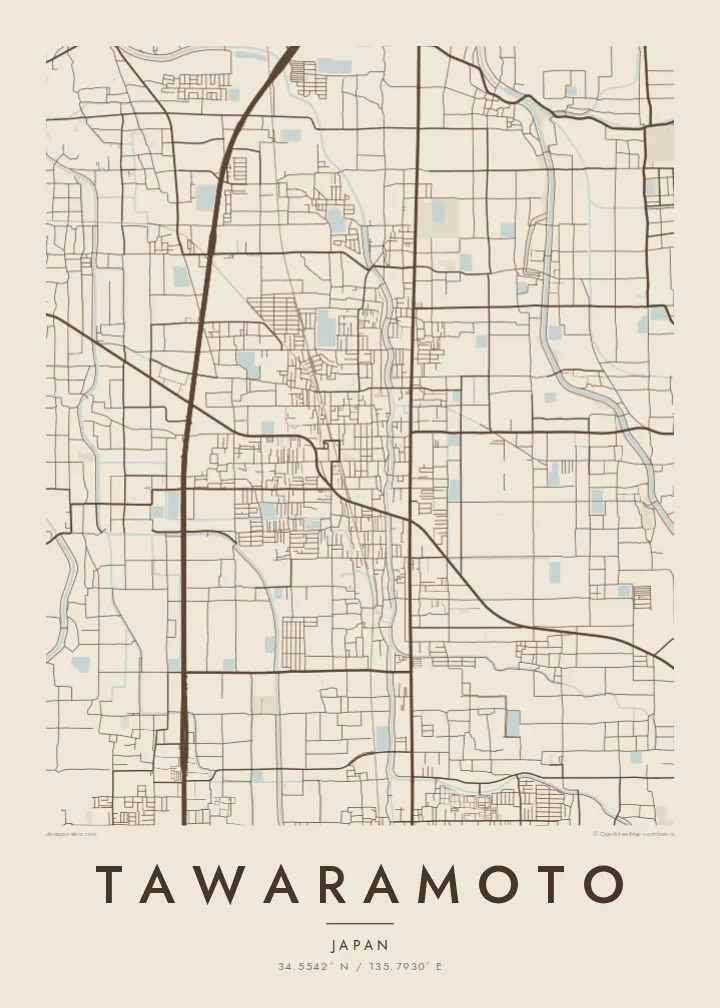
Around the built-up areas, rice fields form a regular grid of small plots. They give the map the finely divided texture typical of the Nara Basin.
Fakatino mape mukamuka · Japan
34.5542° N / 135.7930° E
A flat town in the Nara Basin, where rice paddies, two rail lines and small village clusters form a quiet patchwork.


Taha e taone, lima e onoonoaga
Tapaki e taha puhala ke kitia ai ki luga he puipui. Kua tatai e totogi he tau puhala oti — pete he lolomi, poloka, po ke faila HD.
 Tau pikselo mooli · faila lolomi 24 × 36″
Maama mitaki ke lolomi
Ko e 100% e fahi mooli mai he faila lolomi. Ko e tau poster oti — pete kua lolomi, poloka, po ke utu hifo — kua taute ke he ha mautolu a tau tokoluga (server) ke he 300 DPI, hokotia ke he 7,200 × 10,800 piksela, ke maeke ai e tau ala ikiiki tote ke maaliali fakamitaki he lolomi 24 × 36″.
He Pā


Ko e mape
Tawaramoto lies in the middle of the Nara Basin, on level ground, with the mountains that ring the basin in the distance. The town is flat, and its map mixes residential clusters, narrow lanes and rice fields laid out in neat rectangular plots. Small rivers and irrigation channels cross the land, most of them in straight lines.
Two railway lines pass through the town, and their stations form small centres of denser streets. Tawaramoto is also home to the Karako-Kagi site, one of the best-known archaeological sites of Japan's Yayoi period, where a reconstructed tower now stands. A Tawaramoto map poster shows this blend of an old settlement pattern and a modern town.
In monochrome, field boundaries and the grid of lanes make a fine, even texture across the sheet. The clustered villages and the long lines of the railways break it up. The result is subtle and balanced, a map that rewards close looking and suits a calm, uncluttered room.
Around the built-up areas, rice fields form a regular grid of small plots. They give the map the finely divided texture typical of the Nara Basin.
Two railway lines cross the town, each with its own station area. Their straight tracks divide the fields and link Tawaramoto with other parts of the basin.
The Yayoi-period archaeological site forms an open area among the fields. This green space, with its reconstructed tower, marks one of the region's oldest known settlements.
Taute ke ha hau
Lafi e aho, taha higoa po ke taha kupu haau, hiki e fakatino, lahi po ke tuaga.
Ko e kitiaaga nakai totogi kua tote e maaliali mo e fakamailoga vai. Ko e tau lolomi mo e tau faila HD kua taute ke he 300 DPI, hokotia ke he 7,200 × 10,800 px, nakai fai fakamailoga vai.
Ko e ha Tawaramoto
Tawaramoto suits people who like quiet, orderly maps: former residents, visitors to the Nara region, or anyone interested in Japan's early history. Add your own title and subtitle, perhaps a family name or the dates of a stay, and keep or edit the coordinates line.
Choose Classic black & white, Noir, Paper, Blueprint or Sand. The free preview shows a 900 px watermarked version. The $9 purchase includes six sizes, among them A3 and A2, as 300 DPI PNG and print-ready PDF, and matte printed posters come with an optional wooden frame.
Talaage e poster Tawaramoto| Lahi he lolomi | Maama | Tau faila |
|---|---|---|
| 30 × 40 cm11.8 × 15.7″ | 3,543 × 4,724 px | PNG · PDF |
| 29.7 × 42 cm (A3)11.7 × 16.5″ | 3,508 × 4,961 px | PNG · PDF |
| 42 × 59.4 cm (A2)16.5 × 23.4″ | 4,961 × 7,016 px | PNG · PDF |
| 45.7 × 61 cm18 × 24″ | 5,400 × 7,200 px | PNG · PDF |
| 50 × 70 cm19.7 × 27.6″ | 5,906 × 8,268 px | PNG · PDF |
| 61 × 91.4 cm24 × 36″ | 7,200 × 10,800 px | PNG · PDF |
Ke fakatatai, ko e fakatino noa kua 900 px e laulahi, fai fakamailoga mo e mo e tau mata komipiuta ni. Ko e tau faila HD kua ato hoko ke he 8× e maama ke he tau faahi takitaha mo e lolomi mitaki he lahi katoa he fakatino.
Fifili e taha puhala i luga he kupega, ti fifili e Poster Lolomi — e lahi mo e, kaeke ke manako ai koe, taha poloka — po ke Tau Faila HD Fakaeletonika. Ko e fakaotiaga totogi ko e taha gahua ni, ti ko e kupega he hau a talaaga ka fakafou fakahaga i mua he fakaotiaga e totogi.
Kua lolomi ai ke he pepa mitaki 200 gsm matte he taha he tau lahi ono, mai he 30 × 40 cm ke hoko ke he 24 × 36″. Kamata e tau poster lolomi mai he $39, kua putoia ai e utaaga.
E. Fifili e poloka akau malolō ke he lanu uli, tea, akau oki mooli, po ke akau pouli. Kua fakalataha mo e sioga malolō nakai malepe ti kua mautali ke tautau. Kamata e tau poster poloka mai he $99, kua putoia ai e utaaga.
Nakai totogi e fakafano ke he motu 60+. Ko e fakatino taha kua lolomi he fenoga lolomi ha mautolu kua tata mo e tau motu 30+, kua hoko mai he tau aho gahua 3–7. Maeke ia koe ke kikite e tuaga mo e fakamuitua he lalo he Haku Tau Fakatonu. Ke he falu motu kua 2–5 e tau tapu, ti ka nakai fakafano a mautolu ki ai, to fakaha he api tupe ia ki mua he totogi.
Fakafano mai e taha ata ki a mautolu he loto he 14 e tau aho tali mai he hokoaga, ti to lolomi foki e mautolu nakai totogi po ke liu atu e totogi ki a koe.
E. He editor i luga he kupega nei, hikihiki e matakupu, e matakupu lalo mo e laini coordinates ke he taha mena kua manako a koe ki ai, ti fifili e puhala mo e lahi. Ko e tau talaaga lolomi, poloka mo e fakaeletonika oti kua fakaaoga tonu e hau a fakatino.
Ma e $9 ka moua e koe e tau faila PNG 300 DPI mo e PDF kua mautali ke lolomi he tau lahi ono oti, nakai fai fakamailoga vai, ke lolomi i fe mena. Nakai maopoopo agaia? Utu hifo fakamua e kitiaaga nakai totogi ne fai fakamailoga vai.
Tata mai
