The old medina
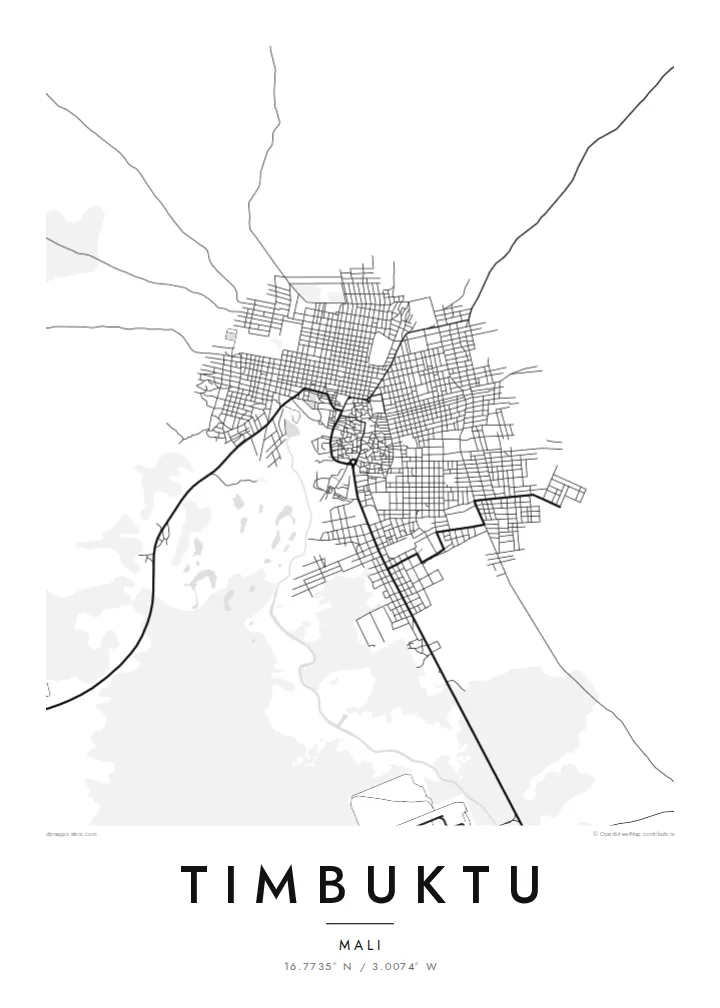
The historic core is a dense, organic tangle of alleys with no straight axis. On the map it looks almost woven, and that texture comes through strongly in Noir.
Fakatino mape mukamuka · Mali
16.7735° N / 3.0074° W
A sand-coloured maze of lanes on the Sahara's edge, a few kilometres from the great bend of the Niger


Taha e taone, lima e onoonoaga
Tapaki e taha puhala ke kitia ai ki luga he puipui. Kua tatai e totogi he tau puhala oti — pete he lolomi, poloka, po ke faila HD.
 Tau pikselo mooli · faila lolomi 24 × 36″
Maama mitaki ke lolomi
Ko e 100% e fahi mooli mai he faila lolomi. Ko e tau poster oti — pete kua lolomi, poloka, po ke utu hifo — kua taute ke he ha mautolu a tau tokoluga (server) ke he 300 DPI, hokotia ke he 7,200 × 10,800 piksela, ke maeke ai e tau ala ikiiki tote ke maaliali fakamitaki he lolomi 24 × 36″.
He Pā


Ko e mape
Timbuktu stands where the Sahara meets the floodplain of the Niger, a short distance north of the river. From above, the old town is a tight knot of narrow, irregular lanes. The houses are built of earth and set close together, and beyond them sand runs to the horizon on every side. A road and seasonal channels link the town to its river port at Kabara.
For centuries the town was a meeting point for camel caravans from the desert and boats on the Niger. It became a centre of Islamic learning, and its three great earthen mosques, Djinguereber, Sankore and Sidi Yahia, are listed together with the old town as a UNESCO World Heritage Site.
Its libraries still hold hundreds of thousands of manuscripts on law, astronomy, medicine and poetry, many of them preserved by local families. A Timbuktu map poster shows how compact the historic town really is. There is no grid and no ring road, only lanes that bend around courtyards and open onto small squares, much as they have for generations.
The historic core is a dense, organic tangle of alleys with no straight axis. On the map it looks almost woven, and that texture comes through strongly in Noir.
Djinguereber, Sankore and Sidi Yahia sit within the old town. Their open courtyards leave small gaps in the dense street pattern, which make useful points of reference.
To the south, a road and seasonal channels run towards Kabara on the Niger. It is a reminder that the town has always depended on its river port as well as the desert routes.
Taute ke ha hau
Lafi e aho, taha higoa po ke taha kupu haau, hiki e fakatino, lahi po ke tuaga.
Ko e kitiaaga nakai totogi kua tote e maaliali mo e fakamailoga vai. Ko e tau lolomi mo e tau faila HD kua taute ke he 300 DPI, hokotia ke he 7,200 × 10,800 px, nakai fai fakamailoga vai.
Ko e ha Timbuktu
Timbuktu has been a byword for distance for centuries, which is part of why a precise map of it feels so striking. Hung on a wall, it turns a half-legendary name into real streets, and it suits readers, travellers and anyone who has worked in the Sahel.
The Sand style matches the town's earthen colours, and Paper gives it the feel of an archive. You can personalise the title, subtitle and coordinates. Printed posters come on matte paper, with an optional wooden frame, and HD files cost $9.
Talaage e poster Timbuktu| Lahi he lolomi | Maama | Tau faila |
|---|---|---|
| 30 × 40 cm11.8 × 15.7″ | 3,543 × 4,724 px | PNG · PDF |
| 29.7 × 42 cm (A3)11.7 × 16.5″ | 3,508 × 4,961 px | PNG · PDF |
| 42 × 59.4 cm (A2)16.5 × 23.4″ | 4,961 × 7,016 px | PNG · PDF |
| 45.7 × 61 cm18 × 24″ | 5,400 × 7,200 px | PNG · PDF |
| 50 × 70 cm19.7 × 27.6″ | 5,906 × 8,268 px | PNG · PDF |
| 61 × 91.4 cm24 × 36″ | 7,200 × 10,800 px | PNG · PDF |
Ke fakatatai, ko e fakatino noa kua 900 px e laulahi, fai fakamailoga mo e mo e tau mata komipiuta ni. Ko e tau faila HD kua ato hoko ke he 8× e maama ke he tau faahi takitaha mo e lolomi mitaki he lahi katoa he fakatino.
Fifili e taha puhala i luga he kupega, ti fifili e Poster Lolomi — e lahi mo e, kaeke ke manako ai koe, taha poloka — po ke Tau Faila HD Fakaeletonika. Ko e fakaotiaga totogi ko e taha gahua ni, ti ko e kupega he hau a talaaga ka fakafou fakahaga i mua he fakaotiaga e totogi.
Kua lolomi ai ke he pepa mitaki 200 gsm matte he taha he tau lahi ono, mai he 30 × 40 cm ke hoko ke he 24 × 36″. Kamata e tau poster lolomi mai he $39, kua putoia ai e utaaga.
E. Fifili e poloka akau malolō ke he lanu uli, tea, akau oki mooli, po ke akau pouli. Kua fakalataha mo e sioga malolō nakai malepe ti kua mautali ke tautau. Kamata e tau poster poloka mai he $99, kua putoia ai e utaaga.
Nakai totogi e fakafano ke he motu 60+. Ko e fakatino taha kua lolomi he fenoga lolomi ha mautolu kua tata mo e tau motu 30+, kua hoko mai he tau aho gahua 3–7. Maeke ia koe ke kikite e tuaga mo e fakamuitua he lalo he Haku Tau Fakatonu. Ke he falu motu kua 2–5 e tau tapu, ti ka nakai fakafano a mautolu ki ai, to fakaha he api tupe ia ki mua he totogi.
Fakafano mai e taha ata ki a mautolu he loto he 14 e tau aho tali mai he hokoaga, ti to lolomi foki e mautolu nakai totogi po ke liu atu e totogi ki a koe.
E. He editor i luga he kupega nei, hikihiki e matakupu, e matakupu lalo mo e laini coordinates ke he taha mena kua manako a koe ki ai, ti fifili e puhala mo e lahi. Ko e tau talaaga lolomi, poloka mo e fakaeletonika oti kua fakaaoga tonu e hau a fakatino.
Ma e $9 ka moua e koe e tau faila PNG 300 DPI mo e PDF kua mautali ke lolomi he tau lahi ono oti, nakai fai fakamailoga vai, ke lolomi i fe mena. Nakai maopoopo agaia? Utu hifo fakamua e kitiaaga nakai totogi ne fai fakamailoga vai.
Tata mai
