Sanctuary district
The area around the basilica holds broad avenues and open spaces designed to accommodate pilgrims, a clearly defined zone within the city's otherwise regular pattern.
Fakatino mape mukamuka · Brazil
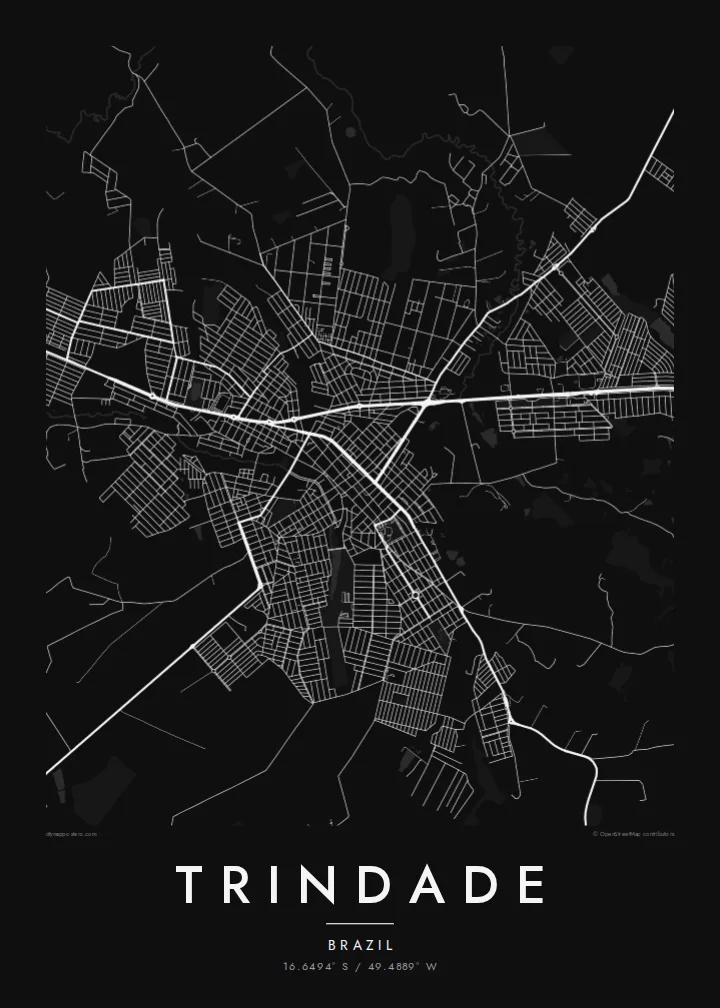
16.6494° S / 49.4889° W
A pilgrimage city west of Goiânia, its regular grid grown around a basilica on the gentle upland of central Brazil.



Taha e taone, lima e onoonoaga
Tapaki e taha puhala ke kitia ai ki luga he puipui. Kua tatai e totogi he tau puhala oti — pete he lolomi, poloka, po ke faila HD.
 Tau pikselo mooli · faila lolomi 24 × 36″
Maama mitaki ke lolomi
Ko e 100% e fahi mooli mai he faila lolomi. Ko e tau poster oti — pete kua lolomi, poloka, po ke utu hifo — kua taute ke he ha mautolu a tau tokoluga (server) ke he 300 DPI, hokotia ke he 7,200 × 10,800 piksela, ke maeke ai e tau ala ikiiki tote ke maaliali fakamitaki he lolomi 24 × 36″.
He Pā


Ko e mape
Trindade lies a short distance west of Goiânia, the capital of Goiás, and forms part of its metropolitan area. It is best known for the Romaria do Divino Pai Eterno, one of the largest Catholic pilgrimages in Brazil, held each year around the beginning of July, when very large numbers of visitors arrive from across the country.
The pilgrimage centres on the Basilica of the Divino Pai Eterno, and much of the city's layout reflects this role. The area around the sanctuary includes wide avenues and open spaces for crowds, while the rest of the town extends in a mostly regular grid across the gentle terrain typical of the Brazilian central plateau.
Many pilgrims walk the road from Goiânia to Trindade, and the highway between them is a strong feature on the map. A Trindade map poster shows the town's grid, its sanctuary district and its connection eastward, a faithful outline of a place that becomes, for a few days each year, one of the most visited in the country.
The area around the basilica holds broad avenues and open spaces designed to accommodate pilgrims, a clearly defined zone within the city's otherwise regular pattern.
The highway linking Trindade with Goiânia runs east toward the capital, a long line walked each year by many pilgrims on their way to the sanctuary.
Beyond the centre, residential blocks follow a largely regular grid across level ground, giving the map a calm, orderly texture that extends in every direction.
Taute ke ha hau
Lafi e aho, taha higoa po ke taha kupu haau, hiki e fakatino, lahi po ke tuaga.
Ko e kitiaaga nakai totogi kua tote e maaliali mo e fakamailoga vai. Ko e tau lolomi mo e tau faila HD kua taute ke he 300 DPI, hokotia ke he 7,200 × 10,800 px, nakai fai fakamailoga vai.
Ko e ha Trindade
For those who have made the pilgrimage, and for families who call Trindade home, the city carries deep personal meaning. Its map is a way to remember a journey or honour a lifelong connection to the place.
Add a title, a subtitle with the year of a romaria or a family name, and custom coordinates. Pick from Classic black & white, Noir, Paper, Blueprint and Sand, and download HD files or order a printed poster on matte paper.
Talaage e poster Trindade| Lahi he lolomi | Maama | Tau faila |
|---|---|---|
| 30 × 40 cm11.8 × 15.7″ | 3,543 × 4,724 px | PNG · PDF |
| 29.7 × 42 cm (A3)11.7 × 16.5″ | 3,508 × 4,961 px | PNG · PDF |
| 42 × 59.4 cm (A2)16.5 × 23.4″ | 4,961 × 7,016 px | PNG · PDF |
| 45.7 × 61 cm18 × 24″ | 5,400 × 7,200 px | PNG · PDF |
| 50 × 70 cm19.7 × 27.6″ | 5,906 × 8,268 px | PNG · PDF |
| 61 × 91.4 cm24 × 36″ | 7,200 × 10,800 px | PNG · PDF |
Ke fakatatai, ko e fakatino noa kua 900 px e laulahi, fai fakamailoga mo e mo e tau mata komipiuta ni. Ko e tau faila HD kua ato hoko ke he 8× e maama ke he tau faahi takitaha mo e lolomi mitaki he lahi katoa he fakatino.
Fifili e taha puhala i luga he kupega, ti fifili e Poster Lolomi — e lahi mo e, kaeke ke manako ai koe, taha poloka — po ke Tau Faila HD Fakaeletonika. Ko e fakaotiaga totogi ko e taha gahua ni, ti ko e kupega he hau a talaaga ka fakafou fakahaga i mua he fakaotiaga e totogi.
Kua lolomi ai ke he pepa mitaki 200 gsm matte he taha he tau lahi ono, mai he 30 × 40 cm ke hoko ke he 24 × 36″. Kamata e tau poster lolomi mai he $39, kua putoia ai e utaaga.
E. Fifili e poloka akau malolō ke he lanu uli, tea, akau oki mooli, po ke akau pouli. Kua fakalataha mo e sioga malolō nakai malepe ti kua mautali ke tautau. Kamata e tau poster poloka mai he $99, kua putoia ai e utaaga.
Nakai totogi e fakafano ke he motu 60+. Ko e fakatino taha kua lolomi he fenoga lolomi ha mautolu kua tata mo e tau motu 30+, kua hoko mai he tau aho gahua 3–7. Maeke ia koe ke kikite e tuaga mo e fakamuitua he lalo he Haku Tau Fakatonu. Ke he falu motu kua 2–5 e tau tapu, ti ka nakai fakafano a mautolu ki ai, to fakaha he api tupe ia ki mua he totogi.
Fakafano mai e taha ata ki a mautolu he loto he 14 e tau aho tali mai he hokoaga, ti to lolomi foki e mautolu nakai totogi po ke liu atu e totogi ki a koe.
E. He editor i luga he kupega nei, hikihiki e matakupu, e matakupu lalo mo e laini coordinates ke he taha mena kua manako a koe ki ai, ti fifili e puhala mo e lahi. Ko e tau talaaga lolomi, poloka mo e fakaeletonika oti kua fakaaoga tonu e hau a fakatino.
Ma e $9 ka moua e koe e tau faila PNG 300 DPI mo e PDF kua mautali ke lolomi he tau lahi ono oti, nakai fai fakamailoga vai, ke lolomi i fe mena. Nakai maopoopo agaia? Utu hifo fakamua e kitiaaga nakai totogi ne fai fakamailoga vai.
Tata mai
