Ridge-top centre
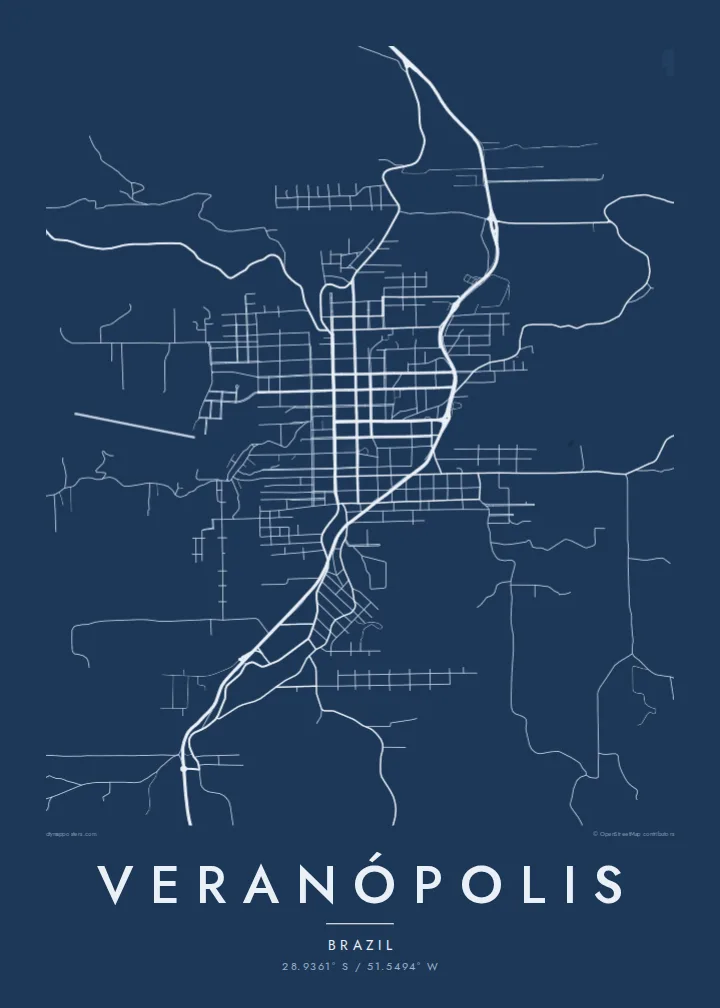
The core of the town sits on elevated ground, with a relatively ordered street plan that becomes more irregular as it spreads down the surrounding slopes.
Fakatino mape mukamuka · Brazil
28.9361° S / 51.5494° W
A hilltop town in the Serra Gaúcha, its streets following ridges above deep green river valleys



Taha e taone, lima e onoonoaga
Tapaki e taha puhala ke kitia ai ki luga he puipui. Kua tatai e totogi he tau puhala oti — pete he lolomi, poloka, po ke faila HD.
 Tau pikselo mooli · faila lolomi 24 × 36″
Maama mitaki ke lolomi
Ko e 100% e fahi mooli mai he faila lolomi. Ko e tau poster oti — pete kua lolomi, poloka, po ke utu hifo — kua taute ke he ha mautolu a tau tokoluga (server) ke he 300 DPI, hokotia ke he 7,200 × 10,800 piksela, ke maeke ai e tau ala ikiiki tote ke maaliali fakamitaki he lolomi 24 × 36″.
He Pā


Ko e mape
Veranópolis stands on the high ground of the Serra Gaúcha in Rio Grande do Sul, a region settled largely by Italian immigrants in the late nineteenth century. The town sits on a ridge, and its streets bend to follow the terrain. To the east, the land falls sharply into the valley of the Rio das Antas, adding depth to the edges of the map.
The town is known in Brazil as the Terra da Longevidade, the land of longevity, because of the unusually long lives of many residents, which have been the subject of health studies. Around the urban area, the map shows small farms, vineyards and winding rural roads that reflect the region's Italian farming heritage.
A Veranópolis map poster turns this hilly setting into a clear graphic form. The centre has a fairly regular layout, while the outer streets loosen and curve with the slopes. Rural roads extend in all directions, tracing ridgelines between steep-sided valleys, and give the town a strong outline even without shading or colour.
The core of the town sits on elevated ground, with a relatively ordered street plan that becomes more irregular as it spreads down the surrounding slopes.
The deep valley of the Rio das Antas runs near the town, a winding line that contrasts with the built-up area and marks the dramatic relief of the Serra.
Narrow rural roads follow the ridges between farms and vineyards, a pattern that goes back to the Italian colonial settlement of the region.
Taute ke ha hau
Lafi e aho, taha higoa po ke taha kupu haau, hiki e fakatino, lahi po ke tuaga.
Ko e kitiaaga nakai totogi kua tote e maaliali mo e fakamailoga vai. Ko e tau lolomi mo e tau faila HD kua taute ke he 300 DPI, hokotia ke he 7,200 × 10,800 px, nakai fai fakamailoga vai.
Ko e ha Veranópolis
Veranópolis means a lot to descendants of Italian settlers and to anyone who grew up in the Serra Gaúcha. A map of its ridge-top streets is a quiet tribute to family history, and it fits well in a kitchen, study or hallway.
Add a family name, an arrival year or a wedding date to the title and subtitle, and pick from Classic black & white, Noir, Paper, Blueprint or Sand. Sand suits the warm, rural character of the town. Printed posters ship from partners in over 30 countries.
Talaage e poster Veranópolis| Lahi he lolomi | Maama | Tau faila |
|---|---|---|
| 30 × 40 cm11.8 × 15.7″ | 3,543 × 4,724 px | PNG · PDF |
| 29.7 × 42 cm (A3)11.7 × 16.5″ | 3,508 × 4,961 px | PNG · PDF |
| 42 × 59.4 cm (A2)16.5 × 23.4″ | 4,961 × 7,016 px | PNG · PDF |
| 45.7 × 61 cm18 × 24″ | 5,400 × 7,200 px | PNG · PDF |
| 50 × 70 cm19.7 × 27.6″ | 5,906 × 8,268 px | PNG · PDF |
| 61 × 91.4 cm24 × 36″ | 7,200 × 10,800 px | PNG · PDF |
Ke fakatatai, ko e fakatino noa kua 900 px e laulahi, fai fakamailoga mo e mo e tau mata komipiuta ni. Ko e tau faila HD kua ato hoko ke he 8× e maama ke he tau faahi takitaha mo e lolomi mitaki he lahi katoa he fakatino.
Fifili e taha puhala i luga he kupega, ti fifili e Poster Lolomi — e lahi mo e, kaeke ke manako ai koe, taha poloka — po ke Tau Faila HD Fakaeletonika. Ko e fakaotiaga totogi ko e taha gahua ni, ti ko e kupega he hau a talaaga ka fakafou fakahaga i mua he fakaotiaga e totogi.
Kua lolomi ai ke he pepa mitaki 200 gsm matte he taha he tau lahi ono, mai he 30 × 40 cm ke hoko ke he 24 × 36″. Kamata e tau poster lolomi mai he $39, kua putoia ai e utaaga.
E. Fifili e poloka akau malolō ke he lanu uli, tea, akau oki mooli, po ke akau pouli. Kua fakalataha mo e sioga malolō nakai malepe ti kua mautali ke tautau. Kamata e tau poster poloka mai he $99, kua putoia ai e utaaga.
Nakai totogi e fakafano ke he motu 60+. Ko e fakatino taha kua lolomi he fenoga lolomi ha mautolu kua tata mo e tau motu 30+, kua hoko mai he tau aho gahua 3–7. Maeke ia koe ke kikite e tuaga mo e fakamuitua he lalo he Haku Tau Fakatonu. Ke he falu motu kua 2–5 e tau tapu, ti ka nakai fakafano a mautolu ki ai, to fakaha he api tupe ia ki mua he totogi.
Fakafano mai e taha ata ki a mautolu he loto he 14 e tau aho tali mai he hokoaga, ti to lolomi foki e mautolu nakai totogi po ke liu atu e totogi ki a koe.
E. He editor i luga he kupega nei, hikihiki e matakupu, e matakupu lalo mo e laini coordinates ke he taha mena kua manako a koe ki ai, ti fifili e puhala mo e lahi. Ko e tau talaaga lolomi, poloka mo e fakaeletonika oti kua fakaaoga tonu e hau a fakatino.
Ma e $9 ka moua e koe e tau faila PNG 300 DPI mo e PDF kua mautali ke lolomi he tau lahi ono oti, nakai fai fakamailoga vai, ke lolomi i fe mena. Nakai maopoopo agaia? Utu hifo fakamua e kitiaaga nakai totogi ne fai fakamailoga vai.
Tata mai
