The Vesdre river
The river curves through the centre of town and is crossed by a series of bridges. Much of Verviers' industrial past was built along its banks.
Fakatino mape mukamuka · Belgium
50.5891° N / 5.8624° E
A former wool town winding along the Vesdre valley, its streets climbing steep slopes above the river



Taha e taone, lima e onoonoaga
Tapaki e taha puhala ke kitia ai ki luga he puipui. Kua tatai e totogi he tau puhala oti — pete he lolomi, poloka, po ke faila HD.
 Tau pikselo mooli · faila lolomi 24 × 36″
Maama mitaki ke lolomi
Ko e 100% e fahi mooli mai he faila lolomi. Ko e tau poster oti — pete kua lolomi, poloka, po ke utu hifo — kua taute ke he ha mautolu a tau tokoluga (server) ke he 300 DPI, hokotia ke he 7,200 × 10,800 piksela, ke maeke ai e tau ala ikiiki tote ke maaliali fakamitaki he lolomi 24 × 36″.
He Pā


Ko e mape
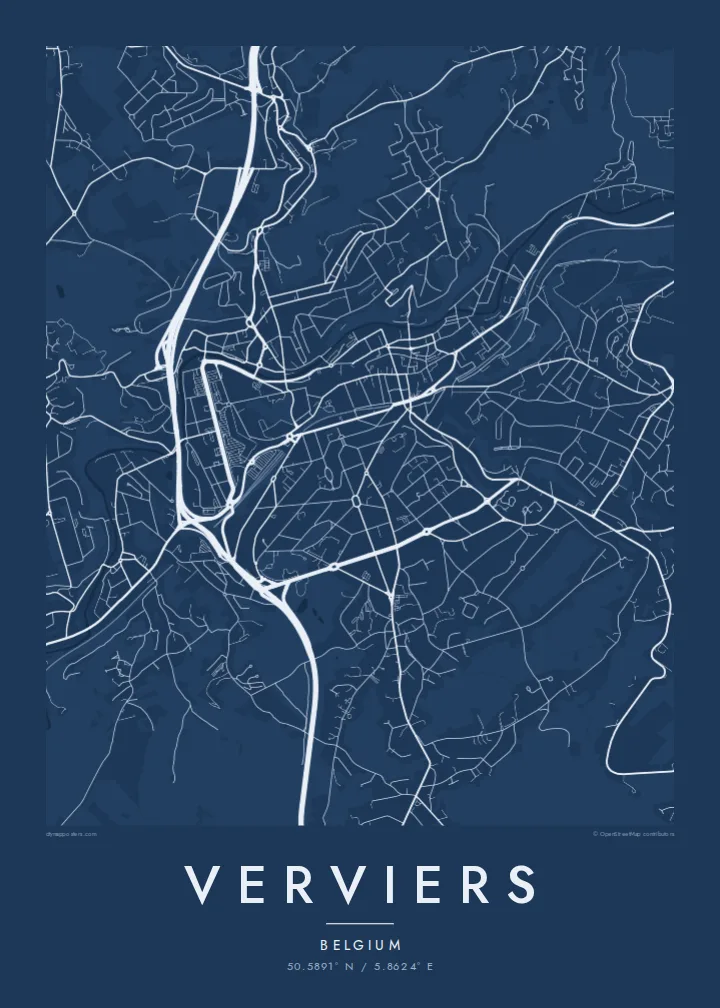
Verviers grew up in the narrow valley of the Vesdre, in the east of Belgium's Wallonia region, between Liège and the German border. On a map, the river and the railway run side by side along the valley floor. The town is squeezed around them, and streets break away to climb the hillsides in bends, switchbacks and stepped terraces.
In the nineteenth century Verviers was one of Europe's leading centres for washing and spinning wool, using the soft water of the Vesdre. Former mill buildings still line the riverbanks, and the town calls itself the water capital of Wallonia. Its fountains and the nearby Gileppe dam reflect that link. The same valley was hit hard by the floods of July 2021.
A Verviers map poster traces how the town's layout was set by its topography. You can see a dense centre on the valley floor, a looping river crossed by frequent bridges, and residential districts spreading over the heights on both sides. It is a map of a working valley town, drawn with the clarity that suits its layered, uneven terrain.
The river curves through the centre of town and is crossed by a series of bridges. Much of Verviers' industrial past was built along its banks.
Roads leave the valley floor and climb in curves and hairpins. On the poster they create a flowing texture that contrasts with the tight blocks below.
The railway and main roads follow the river in a narrow band. This gives the map a strong diagonal axis that ties the whole composition together.
Taute ke ha hau
Lafi e aho, taha higoa po ke taha kupu haau, hiki e fakatino, lahi po ke tuaga.
Ko e kitiaaga nakai totogi kua tote e maaliali mo e fakamailoga vai. Ko e tau lolomi mo e tau faila HD kua taute ke he 300 DPI, hokotia ke he 7,200 × 10,800 px, nakai fai fakamailoga vai.
Ko e ha Verviers
Verviers suits anyone who grew up in the Vesdre valley, who has family among its old textile workers, or who remembers its hillside streets. The map records a town shaped by water and industry. Hung on a wall, it holds that story without needing a word of explanation.
You can change the title, subtitle and coordinates line, for example to add a street name, a family surname or a date. Choose from five styles: Classic black & white, Noir, Paper, Blueprint and Sand. Paper and Sand bring out a warmer, archival feel.
Talaage e poster Verviers| Lahi he lolomi | Maama | Tau faila |
|---|---|---|
| 30 × 40 cm11.8 × 15.7″ | 3,543 × 4,724 px | PNG · PDF |
| 29.7 × 42 cm (A3)11.7 × 16.5″ | 3,508 × 4,961 px | PNG · PDF |
| 42 × 59.4 cm (A2)16.5 × 23.4″ | 4,961 × 7,016 px | PNG · PDF |
| 45.7 × 61 cm18 × 24″ | 5,400 × 7,200 px | PNG · PDF |
| 50 × 70 cm19.7 × 27.6″ | 5,906 × 8,268 px | PNG · PDF |
| 61 × 91.4 cm24 × 36″ | 7,200 × 10,800 px | PNG · PDF |
Ke fakatatai, ko e fakatino noa kua 900 px e laulahi, fai fakamailoga mo e mo e tau mata komipiuta ni. Ko e tau faila HD kua ato hoko ke he 8× e maama ke he tau faahi takitaha mo e lolomi mitaki he lahi katoa he fakatino.
Fifili e taha puhala i luga he kupega, ti fifili e Poster Lolomi — e lahi mo e, kaeke ke manako ai koe, taha poloka — po ke Tau Faila HD Fakaeletonika. Ko e fakaotiaga totogi ko e taha gahua ni, ti ko e kupega he hau a talaaga ka fakafou fakahaga i mua he fakaotiaga e totogi.
Kua lolomi ai ke he pepa mitaki 200 gsm matte he taha he tau lahi ono, mai he 30 × 40 cm ke hoko ke he 24 × 36″. Kamata e tau poster lolomi mai he $39, kua putoia ai e utaaga.
E. Fifili e poloka akau malolō ke he lanu uli, tea, akau oki mooli, po ke akau pouli. Kua fakalataha mo e sioga malolō nakai malepe ti kua mautali ke tautau. Kamata e tau poster poloka mai he $99, kua putoia ai e utaaga.
Nakai totogi e fakafano ke he motu 60+. Ko e fakatino taha kua lolomi he fenoga lolomi ha mautolu kua tata mo e tau motu 30+, kua hoko mai he tau aho gahua 3–7. Maeke ia koe ke kikite e tuaga mo e fakamuitua he lalo he Haku Tau Fakatonu. Ke he falu motu kua 2–5 e tau tapu, ti ka nakai fakafano a mautolu ki ai, to fakaha he api tupe ia ki mua he totogi.
Fakafano mai e taha ata ki a mautolu he loto he 14 e tau aho tali mai he hokoaga, ti to lolomi foki e mautolu nakai totogi po ke liu atu e totogi ki a koe.
E. He editor i luga he kupega nei, hikihiki e matakupu, e matakupu lalo mo e laini coordinates ke he taha mena kua manako a koe ki ai, ti fifili e puhala mo e lahi. Ko e tau talaaga lolomi, poloka mo e fakaeletonika oti kua fakaaoga tonu e hau a fakatino.
Ma e $9 ka moua e koe e tau faila PNG 300 DPI mo e PDF kua mautali ke lolomi he tau lahi ono oti, nakai fai fakamailoga vai, ke lolomi i fe mena. Nakai maopoopo agaia? Utu hifo fakamua e kitiaaga nakai totogi ne fai fakamailoga vai.
Tata mai
