Central grid
The old centre follows a broadly regular pattern of blocks. The layout is common to towns across central Mexico and reads with particular clarity in black and white.
Fakatino mape mukamuka · Mexico
20.5136° N / 100.9964° W
A small Bajío town on level farmland between Celaya and Salamanca, its grid squared off against the surrounding fields.



Taha e taone, lima e onoonoaga
Tapaki e taha puhala ke kitia ai ki luga he puipui. Kua tatai e totogi he tau puhala oti — pete he lolomi, poloka, po ke faila HD.
 Tau pikselo mooli · faila lolomi 24 × 36″
Maama mitaki ke lolomi
Ko e 100% e fahi mooli mai he faila lolomi. Ko e tau poster oti — pete kua lolomi, poloka, po ke utu hifo — kua taute ke he ha mautolu a tau tokoluga (server) ke he 300 DPI, hokotia ke he 7,200 × 10,800 piksela, ke maeke ai e tau ala ikiiki tote ke maaliali fakamitaki he lolomi 24 × 36″.
He Pā


Ko e mape
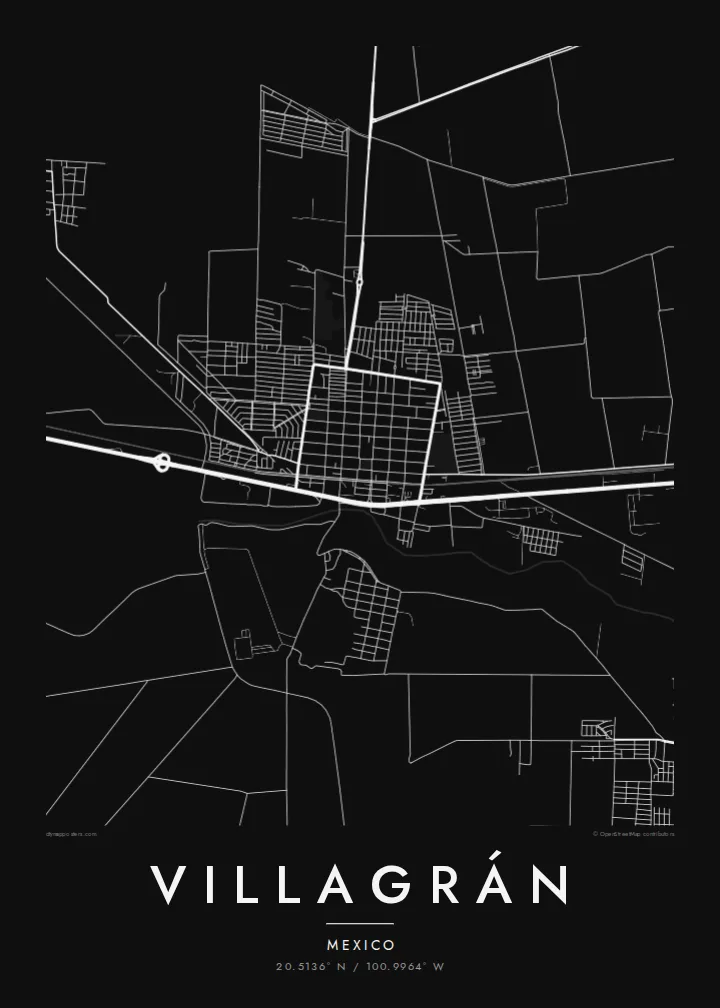
Villagrán is a municipal seat in the state of Guanajuato, in the heart of the Bajío, the fertile lowland that has long been one of central Mexico's farming and industrial cores. The town lies on flat ground in the corridor between Celaya and Salamanca. On the map, an almost unbroken pattern of irrigated fields surrounds its compact centre.
Like many towns in the region, Villagrán is organised around a central square and church, with a broadly regular grid of streets extending from it. Regional roads cross the flat terrain in long, straight runs, and the rectangular farm parcels carry the geometry of the streets far into the countryside.
A Villagrán map poster is a study in straight lines. The street grid, the field boundaries and the roads all share the same measured order, broken only by watercourses and the occasional diagonal track. The effect is calm and orderly, a clear picture of how towns in the Bajío sit within their farmland.
The old centre follows a broadly regular pattern of blocks. The layout is common to towns across central Mexico and reads with particular clarity in black and white.
A main road linking the neighbouring cities of the Bajío passes the town. It draws a long, direct line across the plain and ties Villagrán into the region's busy corridor.
Flat farmland divided into long rectangular plots surrounds the town. It carries the geometry of the streets outward and fills the edges of the sheet with a quiet, even pattern.
Taute ke ha hau
Lafi e aho, taha higoa po ke taha kupu haau, hiki e fakatino, lahi po ke tuaga.
Ko e kitiaaga nakai totogi kua tote e maaliali mo e fakamailoga vai. Ko e tau lolomi mo e tau faila HD kua taute ke he 300 DPI, hokotia ke he 7,200 × 10,800 px, nakai fai fakamailoga vai.
Ko e ha Villagrán
Villagrán is home to many families in Guanajuato, and to many more who have moved north or abroad. A map of the town keeps the familiar streets and square close, wherever the poster ends up hanging.
Add a title, a subtitle and your own coordinates line, then pick Classic black & white, Noir, Paper, Blueprint or Sand. Start with the free 900 px preview. The $9 download includes six print sizes, each as a 300 DPI PNG and a print-ready PDF.
Talaage e poster Villagrán| Lahi he lolomi | Maama | Tau faila |
|---|---|---|
| 30 × 40 cm11.8 × 15.7″ | 3,543 × 4,724 px | PNG · PDF |
| 29.7 × 42 cm (A3)11.7 × 16.5″ | 3,508 × 4,961 px | PNG · PDF |
| 42 × 59.4 cm (A2)16.5 × 23.4″ | 4,961 × 7,016 px | PNG · PDF |
| 45.7 × 61 cm18 × 24″ | 5,400 × 7,200 px | PNG · PDF |
| 50 × 70 cm19.7 × 27.6″ | 5,906 × 8,268 px | PNG · PDF |
| 61 × 91.4 cm24 × 36″ | 7,200 × 10,800 px | PNG · PDF |
Ke fakatatai, ko e fakatino noa kua 900 px e laulahi, fai fakamailoga mo e mo e tau mata komipiuta ni. Ko e tau faila HD kua ato hoko ke he 8× e maama ke he tau faahi takitaha mo e lolomi mitaki he lahi katoa he fakatino.
Fifili e taha puhala i luga he kupega, ti fifili e Poster Lolomi — e lahi mo e, kaeke ke manako ai koe, taha poloka — po ke Tau Faila HD Fakaeletonika. Ko e fakaotiaga totogi ko e taha gahua ni, ti ko e kupega he hau a talaaga ka fakafou fakahaga i mua he fakaotiaga e totogi.
Kua lolomi ai ke he pepa mitaki 200 gsm matte he taha he tau lahi ono, mai he 30 × 40 cm ke hoko ke he 24 × 36″. Kamata e tau poster lolomi mai he $39, kua putoia ai e utaaga.
E. Fifili e poloka akau malolō ke he lanu uli, tea, akau oki mooli, po ke akau pouli. Kua fakalataha mo e sioga malolō nakai malepe ti kua mautali ke tautau. Kamata e tau poster poloka mai he $99, kua putoia ai e utaaga.
Nakai totogi e fakafano ke he motu 60+. Ko e fakatino taha kua lolomi he fenoga lolomi ha mautolu kua tata mo e tau motu 30+, kua hoko mai he tau aho gahua 3–7. Maeke ia koe ke kikite e tuaga mo e fakamuitua he lalo he Haku Tau Fakatonu. Ke he falu motu kua 2–5 e tau tapu, ti ka nakai fakafano a mautolu ki ai, to fakaha he api tupe ia ki mua he totogi.
Fakafano mai e taha ata ki a mautolu he loto he 14 e tau aho tali mai he hokoaga, ti to lolomi foki e mautolu nakai totogi po ke liu atu e totogi ki a koe.
E. He editor i luga he kupega nei, hikihiki e matakupu, e matakupu lalo mo e laini coordinates ke he taha mena kua manako a koe ki ai, ti fifili e puhala mo e lahi. Ko e tau talaaga lolomi, poloka mo e fakaeletonika oti kua fakaaoga tonu e hau a fakatino.
Ma e $9 ka moua e koe e tau faila PNG 300 DPI mo e PDF kua mautali ke lolomi he tau lahi ono oti, nakai fai fakamailoga vai, ke lolomi i fe mena. Nakai maopoopo agaia? Utu hifo fakamua e kitiaaga nakai totogi ne fai fakamailoga vai.
Tata mai
