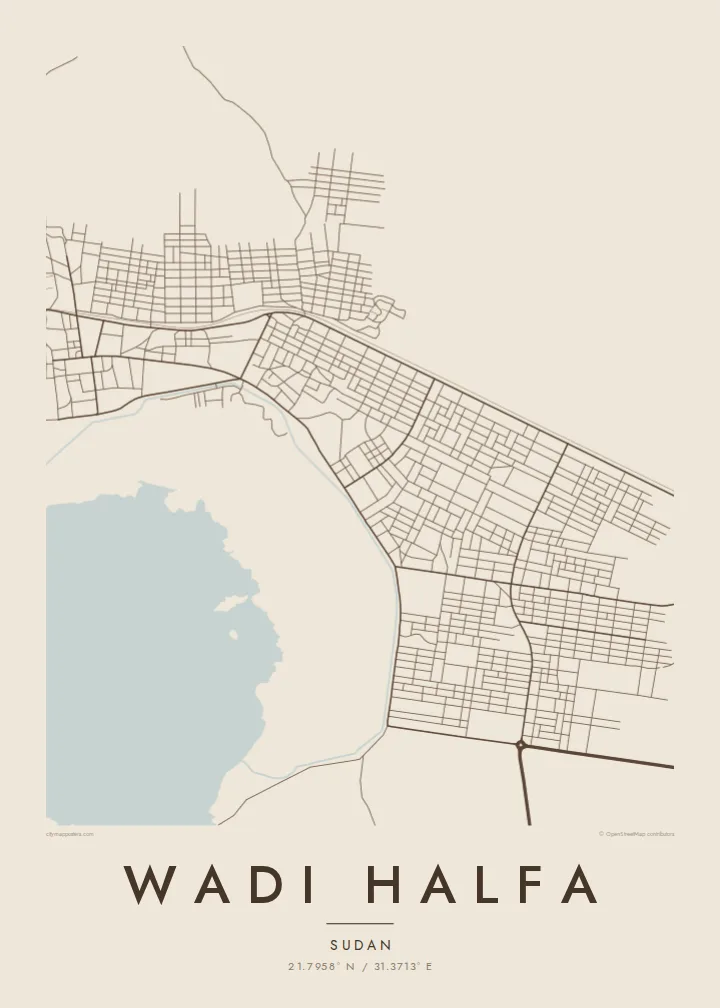
Lake Nubia shoreline
The irregular edge of the reservoir, cut by inlets and flooded wadis, forms the dominant line of the map and frames the town along its western side.
Fakatino mape mukamuka · Sudan
21.7958° N / 31.3713° E
A desert town on the shore of Lake Nubia, its loose grid of streets meeting open water and bare sand.


Taha e taone, lima e onoonoaga
Tapaki e taha puhala ke kitia ai ki luga he puipui. Kua tatai e totogi he tau puhala oti — pete he lolomi, poloka, po ke faila HD.
 Tau pikselo mooli · faila lolomi 24 × 36″
Maama mitaki ke lolomi
Ko e 100% e fahi mooli mai he faila lolomi. Ko e tau poster oti — pete kua lolomi, poloka, po ke utu hifo — kua taute ke he ha mautolu a tau tokoluga (server) ke he 300 DPI, hokotia ke he 7,200 × 10,800 piksela, ke maeke ai e tau ala ikiiki tote ke maaliali fakamitaki he lolomi 24 × 36″.
He Pā


Ko e mape
Wadi Halfa lies at the northern edge of Sudan, close to the Egyptian border, on the eastern shore of the reservoir the Sudanese call Lake Nubia and Egyptians know as Lake Nasser. From above there is little to soften the picture: a low-rise town of wide, straight streets, the flat surface of the lake to one side and open desert on every other.
The present town is a replacement. The original Wadi Halfa was submerged when the lake behind the Aswan High Dam filled in the 1960s, and much of its population was resettled far to the south. The new settlement grew on higher ground nearby, which is why its plan looks so regular compared with older Nile towns. It remains the terminus of the railway from Khartoum and the arrival point for the lake ferry from Aswan.
On a Wadi Halfa map poster, the shoreline carries most of the composition, a ragged edge that no street grid can quite match. Noir turns the water into a dark mass against pale land, while Sand suits the desert setting without leaning into cliché. It is a spare, graphic image, and its restraint is the point.
The irregular edge of the reservoir, cut by inlets and flooded wadis, forms the dominant line of the map and frames the town along its western side.
Rebuilt after the flooding of the old town, Wadi Halfa has a regular layout of broad streets and blocks that reads clearly even at the smallest print sizes.
The railway from Khartoum ends here, and the port serves the ferry across the lake to Aswan, making the town a long-standing gateway between Sudan and Egypt.
Taute ke ha hau
Lafi e aho, taha higoa po ke taha kupu haau, hiki e fakatino, lahi po ke tuaga.
Ko e kitiaaga nakai totogi kua tote e maaliali mo e fakamailoga vai. Ko e tau lolomi mo e tau faila HD kua taute ke he 300 DPI, hokotia ke he 7,200 × 10,800 px, nakai fai fakamailoga vai.
Ko e ha Wadi Halfa
Wadi Halfa means something particular to Nubian families whose old town lies under the lake, and to travellers who crossed the border by ferry and train. A map poster records the new town and the water that replaced the old one, a quiet document of a place that moved.
Personalise the title, subtitle and coordinates, perhaps with the year of a journey, and choose Classic black & white, Noir, Paper, Blueprint or Sand. Download the HD files for $9 in six sizes, or have a matte print, with an optional wooden frame, shipped from a nearby partner.
Talaage e poster Wadi Halfa| Lahi he lolomi | Maama | Tau faila |
|---|---|---|
| 30 × 40 cm11.8 × 15.7″ | 3,543 × 4,724 px | PNG · PDF |
| 29.7 × 42 cm (A3)11.7 × 16.5″ | 3,508 × 4,961 px | PNG · PDF |
| 42 × 59.4 cm (A2)16.5 × 23.4″ | 4,961 × 7,016 px | PNG · PDF |
| 45.7 × 61 cm18 × 24″ | 5,400 × 7,200 px | PNG · PDF |
| 50 × 70 cm19.7 × 27.6″ | 5,906 × 8,268 px | PNG · PDF |
| 61 × 91.4 cm24 × 36″ | 7,200 × 10,800 px | PNG · PDF |
Ke fakatatai, ko e fakatino noa kua 900 px e laulahi, fai fakamailoga mo e mo e tau mata komipiuta ni. Ko e tau faila HD kua ato hoko ke he 8× e maama ke he tau faahi takitaha mo e lolomi mitaki he lahi katoa he fakatino.
Fifili e taha puhala i luga he kupega, ti fifili e Poster Lolomi — e lahi mo e, kaeke ke manako ai koe, taha poloka — po ke Tau Faila HD Fakaeletonika. Ko e fakaotiaga totogi ko e taha gahua ni, ti ko e kupega he hau a talaaga ka fakafou fakahaga i mua he fakaotiaga e totogi.
Kua lolomi ai ke he pepa mitaki 200 gsm matte he taha he tau lahi ono, mai he 30 × 40 cm ke hoko ke he 24 × 36″. Kamata e tau poster lolomi mai he $39, kua putoia ai e utaaga.
E. Fifili e poloka akau malolō ke he lanu uli, tea, akau oki mooli, po ke akau pouli. Kua fakalataha mo e sioga malolō nakai malepe ti kua mautali ke tautau. Kamata e tau poster poloka mai he $99, kua putoia ai e utaaga.
Nakai totogi e fakafano ke he motu 60+. Ko e fakatino taha kua lolomi he fenoga lolomi ha mautolu kua tata mo e tau motu 30+, kua hoko mai he tau aho gahua 3–7. Maeke ia koe ke kikite e tuaga mo e fakamuitua he lalo he Haku Tau Fakatonu. Ke he falu motu kua 2–5 e tau tapu, ti ka nakai fakafano a mautolu ki ai, to fakaha he api tupe ia ki mua he totogi.
Fakafano mai e taha ata ki a mautolu he loto he 14 e tau aho tali mai he hokoaga, ti to lolomi foki e mautolu nakai totogi po ke liu atu e totogi ki a koe.
E. He editor i luga he kupega nei, hikihiki e matakupu, e matakupu lalo mo e laini coordinates ke he taha mena kua manako a koe ki ai, ti fifili e puhala mo e lahi. Ko e tau talaaga lolomi, poloka mo e fakaeletonika oti kua fakaaoga tonu e hau a fakatino.
Ma e $9 ka moua e koe e tau faila PNG 300 DPI mo e PDF kua mautali ke lolomi he tau lahi ono oti, nakai fai fakamailoga vai, ke lolomi i fe mena. Nakai maopoopo agaia? Utu hifo fakamua e kitiaaga nakai totogi ne fai fakamailoga vai.
Tata mai
