Mittelland Canal
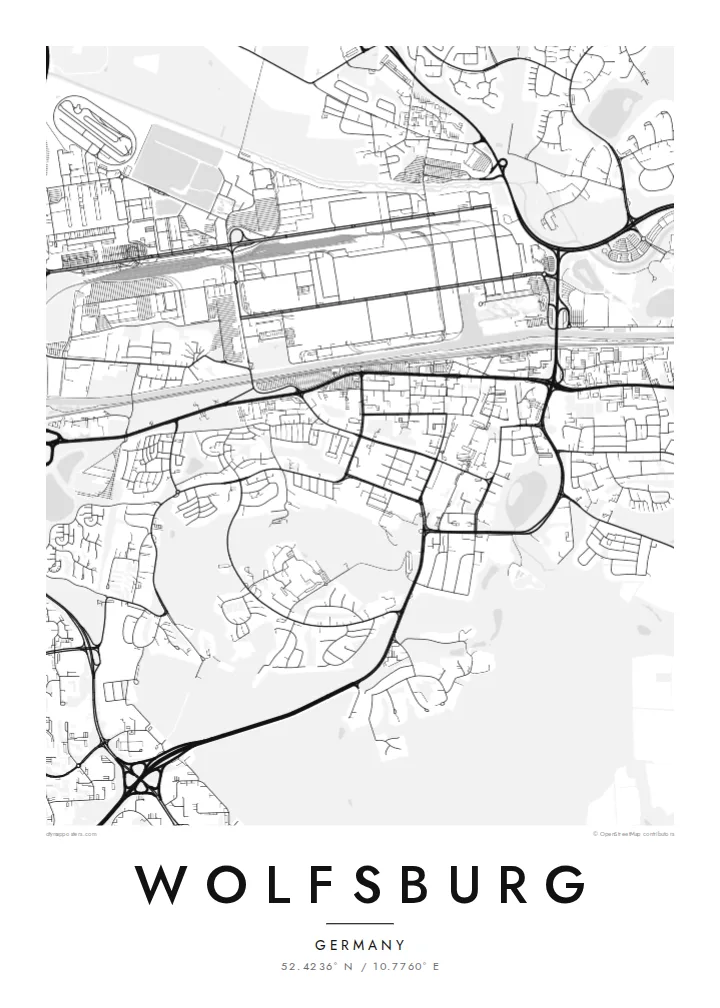
The canal crosses the city in a nearly straight line, separating the factory from the town and forming the strongest single stroke on the map.
Fakatino mape mukamuka · Germany
52.4236° N / 10.7760° E
A planned industrial town laid out along the Mittelland Canal, facing one of the world's largest car factories across the water.



Taha e taone, lima e onoonoaga
Tapaki e taha puhala ke kitia ai ki luga he puipui. Kua tatai e totogi he tau puhala oti — pete he lolomi, poloka, po ke faila HD.
 Tau pikselo mooli · faila lolomi 24 × 36″
Maama mitaki ke lolomi
Ko e 100% e fahi mooli mai he faila lolomi. Ko e tau poster oti — pete kua lolomi, poloka, po ke utu hifo — kua taute ke he ha mautolu a tau tokoluga (server) ke he 300 DPI, hokotia ke he 7,200 × 10,800 piksela, ke maeke ai e tau ala ikiiki tote ke maaliali fakamitaki he lolomi 24 × 36″.
He Pā


Ko e mape
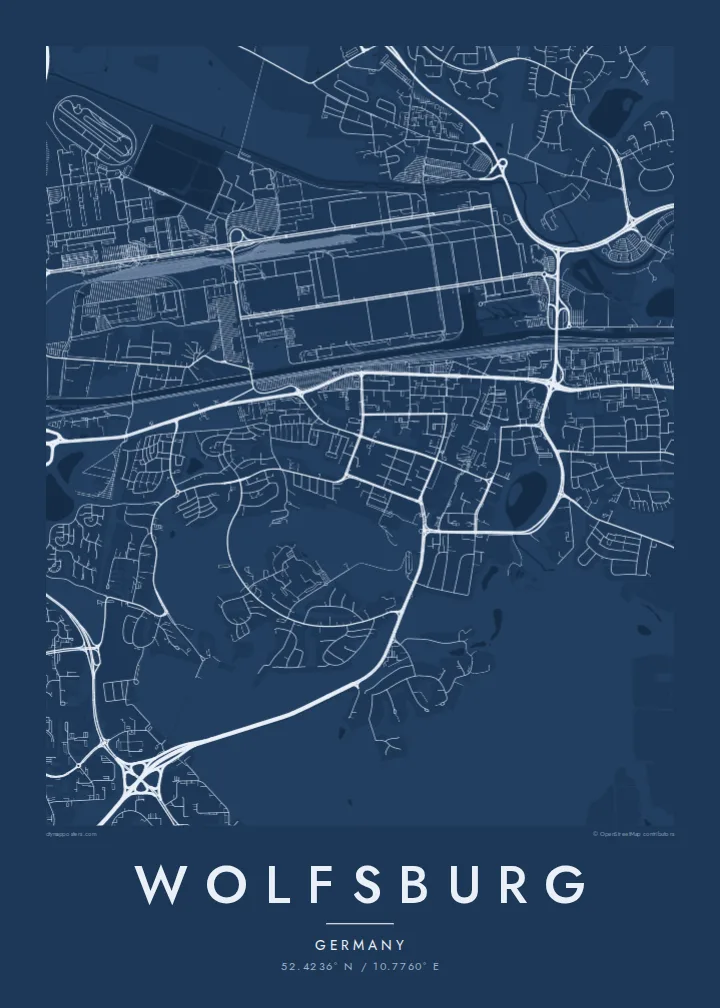
Wolfsburg was founded in 1938 as a new town for the Volkswagen works, and its map still reads like a plan rather than something that grew by accident. The Mittelland Canal cuts a straight line across the north of the town. The long factory complex sits on one bank and the town centre on the other, linked by bridges and by the railway station between them.
South of the canal, Porschestraße runs as the main axis of the centre. Residential districts spread outward in curving streets with generous green gaps between them, an echo of the garden-city ideas behind the original plan. The Aller and its meadows trace a softer line through the north, and Wolfsburg Castle, much older than the town itself, stands east of the centre.
Between the station and the canal stand two sites that give the centre a sharp outline from above: the Phaeno science centre designed by Zaha Hadid and, across the water, the Autostadt, Volkswagen's visitor park. A Wolfsburg map poster captures that unusual pairing of civic plan and industrial scale, with the canal holding the two halves together.
The canal crosses the city in a nearly straight line, separating the factory from the town and forming the strongest single stroke on the map.
The Volkswagen works stretch for kilometres along the northern bank, a vast rectangular footprint of halls and rail sidings that dwarfs the residential blocks around it.
The residential districts south of the centre follow curving streets, crescents and wide green strips, a deliberate contrast to the rigid geometry of the industrial zone across the canal.
Taute ke ha hau
Lafi e aho, taha higoa po ke taha kupu haau, hiki e fakatino, lahi po ke tuaga.
Ko e kitiaaga nakai totogi kua tote e maaliali mo e fakamailoga vai. Ko e tau lolomi mo e tau faila HD kua taute ke he 300 DPI, hokotia ke he 7,200 × 10,800 px, nakai fai fakamailoga vai.
Ko e ha Wolfsburg
Wolfsburg means something specific to people who have worked at the plant, followed the local football club or grown up in its green suburbs. This map shows how the town was drawn around industry, a story told entirely through lines.
Add a personal title or a date, such as the year you started at the works, and choose from Classic black & white, Noir, Paper, Blueprint and Sand. Download high-resolution files for $9, or have a matte print shipped, framed if you like.
Talaage e poster Wolfsburg| Lahi he lolomi | Maama | Tau faila |
|---|---|---|
| 30 × 40 cm11.8 × 15.7″ | 3,543 × 4,724 px | PNG · PDF |
| 29.7 × 42 cm (A3)11.7 × 16.5″ | 3,508 × 4,961 px | PNG · PDF |
| 42 × 59.4 cm (A2)16.5 × 23.4″ | 4,961 × 7,016 px | PNG · PDF |
| 45.7 × 61 cm18 × 24″ | 5,400 × 7,200 px | PNG · PDF |
| 50 × 70 cm19.7 × 27.6″ | 5,906 × 8,268 px | PNG · PDF |
| 61 × 91.4 cm24 × 36″ | 7,200 × 10,800 px | PNG · PDF |
Ke fakatatai, ko e fakatino noa kua 900 px e laulahi, fai fakamailoga mo e mo e tau mata komipiuta ni. Ko e tau faila HD kua ato hoko ke he 8× e maama ke he tau faahi takitaha mo e lolomi mitaki he lahi katoa he fakatino.
Fifili e taha puhala i luga he kupega, ti fifili e Poster Lolomi — e lahi mo e, kaeke ke manako ai koe, taha poloka — po ke Tau Faila HD Fakaeletonika. Ko e fakaotiaga totogi ko e taha gahua ni, ti ko e kupega he hau a talaaga ka fakafou fakahaga i mua he fakaotiaga e totogi.
Kua lolomi ai ke he pepa mitaki 200 gsm matte he taha he tau lahi ono, mai he 30 × 40 cm ke hoko ke he 24 × 36″. Kamata e tau poster lolomi mai he $39, kua putoia ai e utaaga.
E. Fifili e poloka akau malolō ke he lanu uli, tea, akau oki mooli, po ke akau pouli. Kua fakalataha mo e sioga malolō nakai malepe ti kua mautali ke tautau. Kamata e tau poster poloka mai he $99, kua putoia ai e utaaga.
Nakai totogi e fakafano ke he motu 60+. Ko e fakatino taha kua lolomi he fenoga lolomi ha mautolu kua tata mo e tau motu 30+, kua hoko mai he tau aho gahua 3–7. Maeke ia koe ke kikite e tuaga mo e fakamuitua he lalo he Haku Tau Fakatonu. Ke he falu motu kua 2–5 e tau tapu, ti ka nakai fakafano a mautolu ki ai, to fakaha he api tupe ia ki mua he totogi.
Fakafano mai e taha ata ki a mautolu he loto he 14 e tau aho tali mai he hokoaga, ti to lolomi foki e mautolu nakai totogi po ke liu atu e totogi ki a koe.
E. He editor i luga he kupega nei, hikihiki e matakupu, e matakupu lalo mo e laini coordinates ke he taha mena kua manako a koe ki ai, ti fifili e puhala mo e lahi. Ko e tau talaaga lolomi, poloka mo e fakaeletonika oti kua fakaaoga tonu e hau a fakatino.
Ma e $9 ka moua e koe e tau faila PNG 300 DPI mo e PDF kua mautali ke lolomi he tau lahi ono oti, nakai fai fakamailoga vai, ke lolomi i fe mena. Nakai maopoopo agaia? Utu hifo fakamua e kitiaaga nakai totogi ne fai fakamailoga vai.
Tata mai
