Historic centre
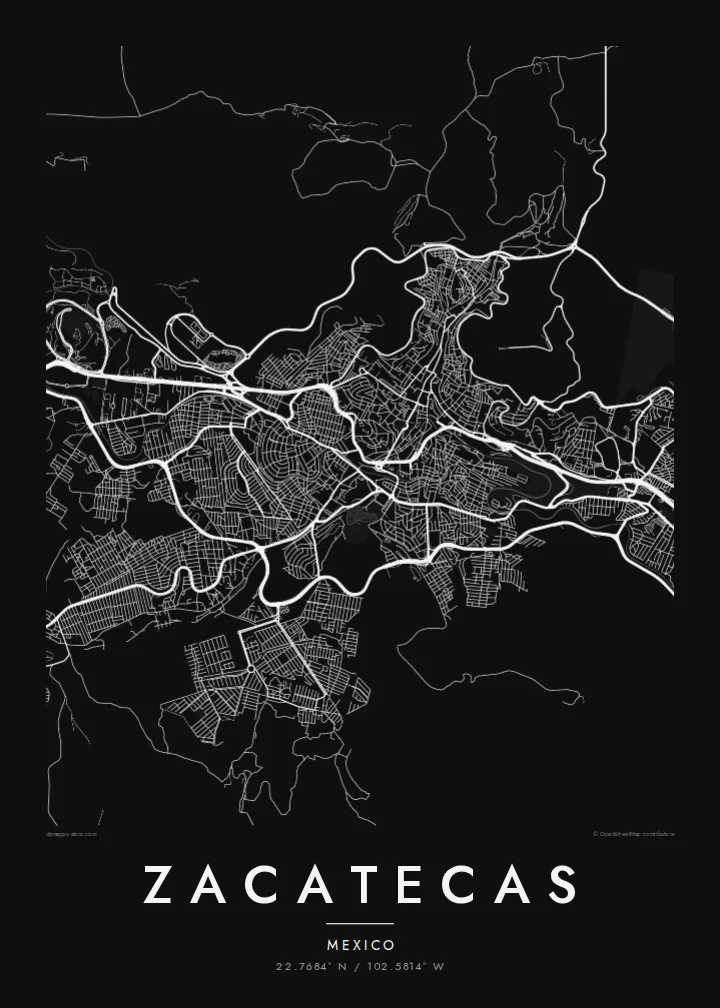
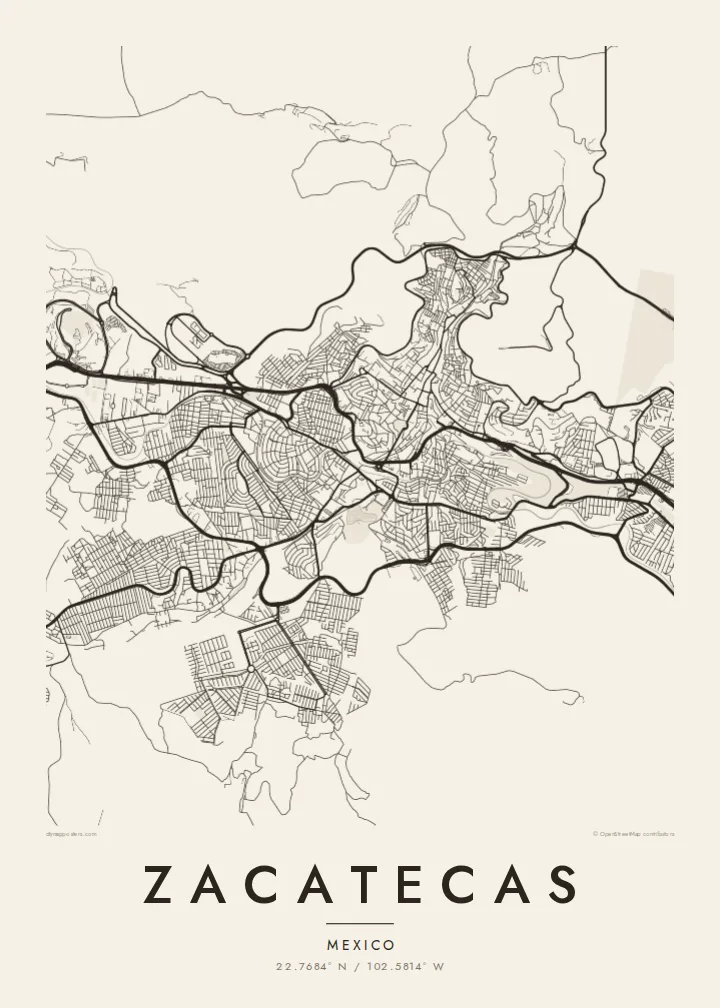
Irregular streets and small plazas cluster along the valley floor around the cathedral, an intricate pattern shaped by terrain rather than by any colonial grid plan.
Fakatino mape mukamuka · Mexico
22.7684° N / 102.5814° W
A silver-mining city squeezed into a narrow ravine, its streets winding between steep slopes beneath the rocky crest of La Bufa.



Taha e taone, lima e onoonoaga
Tapaki e taha puhala ke kitia ai ki luga he puipui. Kua tatai e totogi he tau puhala oti — pete he lolomi, poloka, po ke faila HD.
 Tau pikselo mooli · faila lolomi 24 × 36″
Maama mitaki ke lolomi
Ko e 100% e fahi mooli mai he faila lolomi. Ko e tau poster oti — pete kua lolomi, poloka, po ke utu hifo — kua taute ke he ha mautolu a tau tokoluga (server) ke he 300 DPI, hokotia ke he 7,200 × 10,800 piksela, ke maeke ai e tau ala ikiiki tote ke maaliali fakamitaki he lolomi 24 × 36″.
He Pā


Ko e mape
Zacatecas is built in a narrow ravine high in the mountains of north-central Mexico, at around 2,400 metres above sea level. On a map its historic centre has none of the neat grid of many colonial cities. Streets follow the fold of the valley, lanes and stairways climb the slopes on either side, and the city stretches in a long band between the hills.
The city grew from silver discovered in the sixteenth century and became one of the richest mining centres of New Spain. Its historic centre, with a cathedral carved in pink sandstone, is a UNESCO World Heritage Site. Above it rises the Cerro de la Bufa, connected to the Cerro del Grillo by a cable car that crosses the old town.
A Zacatecas map poster gives form to that unusual geography. The irregular streets of the centre gather into a dense knot, roads curve along the contours, and later districts spread out onto flatter land toward neighbouring Guadalupe. In monochrome the topography shows through the street pattern itself, making the city recognisable at a glance.
Irregular streets and small plazas cluster along the valley floor around the cathedral, an intricate pattern shaped by terrain rather than by any colonial grid plan.
The rocky hill east of the centre forms an open space in the street network, with roads curling up to the summit that gives the city its classic silhouette.
To the south-east, avenues lead toward the neighbouring city of Guadalupe, where the terrain opens and the street pattern becomes wider and more regular.
Taute ke ha hau
Lafi e aho, taha higoa po ke taha kupu haau, hiki e fakatino, lahi po ke tuaga.
Ko e kitiaaga nakai totogi kua tote e maaliali mo e fakamailoga vai. Ko e tau lolomi mo e tau faila HD kua taute ke he 300 DPI, hokotia ke he 7,200 × 10,800 px, nakai fai fakamailoga vai.
Ko e ha Zacatecas
Zacatecas is a city people remember in detail, from the climb to La Bufa to evenings in the old centre. A map of its streets suits former students, returning emigrants and travellers alike, and holds up well in a living room or office.
Personalise the title, the subtitle and the coordinates line with names or dates of your own. Five styles are available, Classic black & white, Noir, Paper, Blueprint and Sand, and each order includes six print sizes as 300 DPI PNG and PDF files.
Talaage e poster Zacatecas| Lahi he lolomi | Maama | Tau faila |
|---|---|---|
| 30 × 40 cm11.8 × 15.7″ | 3,543 × 4,724 px | PNG · PDF |
| 29.7 × 42 cm (A3)11.7 × 16.5″ | 3,508 × 4,961 px | PNG · PDF |
| 42 × 59.4 cm (A2)16.5 × 23.4″ | 4,961 × 7,016 px | PNG · PDF |
| 45.7 × 61 cm18 × 24″ | 5,400 × 7,200 px | PNG · PDF |
| 50 × 70 cm19.7 × 27.6″ | 5,906 × 8,268 px | PNG · PDF |
| 61 × 91.4 cm24 × 36″ | 7,200 × 10,800 px | PNG · PDF |
Ke fakatatai, ko e fakatino noa kua 900 px e laulahi, fai fakamailoga mo e mo e tau mata komipiuta ni. Ko e tau faila HD kua ato hoko ke he 8× e maama ke he tau faahi takitaha mo e lolomi mitaki he lahi katoa he fakatino.
Fifili e taha puhala i luga he kupega, ti fifili e Poster Lolomi — e lahi mo e, kaeke ke manako ai koe, taha poloka — po ke Tau Faila HD Fakaeletonika. Ko e fakaotiaga totogi ko e taha gahua ni, ti ko e kupega he hau a talaaga ka fakafou fakahaga i mua he fakaotiaga e totogi.
Kua lolomi ai ke he pepa mitaki 200 gsm matte he taha he tau lahi ono, mai he 30 × 40 cm ke hoko ke he 24 × 36″. Kamata e tau poster lolomi mai he $39, kua putoia ai e utaaga.
E. Fifili e poloka akau malolō ke he lanu uli, tea, akau oki mooli, po ke akau pouli. Kua fakalataha mo e sioga malolō nakai malepe ti kua mautali ke tautau. Kamata e tau poster poloka mai he $99, kua putoia ai e utaaga.
Nakai totogi e fakafano ke he motu 60+. Ko e fakatino taha kua lolomi he fenoga lolomi ha mautolu kua tata mo e tau motu 30+, kua hoko mai he tau aho gahua 3–7. Maeke ia koe ke kikite e tuaga mo e fakamuitua he lalo he Haku Tau Fakatonu. Ke he falu motu kua 2–5 e tau tapu, ti ka nakai fakafano a mautolu ki ai, to fakaha he api tupe ia ki mua he totogi.
Fakafano mai e taha ata ki a mautolu he loto he 14 e tau aho tali mai he hokoaga, ti to lolomi foki e mautolu nakai totogi po ke liu atu e totogi ki a koe.
E. He editor i luga he kupega nei, hikihiki e matakupu, e matakupu lalo mo e laini coordinates ke he taha mena kua manako a koe ki ai, ti fifili e puhala mo e lahi. Ko e tau talaaga lolomi, poloka mo e fakaeletonika oti kua fakaaoga tonu e hau a fakatino.
Ma e $9 ka moua e koe e tau faila PNG 300 DPI mo e PDF kua mautali ke lolomi he tau lahi ono oti, nakai fai fakamailoga vai, ke lolomi i fe mena. Nakai maopoopo agaia? Utu hifo fakamua e kitiaaga nakai totogi ne fai fakamailoga vai.
Tata mai
