Great Mosque
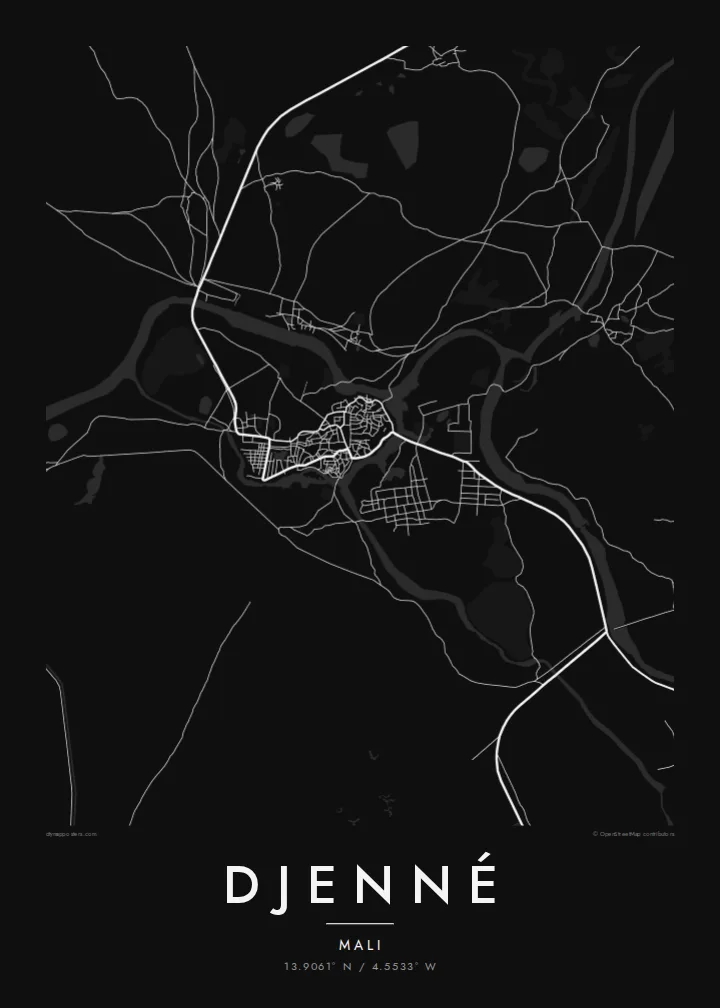
The mosque's broad rectangle and adjoining market square form the clearest landmark on the map, a calm geometric shape set within the dense fabric of the town.
Positala ya mapu yosavuta · Mali
13.9061° N / 4.5533° W
An ancient mud-brick town on a seasonal island in the Bani floodplain, its dense lanes gathered around the Great Mosque.



Mzinda umodzi, mawonekedwe asanu
Khudzani sitayelo kuti muwone pa khoma. Masitayelo onse amawononga ndalama zofanana — zosindikizidwa, zokutidwa mu chimango kapena ngati mafayilo a HD.
 Ma pixel enieni · fayilo yosindikiza 24 × 36″
Yowala posindikiza
Awa ndi chithunzi 100% chodulidwa cha fayilo yeniyeni yosindikiza. Poster iliyonse — yosindikizidwa, yokutidwa mu chimango kapena yotsitsidwa — imapangidwa pa maseva athu pa 300 DPI, mpaka ma pixel 7,200 × 10,800, choncho ngakhale misewu yaying'ono kwambiri imakhalabe yowoneka bwino pa kope la 24 × 36″.
Pakhoma


Mapu
Djenné stands in the inland delta of the Niger in central Mali, on land that becomes an island when the Bani river and its channels flood each year. The old town is a compact, rounded mass of houses and courtyards, built almost entirely of sun-dried mud brick. From above, it appears as a tightly packed maze of narrow lanes, with no clear grid and very little open space.
At its heart lies the Great Mosque, the largest mud-brick building in the world, rebuilt in its present form in 1907, and the square in front of it, where a weekly Monday market gathers traders from across the region. A Djenné map poster shows the mosque's large rectangular footprint as the one clear, regular form within the intricate web of lanes.
The old towns of Djenné, together with nearby archaeological sites such as Djenné-Djeno, are listed as a UNESCO World Heritage Site, and Djenné-Djeno is regarded as one of the oldest known urban sites in sub-Saharan Africa. Around the town, the floodplain spreads out in channels, marshes and fields that change with the seasons, giving the map an open, watery frame.
The mosque's broad rectangle and adjoining market square form the clearest landmark on the map, a calm geometric shape set within the dense fabric of the town.
Narrow lanes twist between courtyard houses, producing an intricate, irregular street pattern that fills the old town and reads as fine texture in black and white.
Channels of the Bani floodplain surround the town, isolating it during high water and giving the map its distinctive enclosed, island-like outline.
Ipangeni yanu
Onjezani tsiku, dzina kapena mawu anu, sinthani mawonekedwe, kukula kapena momwe yaimira.
Chitsanzo chaulere ndi chotsika mu resolution ndipo chili ndi chizindikiro chothira madzi. Zosindikizidwa ndi mafayilo a HD zimapangidwa pa 300 DPI, mpaka ma px 7,200 × 10,800, popanda chizindikiro chothira madzi.
Chifukwa chiyani Djenné
Djenné is one of the most recognisable towns in West Africa, and its plan carries many centuries of continuous settlement. For those who have visited, studied its architecture, or have roots in the Mopti region, a map of its lanes and waters is a meaningful piece.
The title, subtitle and coordinates can be personalised, so the poster can mark a journey, a research trip or a family connection. Choose Classic black & white, Noir, Paper, Blueprint or Sand, and download it for $9 or order a matte print.
Odara poster ya Djenné| Kukula kosindikiza | Mphamvu ya chithunzi | Mafayilo |
|---|---|---|
| 30 × 40 cm (11.8 × 15.7″) | 3,543 × 4,724 px | PNG · PDF |
| 29.7 × 42 cm (A3, 11.7 × 16.5″) | 3,508 × 4,961 px | PNG · PDF |
| 42 × 59.4 cm (A2, 16.5 × 23.4″) | 4,961 × 7,016 px | PNG · PDF |
| 45.7 × 61 cm (18 × 24″) | 5,400 × 7,200 px | PNG · PDF |
| 50 × 70 cm (19.7 × 27.6″) | 5,906 × 8,268 px | PNG · PDF |
| 61 × 91.4 cm (24 × 36″) | 7,200 × 10,800 px | PNG · PDF |
Poyerekeza, chithunzi chaulere ndi cha 900 px m'lifupi, chili ndi chizindikiro ndipo ndi cha pa sikirini. Mafayilo a HD ali ndi mphamvu yochulukira mpaka 8× mbali iliyonse ndipo amasindikizika bwino pa kukula konse kwa positala.
Sankhani sitayelo kumtunda kwa tsamba, kenako musankhe Poster Yosindikizidwa — kukula ndi, mukafuna, chimango — kapena Mafayilo a Digital HD. Kulipira kumatenga sitepe imodzi, ndipo tsamba la oda yanu limasinthidwa nthawi yomweyo pambuyo pa kulipira.
Imasindikizidwa pa pepala labwino la matte la 200 gsm mu kukula kumodzi mwa zisanu ndi chimodzi, kuyambira 30 × 40 cm mpaka 24 × 36″. Maposita osindikizidwa amayamba pa $39, kutumiza kuphatikizidwa.
Inde. Sankhani chimango cha mtengo wolimba mu utoto wakuda, woyera, oak wachilengedwe kapena mtengo wakuda. Chimabwera ndi galasi losathyoka ndipo chikonzekera kupachikidwa nthawi yomweyo. Maposita a mu chimango amayamba pa $99, kutumiza kuphatikizidwa.
Kutumiza ndi kwaulere padziko lonse lapansi. Positala iliyonse imasindikizidwa ndi mnzathu wosindikiza wapafupi kwambiri mwa anzathu m'maiko opitirira 30 ndipo nthawi zambiri imafika m'masiku antchito 3–7. Mukhoza kuona momwe zilili ndi kutsata positalayo pa Maoda Anga. Maiko ena amatenga masabata 2–5, ndipo kumene sitinayambe kutumiza, tsambali limakuuzani musanalipire.
Titumizireni chithunzi masiku 14 kuchokera pa tsiku la kutumiza ndipo tidzaisindikizanso kwaulere kapena kukubwezerani ndalama zanu.
Inde. Mu chida chokonzera pa tsambali, sinthani mutu, mutu wowonjezera ndi mzere wa ma coordinates kukhala chilichonse chomwe mufuna, ndipo sankhani sitayelo ndi kukula. Maoda osindikizidwa, a mu chimango ndi a digital onse amagwiritsa ntchito kapangidwe kanu enieni.
Pa $9 mumalandira mafayilo a PNG a 300 DPI ndi PDF okonzeka kusindikiza mu kukula konse kwa zisanu ndi chimodzi, popanda chizindikiro chothira madzi, kuti musindikize kulikonse. Simunatsimikize? Tsitsani kaye chitsanzo chaulere chokhala ndi chizindikiro chothira madzi.
Pafupi
