A refugee-era grid
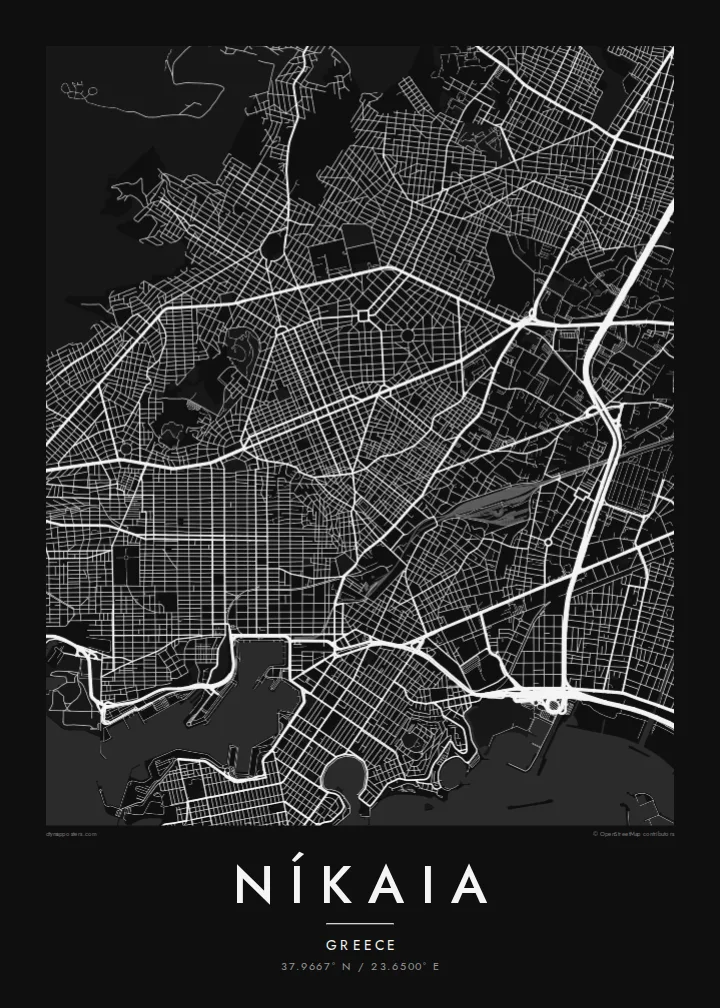
The neighbourhoods laid out for Asia Minor refugees in the 1920s give Níkaia a tight, regular street pattern that stands apart from the looser, older layouts elsewhere in Attica.
Positala ya mapu yosavuta · Greece
37.9667° N / 23.6500° E
A dense, gridded refugee suburb pressed between Piraeus and the Aigaleo hills, its blocks packed tight against the port city.



Mzinda umodzi, mawonekedwe asanu
Khudzani sitayelo kuti muwone pa khoma. Masitayelo onse amawononga ndalama zofanana — zosindikizidwa, zokutidwa mu chimango kapena ngati mafayilo a HD.
 Ma pixel enieni · fayilo yosindikiza 24 × 36″
Yowala posindikiza
Awa ndi chithunzi 100% chodulidwa cha fayilo yeniyeni yosindikiza. Poster iliyonse — yosindikizidwa, yokutidwa mu chimango kapena yotsitsidwa — imapangidwa pa maseva athu pa 300 DPI, mpaka ma pixel 7,200 × 10,800, choncho ngakhale misewu yaying'ono kwambiri imakhalabe yowoneka bwino pa kope la 24 × 36″.
Pakhoma


Mapu
Níkaia sits just inland of Piraeus, in the western part of the Athens basin. From above it reads as one of the densest pieces of the whole conurbation: short blocks, narrow streets and very few gaps, running uphill from the flat land near the port toward the lower slopes of the Aigaleo range. Its edges with its neighbours are hard to see on the ground, and on a map they vanish entirely.
The town was built in the 1920s by refugees from Asia Minor after 1922, and it takes its name from Nicaea, the Anatolian city now called İznik. That origin still shows in the plan. The streets are more regular than in older Attic towns and were laid out quickly to house a large population, so the grid is tighter and more even than the hillside would suggest.
A Níkaia map poster shows a place defined by density rather than by monuments. The ink is heaviest in the residential core, lighter where arterial roads cut through toward Piraeus and central Athens, and it thins out on the rising ground to the north. It suits anyone with family roots in the Asia Minor diaspora, or anyone who grew up on these crowded, orderly streets.
The neighbourhoods laid out for Asia Minor refugees in the 1920s give Níkaia a tight, regular street pattern that stands apart from the looser, older layouts elsewhere in Attica.
To the south, the town's blocks run straight into Piraeus with no visible break, which makes it clear on paper how closely Níkaia is tied to the port.
Toward the Aigaleo slopes the grid loosens and the streets start to follow the contours, a gentle change in texture you can see across the upper part of the frame.
Ipangeni yanu
Onjezani tsiku, dzina kapena mawu anu, sinthani mawonekedwe, kukula kapena momwe yaimira.
Chitsanzo chaulere ndi chotsika mu resolution ndipo chili ndi chizindikiro chothira madzi. Zosindikizidwa ndi mafayilo a HD zimapangidwa pa 300 DPI, mpaka ma px 7,200 × 10,800, popanda chizindikiro chothira madzi.
Chifukwa chiyani Níkaia
People hang Níkaia for the story it carries: a town built from nothing by displaced families, named after a city they had left behind. For descendants of those refugees, the map is a quiet record of where a family started over.
You can personalise the title, subtitle and coordinates line, for example with a family name or the year someone arrived, and choose from five styles: Classic black & white, Noir, Paper, Blueprint or Sand. It is available as a $9 HD digital file or as a printed poster.
Odara poster ya Níkaia| Kukula kosindikiza | Mphamvu ya chithunzi | Mafayilo |
|---|---|---|
| 30 × 40 cm11.8 × 15.7″ | 3,543 × 4,724 px | PNG · PDF |
| 29.7 × 42 cm (A3)11.7 × 16.5″ | 3,508 × 4,961 px | PNG · PDF |
| 42 × 59.4 cm (A2)16.5 × 23.4″ | 4,961 × 7,016 px | PNG · PDF |
| 45.7 × 61 cm18 × 24″ | 5,400 × 7,200 px | PNG · PDF |
| 50 × 70 cm19.7 × 27.6″ | 5,906 × 8,268 px | PNG · PDF |
| 61 × 91.4 cm24 × 36″ | 7,200 × 10,800 px | PNG · PDF |
Poyerekeza, chithunzi chaulere ndi cha 900 px m'lifupi, chili ndi chizindikiro ndipo ndi cha pa sikirini. Mafayilo a HD ali ndi mphamvu yochulukira mpaka 8× mbali iliyonse ndipo amasindikizika bwino pa kukula konse kwa positala.
Sankhani sitayelo kumtunda kwa tsamba, kenako musankhe Poster Yosindikizidwa — kukula ndi, mukafuna, chimango — kapena Mafayilo a Digital HD. Kulipira kumatenga sitepe imodzi, ndipo tsamba la oda yanu limasinthidwa nthawi yomweyo pambuyo pa kulipira.
Imasindikizidwa pa pepala labwino la matte la 200 gsm mu kukula kumodzi mwa zisanu ndi chimodzi, kuyambira 30 × 40 cm mpaka 24 × 36″. Maposita osindikizidwa amayamba pa $39, kutumiza kuphatikizidwa.
Inde. Sankhani chimango cha mtengo wolimba mu utoto wakuda, woyera, oak wachilengedwe kapena mtengo wakuda. Chimabwera ndi galasi losathyoka ndipo chikonzekera kupachikidwa nthawi yomweyo. Maposita a mu chimango amayamba pa $99, kutumiza kuphatikizidwa.
Kutumiza ndi kwaulere kumayiko oposa 60. Positala iliyonse imasindikizidwa ndi mnzathu wosindikiza wapafupi kwambiri mwa anzathu m'mayiko oposa 30, ndipo nthawi zambiri imafika m'masiku 3–7 antchito. Mukhoza kutsatira momwe oda ilili ndi malo ake pa "Maoda Anga". Mayiko ena amatenga masabata 2–5, ndipo kumene sitinayambe kutumiza, tsambali likuuzani musanalipire.
Titumizireni chithunzi masiku 14 kuchokera pa tsiku la kutumiza ndipo tidzaisindikizanso kwaulere kapena kukubwezerani ndalama zanu.
Inde. Mu chida chokonzera pa tsambali, sinthani mutu, mutu wowonjezera ndi mzere wa ma coordinates kukhala chilichonse chomwe mufuna, ndipo sankhani sitayelo ndi kukula. Maoda osindikizidwa, a mu chimango ndi a digital onse amagwiritsa ntchito kapangidwe kanu enieni.
Pa $9 mumalandira mafayilo a PNG a 300 DPI ndi PDF okonzeka kusindikiza mu kukula konse kwa zisanu ndi chimodzi, popanda chizindikiro chothira madzi, kuti musindikize kulikonse. Simunatsimikize? Tsitsani kaye chitsanzo chaulere chokhala ndi chizindikiro chothira madzi.
Pafupi
