Former lakeshore
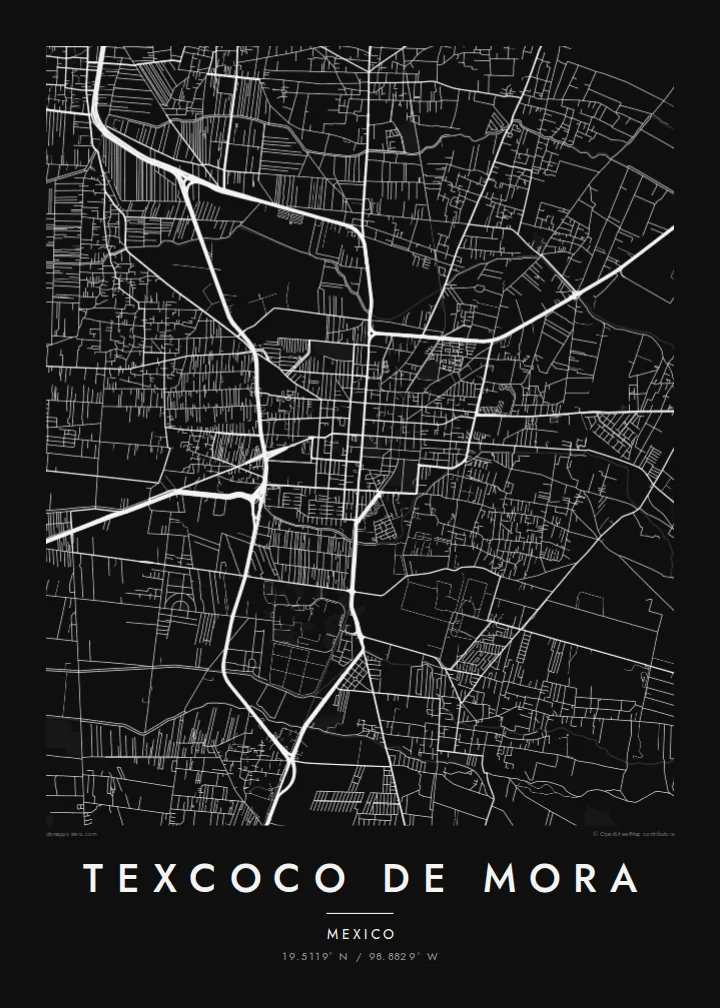
West of town the street network thins into the flat bed of Lake Texcoco. That empty band on the map traces the old waterline the city grew along.
Positala ya mapu yosavuta · Mexico
19.5119° N / 98.8829° W
A dense colonial grid on the old eastern shore of Lake Texcoco, with the dry lakebed flat to the west and hills rising to the east.

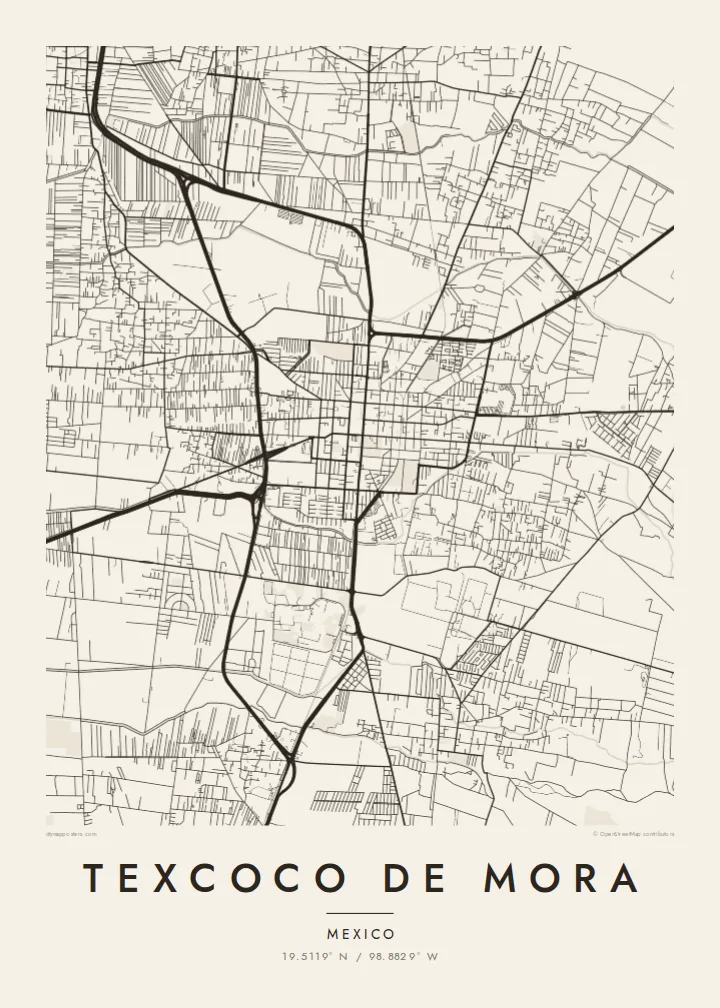

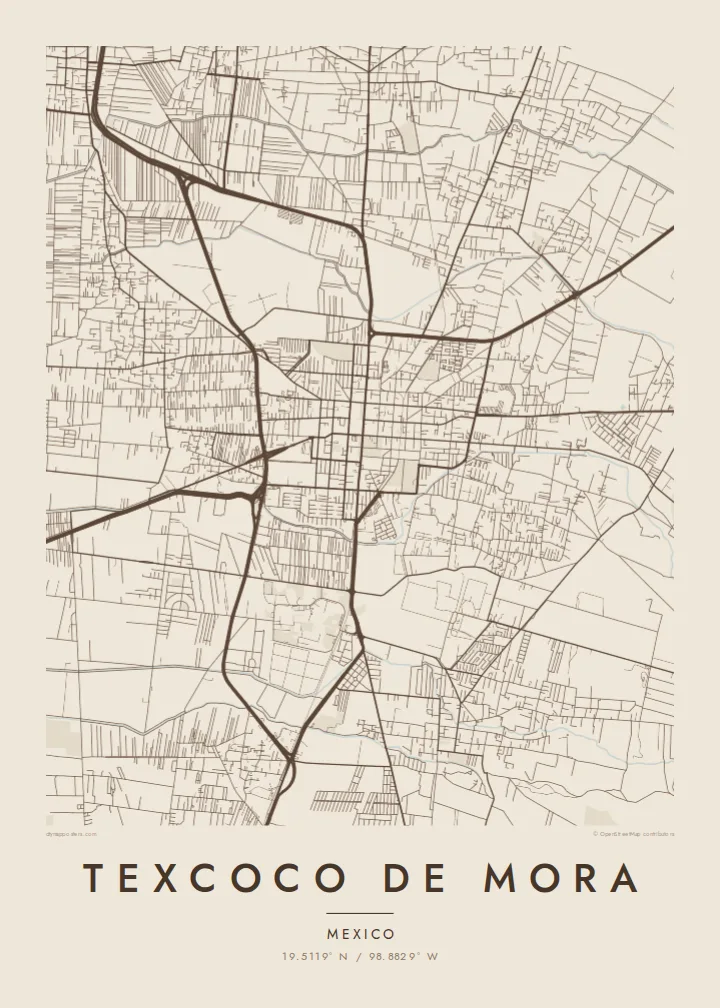
Mzinda umodzi, mawonekedwe asanu
Khudzani sitayelo kuti muwone pa khoma. Masitayelo onse amawononga ndalama zofanana — zosindikizidwa, zokutidwa mu chimango kapena ngati mafayilo a HD.
 Ma pixel enieni · fayilo yosindikiza 24 × 36″
Yowala posindikiza
Awa ndi chithunzi 100% chodulidwa cha fayilo yeniyeni yosindikiza. Poster iliyonse — yosindikizidwa, yokutidwa mu chimango kapena yotsitsidwa — imapangidwa pa maseva athu pa 300 DPI, mpaka ma pixel 7,200 × 10,800, choncho ngakhale misewu yaying'ono kwambiri imakhalabe yowoneka bwino pa kope la 24 × 36″.
Pakhoma


Mapu
Texcoco de Mora sits where the land starts to rise out of the Valley of Mexico. On a map the western edge is plain and open: this is the bed of the lake that once separated the town from Tenochtitlan. The town centre is a compact grid of short blocks around a main square. Past it, the streets loosen into irregular neighbourhoods that climb gently toward the Sierra Nevada foothills.
Before the Spanish conquest, Texcoco was one of the three cities of the Aztec Triple Alliance, alongside Tenochtitlan and Tlacopan. Its fifteenth-century ruler Nezahualcóyotl is still remembered as a poet and builder of waterworks. None of that shows as monumental geometry on the street plan, yet the town's position makes sense once you see the old shoreline and the long gap between it and Mexico City.
A Texcoco de Mora map poster sets the tidy colonial blocks against the looser growth around them. Highways and rail lines run out toward the capital, and the green fields of the Chapingo area lie to the south. In monochrome the drained lake reads as a quiet field of white. It frames the town the way the water once did.
West of town the street network thins into the flat bed of Lake Texcoco. That empty band on the map traces the old waterline the city grew along.
A regular grid of small blocks around the central plaza and cathedral forms the densest part of the poster. The pattern is easy to recognise from any distance.
The grounds of the agricultural university at Chapingo, known for Diego Rivera's murals, show up as a larger, more open parcel among the southern streets.
Ipangeni yanu
Onjezani tsiku, dzina kapena mawu anu, sinthani mawonekedwe, kukula kapena momwe yaimira.
Chitsanzo chaulere ndi chotsika mu resolution ndipo chili ndi chizindikiro chothira madzi. Zosindikizidwa ndi mafayilo a HD zimapangidwa pa 300 DPI, mpaka ma px 7,200 × 10,800, popanda chizindikiro chothira madzi.
Chifukwa chiyani Texcoco de Mora
For families with roots in the eastern Valley of Mexico, or anyone drawn to its pre-Hispanic past, this map puts Texcoco back in its setting between the old lake and the mountains. It is a plain, readable portrait of a place with deep layers.
You can add your own title, subtitle and coordinates line, for example a family name or a date that matters. Choose from Classic black & white, Noir, Paper, Blueprint or Sand. The poster comes as a $9 digital download or as a printed poster, framed if you like.
Odara poster ya Texcoco de Mora| Kukula kosindikiza | Mphamvu ya chithunzi | Mafayilo |
|---|---|---|
| 30 × 40 cm11.8 × 15.7″ | 3,543 × 4,724 px | PNG · PDF |
| 29.7 × 42 cm (A3)11.7 × 16.5″ | 3,508 × 4,961 px | PNG · PDF |
| 42 × 59.4 cm (A2)16.5 × 23.4″ | 4,961 × 7,016 px | PNG · PDF |
| 45.7 × 61 cm18 × 24″ | 5,400 × 7,200 px | PNG · PDF |
| 50 × 70 cm19.7 × 27.6″ | 5,906 × 8,268 px | PNG · PDF |
| 61 × 91.4 cm24 × 36″ | 7,200 × 10,800 px | PNG · PDF |
Poyerekeza, chithunzi chaulere ndi cha 900 px m'lifupi, chili ndi chizindikiro ndipo ndi cha pa sikirini. Mafayilo a HD ali ndi mphamvu yochulukira mpaka 8× mbali iliyonse ndipo amasindikizika bwino pa kukula konse kwa positala.
Sankhani sitayelo kumtunda kwa tsamba, kenako musankhe Poster Yosindikizidwa — kukula ndi, mukafuna, chimango — kapena Mafayilo a Digital HD. Kulipira kumatenga sitepe imodzi, ndipo tsamba la oda yanu limasinthidwa nthawi yomweyo pambuyo pa kulipira.
Imasindikizidwa pa pepala labwino la matte la 200 gsm mu kukula kumodzi mwa zisanu ndi chimodzi, kuyambira 30 × 40 cm mpaka 24 × 36″. Maposita osindikizidwa amayamba pa $39, kutumiza kuphatikizidwa.
Inde. Sankhani chimango cha mtengo wolimba mu utoto wakuda, woyera, oak wachilengedwe kapena mtengo wakuda. Chimabwera ndi galasi losathyoka ndipo chikonzekera kupachikidwa nthawi yomweyo. Maposita a mu chimango amayamba pa $99, kutumiza kuphatikizidwa.
Kutumiza ndi kwaulere kumayiko oposa 60. Positala iliyonse imasindikizidwa ndi mnzathu wosindikiza wapafupi kwambiri mwa anzathu m'mayiko oposa 30, ndipo nthawi zambiri imafika m'masiku 3–7 antchito. Mukhoza kutsatira momwe oda ilili ndi malo ake pa "Maoda Anga". Mayiko ena amatenga masabata 2–5, ndipo kumene sitinayambe kutumiza, tsambali likuuzani musanalipire.
Titumizireni chithunzi masiku 14 kuchokera pa tsiku la kutumiza ndipo tidzaisindikizanso kwaulere kapena kukubwezerani ndalama zanu.
Inde. Mu chida chokonzera pa tsambali, sinthani mutu, mutu wowonjezera ndi mzere wa ma coordinates kukhala chilichonse chomwe mufuna, ndipo sankhani sitayelo ndi kukula. Maoda osindikizidwa, a mu chimango ndi a digital onse amagwiritsa ntchito kapangidwe kanu enieni.
Pa $9 mumalandira mafayilo a PNG a 300 DPI ndi PDF okonzeka kusindikiza mu kukula konse kwa zisanu ndi chimodzi, popanda chizindikiro chothira madzi, kuti musindikize kulikonse. Simunatsimikize? Tsitsani kaye chitsanzo chaulere chokhala ndi chizindikiro chothira madzi.
Pafupi
