A refugee-era grid
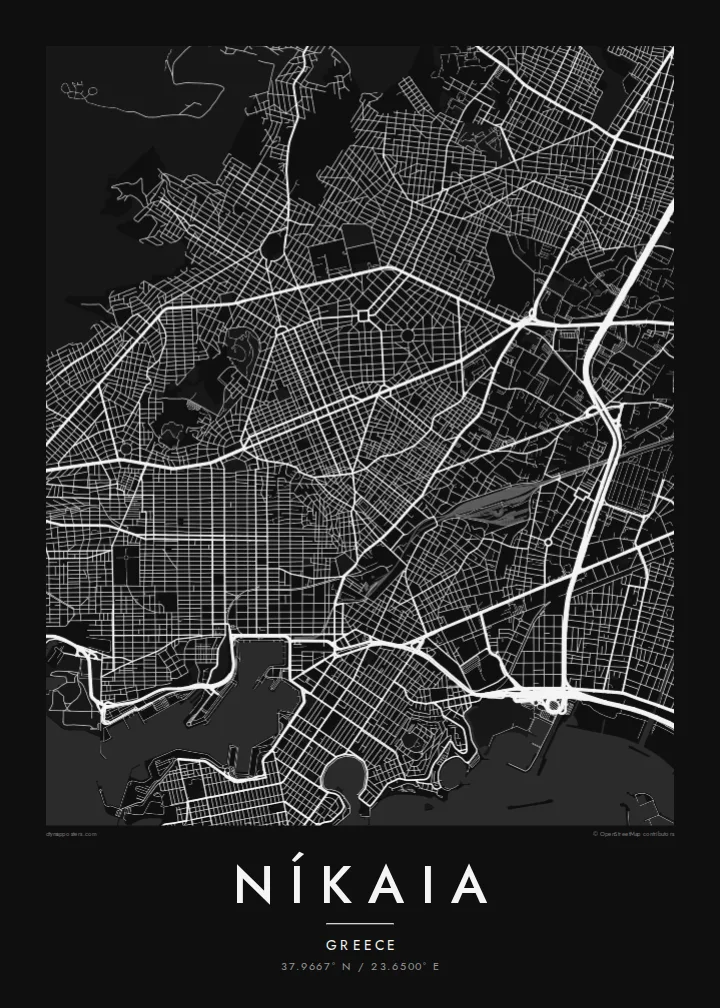
The neighbourhoods laid out for Asia Minor refugees in the 1920s give Níkaia a tight, regular street pattern that stands apart from the looser, older layouts elsewhere in Attica.
Ipositeri y'ikarita yoroheje · GR
37.9667° N / 23.6500° E
A dense, gridded refugee suburb pressed between Piraeus and the Aigaleo hills, its blocks packed tight against the port city.



Umujyi umwe, imiterere itanu
Kanda uburyo bumwe kugira ngo ubibone ku rukuta. Buri buryo bufite igiciro kimwe — cyacapwe, gishyizwemo cadre cyangwa mu madosiye HD.
 Pikiseli nyakuri · Dosiye yo gucapa ya 24 × 36″
Bisobanutse neza iyo bicapwe
Iki ni igice cya 100% cy'idosiye nyayo yo gucapa. Buri poster — yacapwe, ishyizwemo cadre cyangwa yakuwe kuri interineti — ikorwa kuri seriveri zacu ku 300 DPI, kugeza kuri pikiseli 7,200 × 10,800, bityo n'imihanda mito cyane igumana ubwiza ku gucapa kwa 24 × 36″.
Ku rukuta


Ikarita
Níkaia sits just inland of Piraeus, in the western part of the Athens basin. From above it reads as one of the densest pieces of the whole conurbation: short blocks, narrow streets and very few gaps, running uphill from the flat land near the port toward the lower slopes of the Aigaleo range. Its edges with its neighbours are hard to see on the ground, and on a map they vanish entirely.
The town was built in the 1920s by refugees from Asia Minor after 1922, and it takes its name from Nicaea, the Anatolian city now called İznik. That origin still shows in the plan. The streets are more regular than in older Attic towns and were laid out quickly to house a large population, so the grid is tighter and more even than the hillside would suggest.
A Níkaia map poster shows a place defined by density rather than by monuments. The ink is heaviest in the residential core, lighter where arterial roads cut through toward Piraeus and central Athens, and it thins out on the rising ground to the north. It suits anyone with family roots in the Asia Minor diaspora, or anyone who grew up on these crowded, orderly streets.
The neighbourhoods laid out for Asia Minor refugees in the 1920s give Níkaia a tight, regular street pattern that stands apart from the looser, older layouts elsewhere in Attica.
To the south, the town's blocks run straight into Piraeus with no visible break, which makes it clear on paper how closely Níkaia is tied to the port.
Toward the Aigaleo slopes the grid loosens and the streets start to follow the contours, a gentle change in texture you can see across the upper part of the frame.
Yigire iyawe
Ongeraho itariki, izina cyangwa interuro yawe, uhindure imiterere, ingano cyangwa icyerekezo.
Urugero rw'ubuntu rufite ubwiza buke kandi rufite ikimenyetso cy'amazi. Poster zacapwe n'amadosiye ya HD bikorwa ku 300 DPI, kugeza kuri 7,200 × 10,800 px, nta kimenyetso cy'amazi.
Kuki Níkaia
People hang Níkaia for the story it carries: a town built from nothing by displaced families, named after a city they had left behind. For descendants of those refugees, the map is a quiet record of where a family started over.
You can personalise the title, subtitle and coordinates line, for example with a family name or the year someone arrived, and choose from five styles: Classic black & white, Noir, Paper, Blueprint or Sand. It is available as a $9 HD digital file or as a printed poster.
Tumiza poster ya Níkaia| Ingano yo gucapa | Ubwiza bw'ifoto | Amadosiye |
|---|---|---|
| 30 × 40 cm11.8 × 15.7″ | 3,543 × 4,724 px | PNG · PDF |
| 29.7 × 42 cm (A3)11.7 × 16.5″ | 3,508 × 4,961 px | PNG · PDF |
| 42 × 59.4 cm (A2)16.5 × 23.4″ | 4,961 × 7,016 px | PNG · PDF |
| 45.7 × 61 cm18 × 24″ | 5,400 × 7,200 px | PNG · PDF |
| 50 × 70 cm19.7 × 27.6″ | 5,906 × 8,268 px | PNG · PDF |
| 61 × 91.4 cm24 × 36″ | 7,200 × 10,800 px | PNG · PDF |
Ugereranyije, igerageza ry'ubuntu rifite ubugari bwa 900 px, ririho ikirango kandi ryagenewe kurebwa kuri ecran. Amadosiye ya HD afite ubwiza bugera kuri 8× kuri buri ruhande kandi acapwa neza ku ngano yuzuye y'ipositeri.
Hitamo uburyo hejuru y'urupapuro, hanyuma uhitemo Poster Yacapwe — ingano n'niba ubishaka, cadre — cyangwa Amadosiye ya Digital HD. Kwishyura bikorwa mu ntambwe imwe, kandi urupapuro rw'ikurikirana ry'ibyo watumije ruvugururwa vuba nyuma yo kwishyura.
Icapwa ku rupapuro rwa mbere rwa 200 gsm rutagaragaza umucyo, mu ngano imwe muri esheshatu, kuva kuri 30 × 40 cm kugeza kuri 24 × 36″. Poster zacapwe zitangirira kuri $39, harimo no kohereza.
Yego. Hitamo cadre y'igiti gikomeye mu ibara ry'umukara, umweru, oak isanzwe cyangwa igiti cyijimye. Iza n'ikirahure kidacika kandi yiteguye kumanikwa. Poster zifite cadre zitangirira kuri $99, harimo no kohereza.
Kohereza ni ubuntu mu bihugu 60+. Buri cyapa gicapirwa n'umufatanyabikorwa wacu wa hafi mu bihugu 30+ dukorana mu gucapa, kandi gisanzwe kigera mu minsi y'akazi 3–7. Ushobora gukurikirana uko giteye n'aho kigeze muri «Ibyo naguze». Ibihugu bimwe bifata ibyumweru 2–5, kandi aho tutarahagera, urubuga rukubwira mbere y'uko wishyura.
Twoherereze ifoto mu minsi 14 ikurikira igihe cyo kuyakira, kandi tuzayicapa bundi bushya ku buntu cyangwa tukagusubiza amafaranga.
Yego. Muri editor iri kuri uru rupapuro, hindura umutwe, ikirongo cy'inyongera n'umurongo w'ibipimo ukagira icyo ushaka, hanyuma ugahitamo uburyo n'ingano. Amatumizo yacapwe, afite cadre n'aya digital yose akoresha ishushanyo ryawe nk'uko ryifashe.
Ku $9 ubona amadosiye ya PNG ya 300 DPI n'aya PDF yiteguye gucapwa mu ngano zose esheshatu, nta kimenyetso cy'amazi, ushobora gucapa aho ariho hose. Ntucyemeje? Banza umanure urugero rw'ubuntu rufite ikimenyetso cy'amazi.
Hafi aho
