The Acari River
The river crosses the neighbourhood in a mostly straightened channel. It gives the map a clear dividing line and explains the name the district carries.
Posta faʻafanua faigofie · Brazil
22.8246° S / 43.3414° W
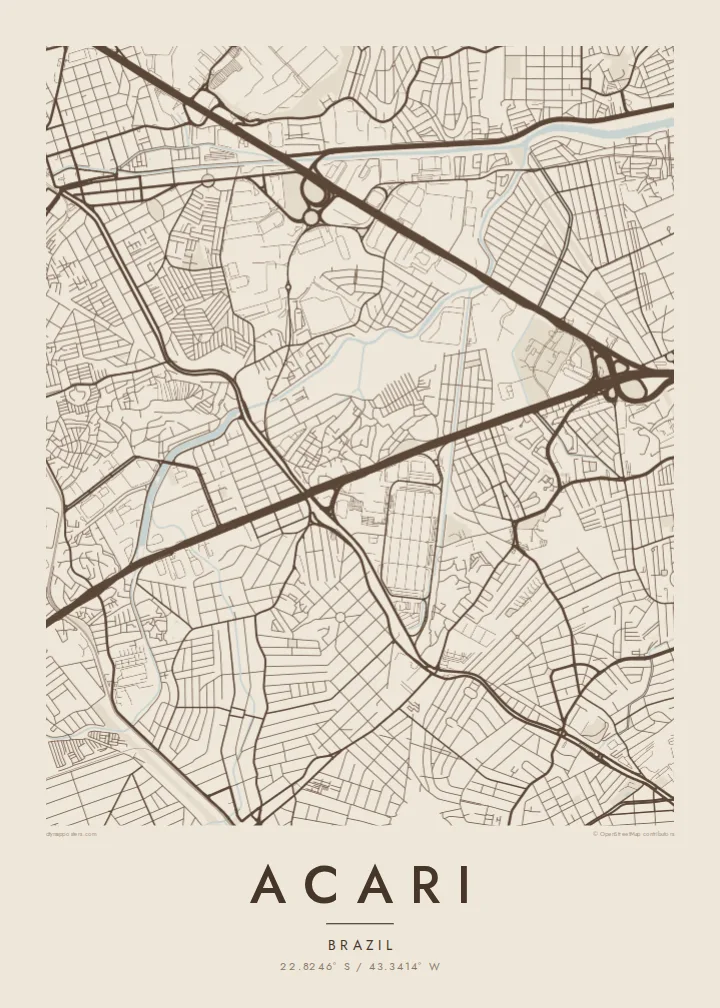
A dense neighbourhood in Rio's North Zone, its tight blocks divided by the Acari River and edged by a long metro corridor.


Tasi le aai, lagona e lima
Tapi se sitaili e vaai ai i luga o le puipui. E tutusa uma le tau o sitaili — pe lolomiina, faapipiiina, pe avea ma faila HD.
 Pika Moni · Faila Lolomi 24 × 36″
Manino mo le lolomi
O se vaega atoa (100%) lenei mai le faila lolomi moni. O posita uma — pe lolomiina, faapipiiina pe download mai — e faia i luga o a matou server i le 300 DPI, e oo atu i le 7,200 × 10,800 pika, ina ia manino pea auala laiti i luga o se lolomiga 24 × 36″.
I luga o le puipui


Le faʻafanua
Acari is a neighbourhood in the North Zone of Rio de Janeiro, far from the beaches that usually represent the city. It takes its name from the Acari River, which runs through the area in a largely channelled course on its way toward Guanabara Bay. On the map the river is one of the few long, continuous lines in a closely packed urban fabric.
The streets here are short and irregular, with small blocks and narrow passages filling nearly every available space. Metro Line 2 runs along the edge of the neighbourhood, with a station serving Acari, and the surrounding districts continue in every direction at the same density. From above it reads as a patch of fine grain, very different from the open grids of the southern districts.
An Acari map poster is a portrait of Rio as most of its residents know it: residential, dense and shaped by water channels and transport lines rather than by postcard views. In black and white the river, the rail corridor and the tightly packed blocks form a strong, textured composition that anyone who has lived there will recognise.
The river crosses the neighbourhood in a mostly straightened channel. It gives the map a clear dividing line and explains the name the district carries.
A station on Rio's Line 2 serves Acari, and the line's long corridor forms a firm straight edge that ties the neighbourhood to the rest of the city.
Small, irregular blocks and narrow passages fill the area, producing the dense, almost woven texture that makes Rio's North Zone so distinctive on paper.
Fai mo oe
Faʻaopoopo se aso, se igoa po o sau lava upu, sui le sitaili, lapoʻa po o le itu.
O le preview e leai se totogi e maualalo le resolution ma iai se watermark. O lolomi ma faila HD e faia i le 300 DPI, e oo atu i le 7,200 × 10,800 px, e aunoa ma se watermark.
Aisea Acari
Most images of Rio show the coast. A map of Acari shows home for the people who actually live in the North Zone, and it can be a meaningful gift for someone who grew up there and has since moved away.
Set your own title and subtitle, in Portuguese if you like, adjust the coordinates line, and pick Classic black & white, Noir, Paper, Blueprint or Sand. You can download a free watermarked preview first, then buy the HD files for $9.
Faatau le posita Acari| Lapoʻa lolomi | Manino | Faila |
|---|---|---|
| 30 × 40 cm (11.8 × 15.7″) | 3,543 × 4,724 px | PNG · PDF |
| 29.7 × 42 cm (A3, 11.7 × 16.5″) | 3,508 × 4,961 px | PNG · PDF |
| 42 × 59.4 cm (A2, 16.5 × 23.4″) | 4,961 × 7,016 px | PNG · PDF |
| 45.7 × 61 cm (18 × 24″) | 5,400 × 7,200 px | PNG · PDF |
| 50 × 70 cm (19.7 × 27.6″) | 5,906 × 8,268 px | PNG · PDF |
| 61 × 91.4 cm (24 × 36″) | 7,200 × 10,800 px | PNG · PDF |
Ae faʻatusatusa, o le faʻataʻitaʻiga e leai se totogi e 900 px le lautele, e iai le faʻailoga vai ma e mo mata. O faila HD e oʻo atu i le 8× le manino i itu taʻitasi ma e lolomi manino i le lapoʻa atoa o le posta.
Filifili se sitaili i le pito i luga o le itulau, ona filifili lea o le Posita Lolomi — se lapopoa ma, afai e te fiafia, se faavaa — po o Faila HD Numera. E na o le tasi laasaga o le Checkout, ma o le a fesuia'i lou itulau o oka i le taimi lava e mae'a ai le totogi.
E lolomiina i luga o pepa matte maualuga le tulaga e 200 gsm, i se tasi o lapopoa e ono, mai le 30 × 40 cm i le 24 × 36″. E amata le tau o posita lolomi mai le $39, aofia ai le auina atu.
Ioe. Filifili se faavaa laau malosi i le lanu uliuli, sina, oak masani, po o le laau pogisa. E aofia ai se tioata e le gau ma ua saunia e tautau i luga. E amata le tau o posita faavaa mai le $99, aofia ai le auina atu.
E leai se totogi mo le uta i le lalolagi atoa. O poster ta'itasi e lolomi e le paaga lolomi e latalata mai i matou i atunuu e 30+, ma e masani ona taunuu i aso faigaluega e 3–7. E mafai ona e mulimuli i le tulaga ma le tracking i le "Aʻu Oka". O nisi atunuu e 2–5 vaiaso, ma i atunuu matou te lei tuuina atu ai, e taʻu atu e le saite iā te oe ae e te leʻi totogiina.
Auina mai se ata i totonu o le 14 aso talu ona taunuu, ma o le a matou toe lolomiina e leai se totogi po o le toe faafoi atu lau tupe.
Ioe. I totonu o le editor i lenei itulau, suia le ulutala, le ulutala laititi ma le laina o coordinates i soo se mea e te fiafia i ai, ma filifili se sitaili ma le lapopoa. O oka lolomi, faavaa ma numera e faaaoga uma lava lau mamanu.
Mo le $9 e te maua ai faila PNG 300 DPI ma PDF ua saunia mo le lolomi i lapopoa uma e ono, e aunoa ma se watermark, e mafai ona lolomi i soo se mea. Le mautinoa lava? Download muamua se preview e leai se totogi ma le watermark.
