Delta waterways
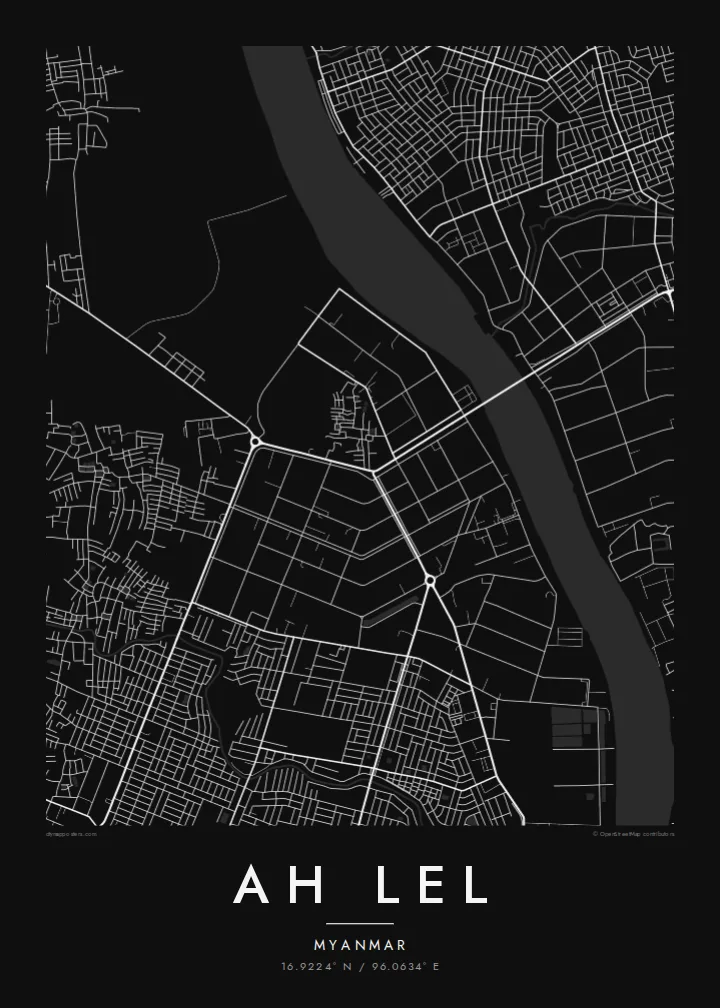
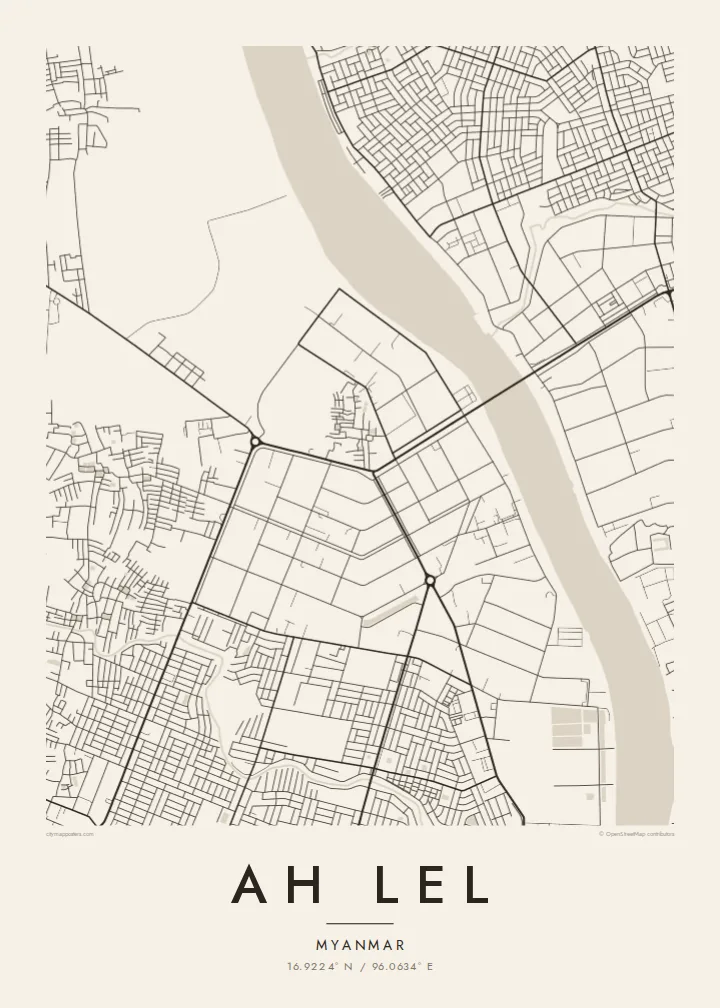
Creeks and channels cross the area in loose curves. They are the strongest natural lines on the map and a reminder of how closely life here follows the water.
Posta faʻafanua faigofie · Myanmar (Burma)
16.9224° N / 96.0634° E
Low delta ground on the edge of Yangon, where waterways, paddy plots and village lanes form a quiet, open pattern.



Tasi le aai, lagona e lima
Tapi se sitaili e vaai ai i luga o le puipui. E tutusa uma le tau o sitaili — pe lolomiina, faapipiiina, pe avea ma faila HD.
 Pika Moni · Faila Lolomi 24 × 36″
Manino mo le lolomi
O se vaega atoa (100%) lenei mai le faila lolomi moni. O posita uma — pe lolomiina, faapipiiina pe download mai — e faia i luga o a matou server i le 300 DPI, e oo atu i le 7,200 × 10,800 pika, ina ia manino pea auala laiti i luga o se lolomiga 24 × 36″.
I luga o le puipui


Le faʻafanua
Ah Lel sits in the Yangon Region, on the flat, river-cut land that spreads out from Myanmar's largest city. From above, the settlement looks less like a dense core and more like a loose cluster of lanes, compounds and small blocks set between channels and open fields. The lowland landscape shapes everything here. Water decides where roads can run, and houses follow the higher, drier ground.
Rendered in black and white, an Ah Lel map poster turns that watery setting into a study of line and space. Roads appear as thin, slightly irregular strokes, and creeks and drainage channels bend through them in softer curves. Large pale areas stand for fields and wet ground. They give the composition room to breathe instead of filling every corner of the sheet.
With around twenty-three thousand residents, Ah Lel is a modest place, and the map shows it honestly. There are no famous boulevards to point to. What you see is the everyday geometry of a community shaped by the lowlands of lower Myanmar and by the steady pull of nearby Yangon. That plainness is exactly what makes the drawing feel personal.
Creeks and channels cross the area in loose curves. They are the strongest natural lines on the map and a reminder of how closely life here follows the water.
Wide unbuilt spaces between clusters of houses stand for paddy land and low ground, which leaves generous white space around the streets on the poster.
The town lies within the Yangon Region, close to the metropolis, and wider frames begin to catch the denser street fabric of the city beyond.
Fai mo oe
Faʻaopoopo se aso, se igoa po o sau lava upu, sui le sitaili, lapoʻa po o le itu.
O le preview e leai se totogi e maualalo le resolution ma iai se watermark. O lolomi ma faila HD e faia i le 300 DPI, e oo atu i le 7,200 × 10,800 px, e aunoa ma se watermark.
Aisea Ah Lel
For people with family ties to Ah Lel, or who have lived on the outskirts of Yangon, this map is a quiet record of home that no postcard can give. It works well in a hallway or study, where its fine lines and open spaces read as calm abstraction.
You can personalise the title, subtitle and coordinates line, perhaps with a family name or a date, and choose one of five styles: Classic black & white, Noir, Paper, Blueprint or Sand. The digital HD files cost $9, or you can order a matte print with an optional wooden frame.
Faatau le posita Ah Lel| Lapoʻa lolomi | Manino | Faila |
|---|---|---|
| 30 × 40 cm11.8 × 15.7″ | 3,543 × 4,724 px | PNG · PDF |
| 29.7 × 42 cm (A3)11.7 × 16.5″ | 3,508 × 4,961 px | PNG · PDF |
| 42 × 59.4 cm (A2)16.5 × 23.4″ | 4,961 × 7,016 px | PNG · PDF |
| 45.7 × 61 cm18 × 24″ | 5,400 × 7,200 px | PNG · PDF |
| 50 × 70 cm19.7 × 27.6″ | 5,906 × 8,268 px | PNG · PDF |
| 61 × 91.4 cm24 × 36″ | 7,200 × 10,800 px | PNG · PDF |
Ae faʻatusatusa, o le faʻataʻitaʻiga e leai se totogi e 900 px le lautele, e iai le faʻailoga vai ma e mo mata. O faila HD e oʻo atu i le 8× le manino i itu taʻitasi ma e lolomi manino i le lapoʻa atoa o le posta.
Filifili se sitaili i le pito i luga o le itulau, ona filifili lea o le Posita Lolomi — se lapopoa ma, afai e te fiafia, se faavaa — po o Faila HD Numera. E na o le tasi laasaga o le Checkout, ma o le a fesuia'i lou itulau o oka i le taimi lava e mae'a ai le totogi.
E lolomiina i luga o pepa matte maualuga le tulaga e 200 gsm, i se tasi o lapopoa e ono, mai le 30 × 40 cm i le 24 × 36″. E amata le tau o posita lolomi mai le $39, aofia ai le auina atu.
Ioe. Filifili se faavaa laau malosi i le lanu uliuli, sina, oak masani, po o le laau pogisa. E aofia ai se tioata e le gau ma ua saunia e tautau i luga. E amata le tau o posita faavaa mai le $99, aofia ai le auina atu.
E leai se totogi o le auina atu i atunuu e 60+. O pepa ata taʻitasi e lolomiina e le tasi o matou paaga lolomi e latalata mai i atunuu e 30+, ma e masani ona taunuu i le 3–7 aso faigaluega. E mafai ona e mulimulitaia le tulaga ma le sailiga i lalo o My Orders. O nisi atunuu e 2–5 vaiaso, ma i nofoaga e lei matou auina atu iai, e taʻu atu e le saite ia te oe a o lei totogi.
Auina mai se ata i totonu o le 14 aso talu ona taunuu, ma o le a matou toe lolomiina e leai se totogi po o le toe faafoi atu lau tupe.
Ioe. I totonu o le editor i lenei itulau, suia le ulutala, le ulutala laititi ma le laina o coordinates i soo se mea e te fiafia i ai, ma filifili se sitaili ma le lapopoa. O oka lolomi, faavaa ma numera e faaaoga uma lava lau mamanu.
Mo le $9 e te maua ai faila PNG 300 DPI ma PDF ua saunia mo le lolomi i lapopoa uma e ono, e aunoa ma se watermark, e mafai ona lolomi i soo se mea. Le mautinoa lava? Download muamua se preview e leai se totogi ma le watermark.
