The pols
Dense clusters of houses around shared lanes and gateways in the old city, forming one of the most intricate street patterns in India and a striking texture on the map.
Posta faʻafanua faigofie · India
23.0258° N / 72.5873° E
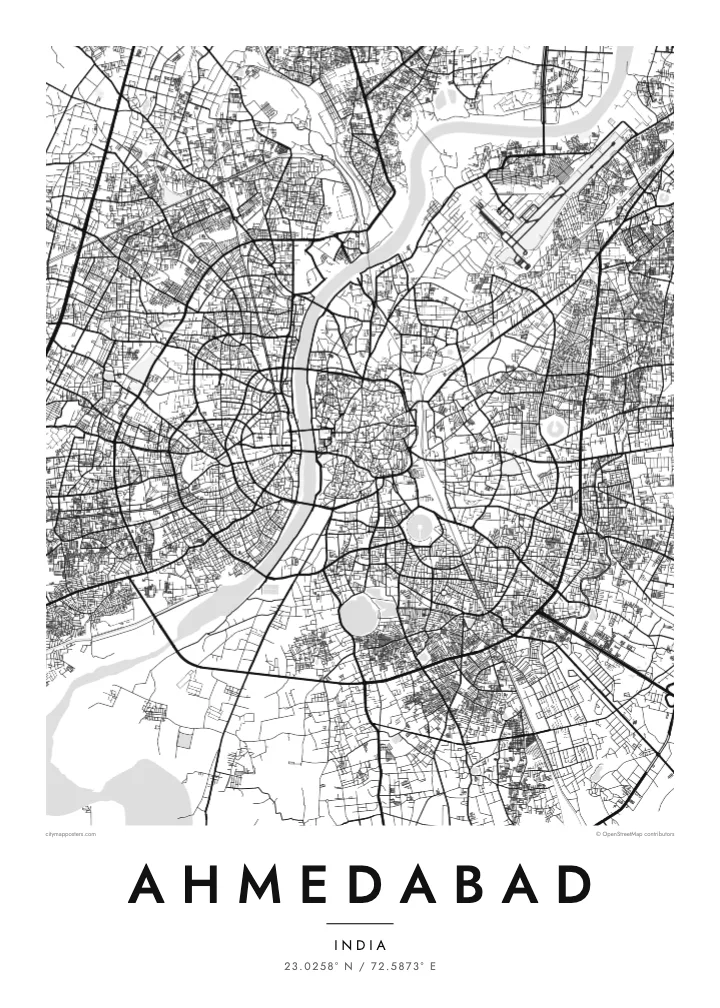
A city divided by the Sabarmati River, its dense old town on the east bank and newer districts spreading west.


Tasi le aai, lagona e lima
Tapi se sitaili e vaai ai i luga o le puipui. E tutusa uma le tau o sitaili — pe lolomiina, faapipiiina, pe avea ma faila HD.
 Pika Moni · Faila Lolomi 24 × 36″
Manino mo le lolomi
O se vaega atoa (100%) lenei mai le faila lolomi moni. O posita uma — pe lolomiina, faapipiiina pe download mai — e faia i luga o a matou server i le 300 DPI, e oo atu i le 7,200 × 10,800 pika, ina ia manino pea auala laiti i luga o se lolomiga 24 × 36″.
I luga o le puipui


Le faʻafanua
The Sabarmati River runs north to south through Ahmedabad and splits the map in two. On the eastern bank lies the old city founded in 1411 by Sultan Ahmed Shah, a tightly packed area of narrow lanes and gated residential clusters known as pols. On the western bank, the city expanded in the twentieth century into broader streets, institutions and residential colonies.
In 2017 the historic walled city became India's first UNESCO World Heritage City, recognised for its Indo-Islamic monuments and its pol houses. On the map this area appears as an intricate knot of streets, while the river itself is now framed by the long, straight embankments of the Sabarmati Riverfront, with several bridges crossing between the two halves.
Upstream on the western bank stands the Sabarmati Ashram, where Mahatma Gandhi lived for more than a decade and from which the Salt March set out in 1930. An Ahmedabad map poster shows the full span of the city, from the old core to Kankaria Lake in the south-east and the ring road that now encircles it.
Dense clusters of houses around shared lanes and gateways in the old city, forming one of the most intricate street patterns in India and a striking texture on the map.
Long, parallel embankments and promenades lining both banks of the river, turning the water into a clean central axis crossed by a sequence of bridges.
A large lake built in the fifteenth century in the south-east of the city, its regular many-sided outline standing out clearly among the surrounding streets.
Fai mo oe
Faʻaopoopo se aso, se igoa po o sau lava upu, sui le sitaili, lapoʻa po o le itu.
O le preview e leai se totogi e maualalo le resolution ma iai se watermark. O lolomi ma faila HD e faia i le 300 DPI, e oo atu i le 7,200 × 10,800 px, e aunoa ma se watermark.
Aisea Ahmedabad
Ahmedabad carries deep personal meaning for families across Gujarat and abroad, and its map makes the story easy to read: the old city on one bank, the newer city on the other, and the river holding them together in the middle.
Customise the title, subtitle and coordinates line to name a pol, a family or a year. Pick from Classic black & white, Noir, Paper, Blueprint and Sand. A free watermarked preview lets you check the composition before buying the $9 HD files.
Faatau le posita Ahmedabad| Lapoʻa lolomi | Manino | Faila |
|---|---|---|
| 30 × 40 cm11.8 × 15.7″ | 3,543 × 4,724 px | PNG · PDF |
| 29.7 × 42 cm (A3)11.7 × 16.5″ | 3,508 × 4,961 px | PNG · PDF |
| 42 × 59.4 cm (A2)16.5 × 23.4″ | 4,961 × 7,016 px | PNG · PDF |
| 45.7 × 61 cm18 × 24″ | 5,400 × 7,200 px | PNG · PDF |
| 50 × 70 cm19.7 × 27.6″ | 5,906 × 8,268 px | PNG · PDF |
| 61 × 91.4 cm24 × 36″ | 7,200 × 10,800 px | PNG · PDF |
Ae faʻatusatusa, o le faʻataʻitaʻiga e leai se totogi e 900 px le lautele, e iai le faʻailoga vai ma e mo mata. O faila HD e oʻo atu i le 8× le manino i itu taʻitasi ma e lolomi manino i le lapoʻa atoa o le posta.
Filifili se sitaili i le pito i luga o le itulau, ona filifili lea o le Posita Lolomi — se lapopoa ma, afai e te fiafia, se faavaa — po o Faila HD Numera. E na o le tasi laasaga o le Checkout, ma o le a fesuia'i lou itulau o oka i le taimi lava e mae'a ai le totogi.
E lolomiina i luga o pepa matte maualuga le tulaga e 200 gsm, i se tasi o lapopoa e ono, mai le 30 × 40 cm i le 24 × 36″. E amata le tau o posita lolomi mai le $39, aofia ai le auina atu.
Ioe. Filifili se faavaa laau malosi i le lanu uliuli, sina, oak masani, po o le laau pogisa. E aofia ai se tioata e le gau ma ua saunia e tautau i luga. E amata le tau o posita faavaa mai le $99, aofia ai le auina atu.
E leai se totogi o le auina atu i atunuu e 60+. O pepa ata taʻitasi e lolomiina e le tasi o matou paaga lolomi e latalata mai i atunuu e 30+, ma e masani ona taunuu i le 3–7 aso faigaluega. E mafai ona e mulimulitaia le tulaga ma le sailiga i lalo o My Orders. O nisi atunuu e 2–5 vaiaso, ma i nofoaga e lei matou auina atu iai, e taʻu atu e le saite ia te oe a o lei totogi.
Auina mai se ata i totonu o le 14 aso talu ona taunuu, ma o le a matou toe lolomiina e leai se totogi po o le toe faafoi atu lau tupe.
Ioe. I totonu o le editor i lenei itulau, suia le ulutala, le ulutala laititi ma le laina o coordinates i soo se mea e te fiafia i ai, ma filifili se sitaili ma le lapopoa. O oka lolomi, faavaa ma numera e faaaoga uma lava lau mamanu.
Mo le $9 e te maua ai faila PNG 300 DPI ma PDF ua saunia mo le lolomi i lapopoa uma e ono, e aunoa ma se watermark, e mafai ona lolomi i soo se mea. Le mautinoa lava? Download muamua se preview e leai se totogi ma le watermark.
Latalata ane
