Dense town core
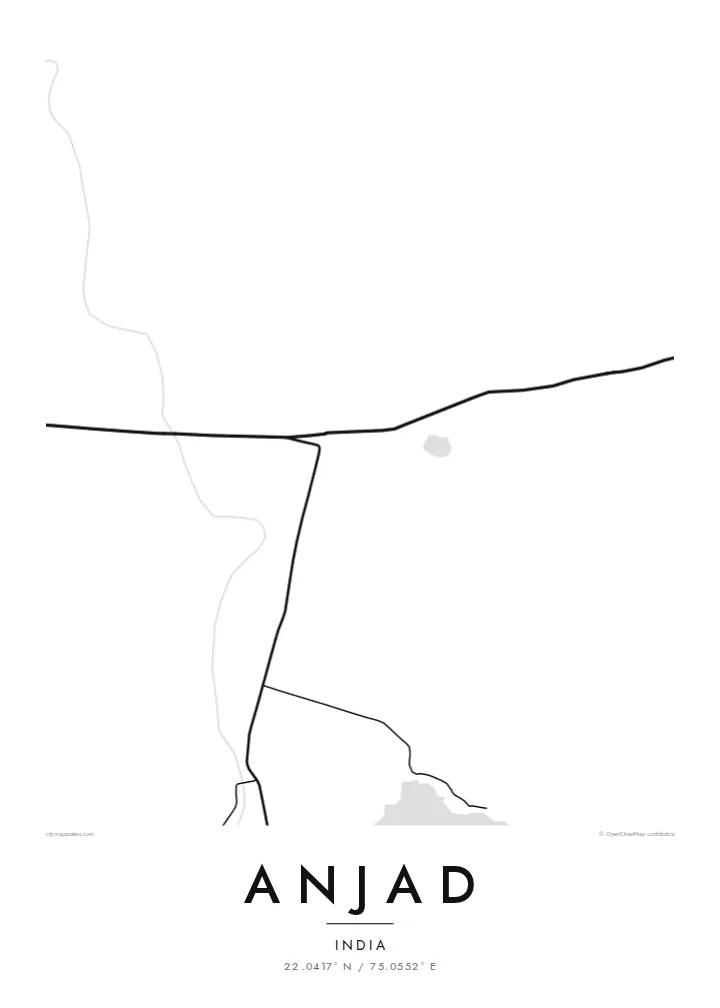
The centre of Anjad is a close grid of narrow, uneven lanes, drawn on the poster as a dark cluster that thins out quickly toward the surrounding farmland.
Posta faʻafanua faigofie · India
22.0417° N / 75.0552° E
A compact market town in the Nimar plains, its lanes gathered tightly among open fields a short way from the Narmada.


Tasi le aai, lagona e lima
Tapi se sitaili e vaai ai i luga o le puipui. E tutusa uma le tau o sitaili — pe lolomiina, faapipiiina, pe avea ma faila HD.
 Pika Moni · Faila Lolomi 24 × 36″
Manino mo le lolomi
O se vaega atoa (100%) lenei mai le faila lolomi moni. O posita uma — pe lolomiina, faapipiiina pe download mai — e faia i luga o a matou server i le 300 DPI, e oo atu i le 7,200 × 10,800 pika, ina ia manino pea auala laiti i luga o se lolomiga 24 × 36″.
I luga o le puipui


Le faʻafanua
Anjad sits in Barwani district in the southwest of Madhya Pradesh, in the part of the Narmada valley known as Nimar. From above, the town is a dense core of short, irregular lanes. Around it spreads a patchwork of farm plots, field boundaries and village roads that run out toward neighbouring settlements. The pattern shows a place that grew around trade and agriculture rather than to a planned layout.
The Narmada, one of the great rivers of central India, flows to the north of the town across the wide valley floor. To the south the land rises gradually toward the Satpura hills. On a map this puts Anjad between a river and a line of high ground, a setting that shapes the roads leading in and out and the way the fields are laid out around them.
A Anjad map poster keeps all of this in black and white: the tight knot of the old centre, the thinner streets at the edges and the long rural roads that connect the town to the rest of the district. Without colour or labels crowding the sheet, the scale of the place becomes clear, a small town set in a wide agricultural landscape.
The centre of Anjad is a close grid of narrow, uneven lanes, drawn on the poster as a dark cluster that thins out quickly toward the surrounding farmland.
The town lies in the broad Nimar stretch of the Narmada valley, with the river to the north and gently rising ground toward the Satpura range to the south.
Country roads leave the town in several directions, crossing field boundaries and linking Anjad with the villages and larger towns of Barwani district.
Fai mo oe
Faʻaopoopo se aso, se igoa po o sau lava upu, sui le sitaili, lapoʻa po o le itu.
O le preview e leai se totogi e maualalo le resolution ma iai se watermark. O lolomi ma faila HD e faia i le 300 DPI, e oo atu i le 7,200 × 10,800 px, e aunoa ma se watermark.
Aisea Anjad
For people who grew up in Anjad or have family there, the map is a quiet reminder of home: the lanes walked every day, the roads out to the fields, the direction of the river. It suits a hallway, a study or a gift for someone living far from Madhya Pradesh.
You can set your own title and subtitle, such as a family name or a year, and edit the coordinates line. Choose between Classic black & white, Noir, Paper, Blueprint and Sand to match the room where the poster will hang.
Faatau le posita Anjad| Lapoʻa lolomi | Manino | Faila |
|---|---|---|
| 30 × 40 cm (11.8 × 15.7″) | 3,543 × 4,724 px | PNG · PDF |
| 29.7 × 42 cm (A3, 11.7 × 16.5″) | 3,508 × 4,961 px | PNG · PDF |
| 42 × 59.4 cm (A2, 16.5 × 23.4″) | 4,961 × 7,016 px | PNG · PDF |
| 45.7 × 61 cm (18 × 24″) | 5,400 × 7,200 px | PNG · PDF |
| 50 × 70 cm (19.7 × 27.6″) | 5,906 × 8,268 px | PNG · PDF |
| 61 × 91.4 cm (24 × 36″) | 7,200 × 10,800 px | PNG · PDF |
Ae faʻatusatusa, o le faʻataʻitaʻiga e leai se totogi e 900 px le lautele, e iai le faʻailoga vai ma e mo mata. O faila HD e oʻo atu i le 8× le manino i itu taʻitasi ma e lolomi manino i le lapoʻa atoa o le posta.
Filifili se sitaili i le pito i luga o le itulau, ona filifili lea o le Posita Lolomi — se lapopoa ma, afai e te fiafia, se faavaa — po o Faila HD Numera. E na o le tasi laasaga o le Checkout, ma o le a fesuia'i lou itulau o oka i le taimi lava e mae'a ai le totogi.
E lolomiina i luga o pepa matte maualuga le tulaga e 200 gsm, i se tasi o lapopoa e ono, mai le 30 × 40 cm i le 24 × 36″. E amata le tau o posita lolomi mai le $39, aofia ai le auina atu.
Ioe. Filifili se faavaa laau malosi i le lanu uliuli, sina, oak masani, po o le laau pogisa. E aofia ai se tioata e le gau ma ua saunia e tautau i luga. E amata le tau o posita faavaa mai le $99, aofia ai le auina atu.
E leai se totogi mo le uta i le lalolagi atoa. O poster ta'itasi e lolomi e le paaga lolomi e latalata mai i matou i atunuu e 30+, ma e masani ona taunuu i aso faigaluega e 3–7. E mafai ona e mulimuli i le tulaga ma le tracking i le "Aʻu Oka". O nisi atunuu e 2–5 vaiaso, ma i atunuu matou te lei tuuina atu ai, e taʻu atu e le saite iā te oe ae e te leʻi totogiina.
Auina mai se ata i totonu o le 14 aso talu ona taunuu, ma o le a matou toe lolomiina e leai se totogi po o le toe faafoi atu lau tupe.
Ioe. I totonu o le editor i lenei itulau, suia le ulutala, le ulutala laititi ma le laina o coordinates i soo se mea e te fiafia i ai, ma filifili se sitaili ma le lapopoa. O oka lolomi, faavaa ma numera e faaaoga uma lava lau mamanu.
Mo le $9 e te maua ai faila PNG 300 DPI ma PDF ua saunia mo le lolomi i lapopoa uma e ono, e aunoa ma se watermark, e mafai ona lolomi i soo se mea. Le mautinoa lava? Download muamua se preview e leai se totogi ma le watermark.
Latalata ane
