The Son River
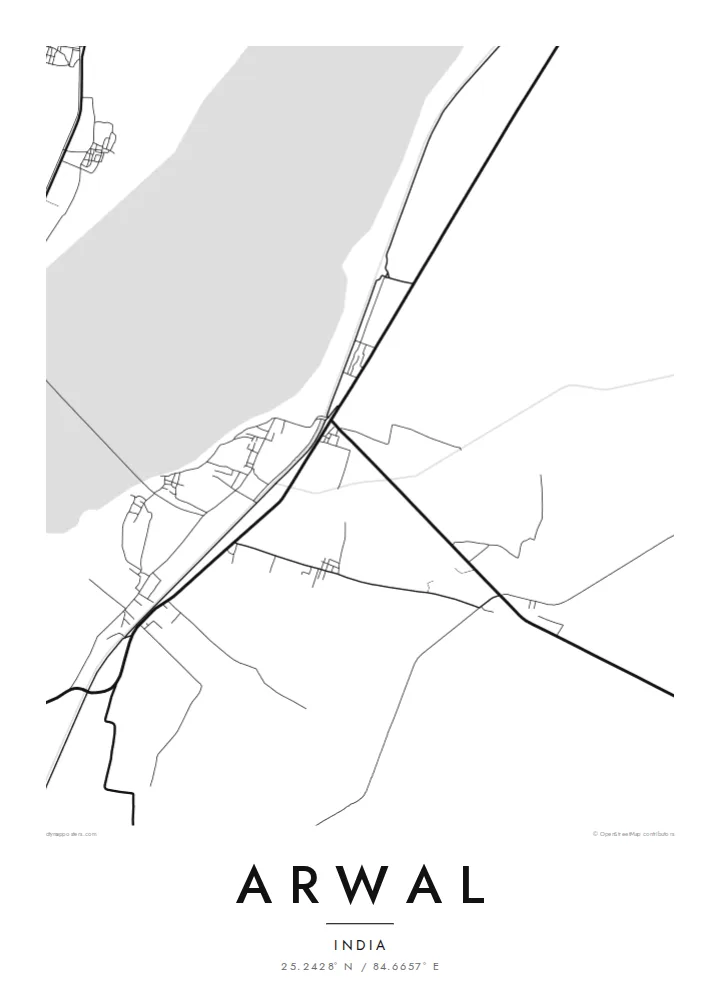
The Son runs wide and braided near Arwal, its sandbanks and channels changing with the seasons. On the map it forms a broad, pale band beside the town.
Posta faʻafanua faigofie · India
25.2428° N / 84.6657° E
A district town on the flat alluvial plain of south Bihar, its streets gathered close to the broad, sandy Son River


Tasi le aai, lagona e lima
Tapi se sitaili e vaai ai i luga o le puipui. E tutusa uma le tau o sitaili — pe lolomiina, faapipiiina, pe avea ma faila HD.
 Pika Moni · Faila Lolomi 24 × 36″
Manino mo le lolomi
O se vaega atoa (100%) lenei mai le faila lolomi moni. O posita uma — pe lolomiina, faapipiiina pe download mai — e faia i luga o a matou server i le 300 DPI, e oo atu i le 7,200 × 10,800 pika, ina ia manino pea auala laiti i luga o se lolomiga 24 × 36″.
I luga o le puipui


Le faʻafanua
Arwal lies on the plain of south Bihar, close to the Son River, one of the major southern tributaries of the Ganges. It is the headquarters of the district of the same name, created in 2001 from part of Jehanabad. The landscape around it is almost perfectly flat, farmed intensively, and crossed by the channels and roads that connect small villages.
On a map the Son is the dominant feature: a wide, braided river with shifting sandbanks, much broader than the town beside it. Arwal's streets cluster on the landward side, a compact core of market lanes and residential blocks, with roads running out across the fields toward Patna, Jehanabad and Aurangabad districts.
An Arwal map poster keeps that simple, strong contrast between river and settlement. The lines of the town are close and busy, and the river's pale expanse gives the composition room to breathe. For a place that rarely appears in guidebooks, the poster offers an honest, unembellished portrait of how it sits on the land.
The Son runs wide and braided near Arwal, its sandbanks and channels changing with the seasons. On the map it forms a broad, pale band beside the town.
The oldest part of town is a close grid of short lanes where most trade happens, forming the densest and darkest patch of lines on the poster.
Straight and slightly curving roads leave the centre in several directions, linking Arwal to the surrounding villages and district towns across the level farmland.
Fai mo oe
Faʻaopoopo se aso, se igoa po o sau lava upu, sui le sitaili, lapoʻa po o le itu.
O le preview e leai se totogi e maualalo le resolution ma iai se watermark. O lolomi ma faila HD e faia i le 300 DPI, e oo atu i le 7,200 × 10,800 px, e aunoa ma se watermark.
Aisea Arwal
People from Arwal who work in Patna, Delhi or further away often keep something from home close by. A clean map of the town and its river is a quiet reminder of where they started, and it makes a thoughtful gift for parents or siblings.
Add a family name, a village name in the subtitle, or a date that matters. Choose from five styles, including Sand for a warm, earthy tone. Digital files in six sizes cost $9, and a printed poster is also available.
Faatau le posita Arwal| Lapoʻa lolomi | Manino | Faila |
|---|---|---|
| 30 × 40 cm (11.8 × 15.7″) | 3,543 × 4,724 px | PNG · PDF |
| 29.7 × 42 cm (A3, 11.7 × 16.5″) | 3,508 × 4,961 px | PNG · PDF |
| 42 × 59.4 cm (A2, 16.5 × 23.4″) | 4,961 × 7,016 px | PNG · PDF |
| 45.7 × 61 cm (18 × 24″) | 5,400 × 7,200 px | PNG · PDF |
| 50 × 70 cm (19.7 × 27.6″) | 5,906 × 8,268 px | PNG · PDF |
| 61 × 91.4 cm (24 × 36″) | 7,200 × 10,800 px | PNG · PDF |
Ae faʻatusatusa, o le faʻataʻitaʻiga e leai se totogi e 900 px le lautele, e iai le faʻailoga vai ma e mo mata. O faila HD e oʻo atu i le 8× le manino i itu taʻitasi ma e lolomi manino i le lapoʻa atoa o le posta.
Filifili se sitaili i le pito i luga o le itulau, ona filifili lea o le Posita Lolomi — se lapopoa ma, afai e te fiafia, se faavaa — po o Faila HD Numera. E na o le tasi laasaga o le Checkout, ma o le a fesuia'i lou itulau o oka i le taimi lava e mae'a ai le totogi.
E lolomiina i luga o pepa matte maualuga le tulaga e 200 gsm, i se tasi o lapopoa e ono, mai le 30 × 40 cm i le 24 × 36″. E amata le tau o posita lolomi mai le {printFrom}, aofia ai le auina atu.
Ioe. Filifili se faavaa laau malosi i le lanu uliuli, sina, oak masani, po o le laau pogisa. E aofia ai se tioata e le gau ma ua saunia e tautau i luga. E amata le tau o posita faavaa mai le {framedFrom}, aofia ai le auina atu.
E leai se totogi mo le uta i le lalolagi atoa. O poster ta'itasi e lolomi e le paaga lolomi e latalata mai i matou i atunuu e 30+, ma e masani ona taunuu i aso faigaluega e 3–7. E mafai ona e mulimuli i le tulaga ma le tracking i le "Aʻu Oka". O nisi atunuu e 2–5 vaiaso, ma i atunuu matou te lei tuuina atu ai, e taʻu atu e le saite iā te oe ae e te leʻi totogiina.
Auina mai se ata i totonu o le 14 aso talu ona taunuu, ma o le a matou toe lolomiina e leai se totogi po o le toe faafoi atu lau tupe.
Ioe. I totonu o le editor i lenei itulau, suia le ulutala, le ulutala laititi ma le laina o coordinates i soo se mea e te fiafia i ai, ma filifili se sitaili ma le lapopoa. O oka lolomi, faavaa ma numera e faaaoga uma lava lau mamanu.
Mo le $9 e te maua ai faila PNG 300 DPI ma PDF ua saunia mo le lolomi i lapopoa uma e ono, e aunoa ma se watermark, e mafai ona lolomi i soo se mea. Le mautinoa lava? Download muamua se preview e leai se totogi ma le watermark.
Latalata ane
