Lower Awash River
The Awash winds past the town in loops and bends. It is the lifeline of the area, and it gives the map its most expressive curving line.
Posta faʻafanua faigofie · Ethiopia
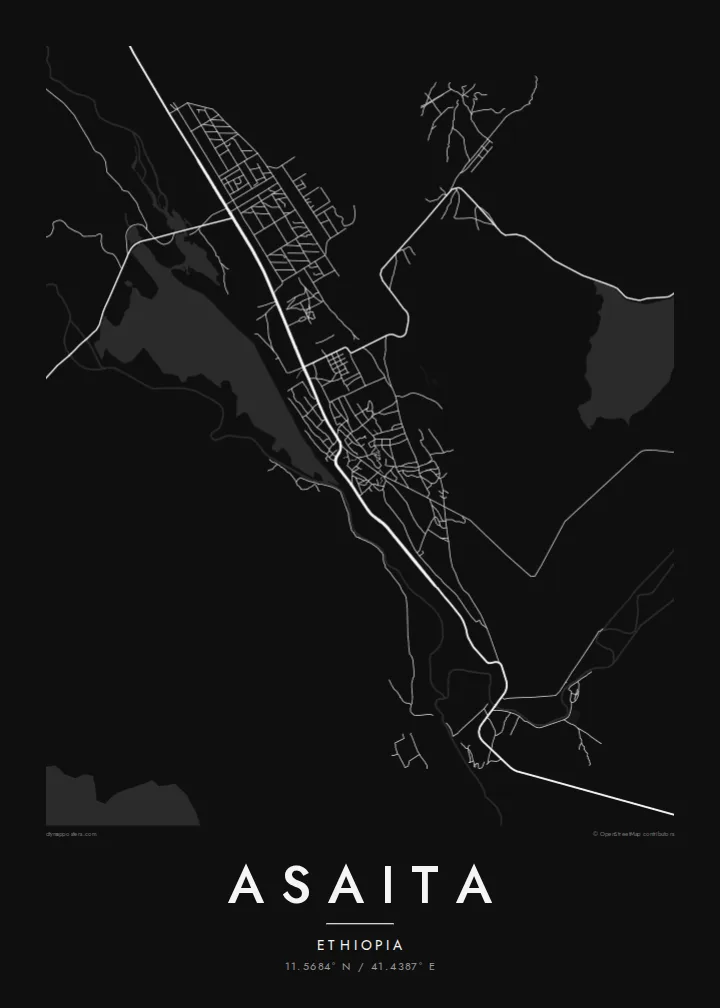
11.5684° N / 41.4387° E
An old Afar town on the lower Awash River, its irrigated fields forming a green island in the surrounding desert plain



Tasi le aai, lagona e lima
Tapi se sitaili e vaai ai i luga o le puipui. E tutusa uma le tau o sitaili — pe lolomiina, faapipiiina, pe avea ma faila HD.
 Pika Moni · Faila Lolomi 24 × 36″
Manino mo le lolomi
O se vaega atoa (100%) lenei mai le faila lolomi moni. O posita uma — pe lolomiina, faapipiiina pe download mai — e faia i luga o a matou server i le 300 DPI, e oo atu i le 7,200 × 10,800 pika, ina ia manino pea auala laiti i luga o se lolomiga 24 × 36″.
I luga o le puipui


Le faʻafanua
Asaita lies in the Afar Region of northeastern Ethiopia, near the lower course of the Awash River. From above, the contrast is striking. A small town and a patch of irrigated farmland sit beside the river, surrounded by vast, dry plains. Downstream, the Awash flows toward a chain of lakes before disappearing into the desert near the Djibouti border.
The town was once the seat of the Sultanate of Aussa, the historic Afar state of the region. It later served as the capital of the Afar Region until the administration moved to the newly built town of Semera. Asaita remains a local centre, with a market that draws people from across the surrounding area.
The Asaita map poster works best when it includes the river. The winding Awash, the rectangular pattern of fields along its banks, and the compact knot of streets in the town together form a small, dense area in a very open frame. It is a clear image of a settlement shaped by water in dry country.
The Awash winds past the town in loops and bends. It is the lifeline of the area, and it gives the map its most expressive curving line.
Farmland along the river is divided into regular plots and channels. Their geometric pattern stands out sharply against the empty desert around them.
The town itself is a small grid of streets and compounds. It forms a tight cluster that anchors the composition near the river.
Fai mo oe
Faʻaopoopo se aso, se igoa po o sau lava upu, sui le sitaili, lapoʻa po o le itu.
O le preview e leai se totogi e maualalo le resolution ma iai se watermark. O lolomi ma faila HD e faia i le 300 DPI, e oo atu i le 7,200 × 10,800 px, e aunoa ma se watermark.
Aisea Asaita
Asaita carries weight as a historic Afar town and a former regional capital. For people from the area, or those who have worked along the Awash, a map of it is a meaningful piece. Visually, the river-and-desert contrast is bold and memorable.
You can edit the title, subtitle and coordinates line, and add a date. Choose from five styles: Classic black & white, Noir, Paper, Blueprint and Sand. Sand suits the desert setting, and Blueprint makes the river stand out.
Faatau le posita Asaita| Lapoʻa lolomi | Manino | Faila |
|---|---|---|
| 30 × 40 cm11.8 × 15.7″ | 3,543 × 4,724 px | PNG · PDF |
| 29.7 × 42 cm (A3)11.7 × 16.5″ | 3,508 × 4,961 px | PNG · PDF |
| 42 × 59.4 cm (A2)16.5 × 23.4″ | 4,961 × 7,016 px | PNG · PDF |
| 45.7 × 61 cm18 × 24″ | 5,400 × 7,200 px | PNG · PDF |
| 50 × 70 cm19.7 × 27.6″ | 5,906 × 8,268 px | PNG · PDF |
| 61 × 91.4 cm24 × 36″ | 7,200 × 10,800 px | PNG · PDF |
Ae faʻatusatusa, o le faʻataʻitaʻiga e leai se totogi e 900 px le lautele, e iai le faʻailoga vai ma e mo mata. O faila HD e oʻo atu i le 8× le manino i itu taʻitasi ma e lolomi manino i le lapoʻa atoa o le posta.
Filifili se sitaili i le pito i luga o le itulau, ona filifili lea o le Posita Lolomi — se lapopoa ma, afai e te fiafia, se faavaa — po o Faila HD Numera. E na o le tasi laasaga o le Checkout, ma o le a fesuia'i lou itulau o oka i le taimi lava e mae'a ai le totogi.
E lolomiina i luga o pepa matte maualuga le tulaga e 200 gsm, i se tasi o lapopoa e ono, mai le 30 × 40 cm i le 24 × 36″. E amata le tau o posita lolomi mai le $39, aofia ai le auina atu.
Ioe. Filifili se faavaa laau malosi i le lanu uliuli, sina, oak masani, po o le laau pogisa. E aofia ai se tioata e le gau ma ua saunia e tautau i luga. E amata le tau o posita faavaa mai le $99, aofia ai le auina atu.
E leai se totogi o le auina atu i atunuu e 60+. O pepa ata taʻitasi e lolomiina e le tasi o matou paaga lolomi e latalata mai i atunuu e 30+, ma e masani ona taunuu i le 3–7 aso faigaluega. E mafai ona e mulimulitaia le tulaga ma le sailiga i lalo o My Orders. O nisi atunuu e 2–5 vaiaso, ma i nofoaga e lei matou auina atu iai, e taʻu atu e le saite ia te oe a o lei totogi.
Auina mai se ata i totonu o le 14 aso talu ona taunuu, ma o le a matou toe lolomiina e leai se totogi po o le toe faafoi atu lau tupe.
Ioe. I totonu o le editor i lenei itulau, suia le ulutala, le ulutala laititi ma le laina o coordinates i soo se mea e te fiafia i ai, ma filifili se sitaili ma le lapopoa. O oka lolomi, faavaa ma numera e faaaoga uma lava lau mamanu.
Mo le $9 e te maua ai faila PNG 300 DPI ma PDF ua saunia mo le lolomi i lapopoa uma e ono, e aunoa ma se watermark, e mafai ona lolomi i soo se mea. Le mautinoa lava? Download muamua se preview e leai se totogi ma le watermark.
Latalata ane
