Dense street weave
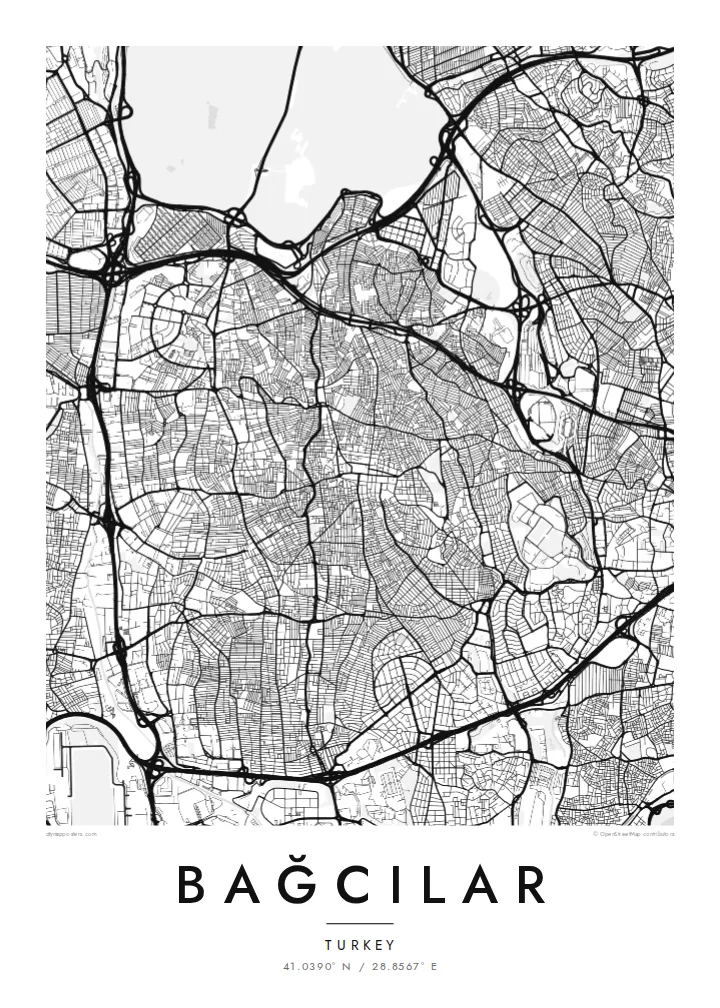
Narrow, irregular streets lined with apartment blocks fill almost the entire district, producing one of the most detailed textures of any Istanbul map.
Posta faʻafanua faigofie · Türkiye
41.0390° N / 28.8567° E
A dense residential district on Istanbul's European side, a tight weave of streets bounded by motorways and industrial zones.


Tasi le aai, lagona e lima
Tapi se sitaili e vaai ai i luga o le puipui. E tutusa uma le tau o sitaili — pe lolomiina, faapipiiina, pe avea ma faila HD.
 Pika Moni · Faila Lolomi 24 × 36″
Manino mo le lolomi
O se vaega atoa (100%) lenei mai le faila lolomi moni. O posita uma — pe lolomiina, faapipiiina pe download mai — e faia i luga o a matou server i le 300 DPI, e oo atu i le 7,200 × 10,800 pika, ina ia manino pea auala laiti i luga o se lolomiga 24 × 36″.
I luga o le puipui


Le faʻafanua
Bağcılar is a district on the European side of Istanbul, well inland from both the Bosphorus and the Sea of Marmara. It is one of the most populous districts in the city, and its map shows why: block after block of apartment buildings packed into a close, irregular street network, with only occasional parks and open squares breaking the density.
Much of the district grew quickly in the second half of the twentieth century, as people moved to Istanbul from across Turkey and settled around the city's expanding industrial edge. The name comes from the vineyards that once covered the area. Today major roads, metro and tram lines tie it to the rest of the city, their straight lines cutting across the finer grain of the neighbourhoods.
A Bağcılar map poster makes a strong graphic piece precisely because it is so dense. In black and white the streets become a fine texture, almost like woven fabric, framed by the broad bands of the motorways. It is a map for people who grew up here, whose families arrived here, or who know Istanbul beyond the postcard districts.
Narrow, irregular streets lined with apartment blocks fill almost the entire district, producing one of the most detailed textures of any Istanbul map.
The T1 tram line ends in Bağcılar and metro lines run through the district, linking it with the historic peninsula and the rest of the city.
Wide highways and interchanges run along and through the district, their long curves standing out clearly against the small-scale neighbourhood grid.
Fai mo oe
Faʻaopoopo se aso, se igoa po o sau lava upu, sui le sitaili, lapoʻa po o le itu.
O le preview e leai se totogi e maualalo le resolution ma iai se watermark. O lolomi ma faila HD e faia i le 300 DPI, e oo atu i le 7,200 × 10,800 px, e aunoa ma se watermark.
Aisea Bağcılar
Bağcılar is where many Istanbul stories begin: families arriving from Anatolia, first apartments, first jobs. A map of the district honours a part of the city that rarely gets the attention given to Sultanahmet or the Bosphorus shore.
Personalise the title, subtitle and coordinates line with a mahalle, a family name or a date, and choose from five styles: Classic black & white, Noir, Paper, Blueprint and Sand. Get the digital files for $9 or order a matte print.
Faatau le posita Bağcılar| Lapoʻa lolomi | Manino | Faila |
|---|---|---|
| 30 × 40 cm11.8 × 15.7″ | 3,543 × 4,724 px | PNG · PDF |
| 29.7 × 42 cm (A3)11.7 × 16.5″ | 3,508 × 4,961 px | PNG · PDF |
| 42 × 59.4 cm (A2)16.5 × 23.4″ | 4,961 × 7,016 px | PNG · PDF |
| 45.7 × 61 cm18 × 24″ | 5,400 × 7,200 px | PNG · PDF |
| 50 × 70 cm19.7 × 27.6″ | 5,906 × 8,268 px | PNG · PDF |
| 61 × 91.4 cm24 × 36″ | 7,200 × 10,800 px | PNG · PDF |
Ae faʻatusatusa, o le faʻataʻitaʻiga e leai se totogi e 900 px le lautele, e iai le faʻailoga vai ma e mo mata. O faila HD e oʻo atu i le 8× le manino i itu taʻitasi ma e lolomi manino i le lapoʻa atoa o le posta.
Filifili se sitaili i le pito i luga o le itulau, ona filifili lea o le Posita Lolomi — se lapopoa ma, afai e te fiafia, se faavaa — po o Faila HD Numera. E na o le tasi laasaga o le Checkout, ma o le a fesuia'i lou itulau o oka i le taimi lava e mae'a ai le totogi.
E lolomiina i luga o pepa matte maualuga le tulaga e 200 gsm, i se tasi o lapopoa e ono, mai le 30 × 40 cm i le 24 × 36″. E amata le tau o posita lolomi mai le $39, aofia ai le auina atu.
Ioe. Filifili se faavaa laau malosi i le lanu uliuli, sina, oak masani, po o le laau pogisa. E aofia ai se tioata e le gau ma ua saunia e tautau i luga. E amata le tau o posita faavaa mai le $99, aofia ai le auina atu.
E leai se totogi o le auina atu i atunuu e 60+. O pepa ata taʻitasi e lolomiina e le tasi o matou paaga lolomi e latalata mai i atunuu e 30+, ma e masani ona taunuu i le 3–7 aso faigaluega. E mafai ona e mulimulitaia le tulaga ma le sailiga i lalo o My Orders. O nisi atunuu e 2–5 vaiaso, ma i nofoaga e lei matou auina atu iai, e taʻu atu e le saite ia te oe a o lei totogi.
Auina mai se ata i totonu o le 14 aso talu ona taunuu, ma o le a matou toe lolomiina e leai se totogi po o le toe faafoi atu lau tupe.
Ioe. I totonu o le editor i lenei itulau, suia le ulutala, le ulutala laititi ma le laina o coordinates i soo se mea e te fiafia i ai, ma filifili se sitaili ma le lapopoa. O oka lolomi, faavaa ma numera e faaaoga uma lava lau mamanu.
Mo le $9 e te maua ai faila PNG 300 DPI ma PDF ua saunia mo le lolomi i lapopoa uma e ono, e aunoa ma se watermark, e mafai ona lolomi i soo se mea. Le mautinoa lava? Download muamua se preview e leai se totogi ma le watermark.
Latalata ane
