Bago River
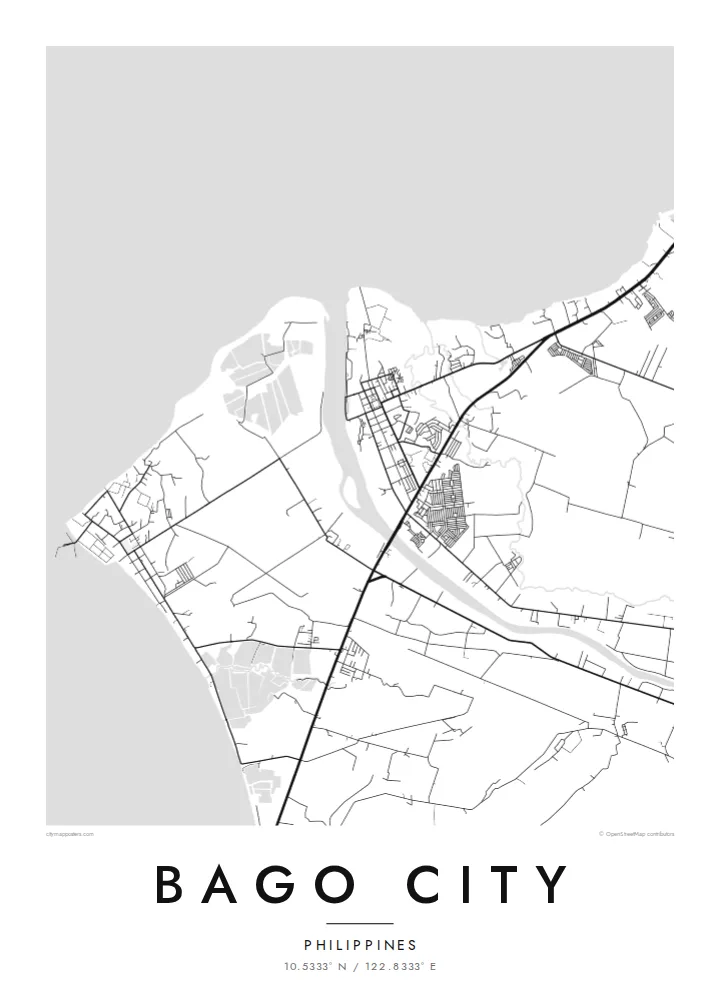
The river crosses the plain from the uplands to the coast, with the town centre close to its banks. On the map it is a clear curving line through the agricultural grid.
Posta faʻafanua faigofie · Philippines
10.5333° N / 122.8333° E
A sugar city on the coastal plain of Negros, stretching from the Guimaras Strait inland toward the slopes of Kanlaon.


Tasi le aai, lagona e lima
Tapi se sitaili e vaai ai i luga o le puipui. E tutusa uma le tau o sitaili — pe lolomiina, faapipiiina, pe avea ma faila HD.
 Pika Moni · Faila Lolomi 24 × 36″
Manino mo le lolomi
O se vaega atoa (100%) lenei mai le faila lolomi moni. O posita uma — pe lolomiina, faapipiiina pe download mai — e faia i luga o a matou server i le 300 DPI, e oo atu i le 7,200 × 10,800 pika, ina ia manino pea auala laiti i luga o se lolomiga 24 × 36″.
I luga o le puipui


Le faʻafanua
Bago City lies on the western side of Negros Island, just south of Bacolod, on a broad plain that rises gently from the Guimaras Strait toward the mountains of the interior. From above, the compact town centre sits near the Bago River, surrounded by an immense pattern of sugarcane fields, farm roads and scattered villages that stretch inland across the city's large territory.
Like much of Negros Occidental, Bago developed around sugar, and cane fields still shape almost every part of the map. The city is the birthplace of General Juan Araneta, a leader of the 1898 revolution on Negros, and to the east its territory reaches toward Mount Kanlaon, the island's highest peak and an active volcano.
A Bago City map poster captures the scale of this landscape: the river winding toward the sea, the town at its banks, the long roads across the plantations and the rising ground in the east. In black and white, the field boundaries and roads form a precise pattern of lines, like a surveyor's drawing.
The river crosses the plain from the uplands to the coast, with the town centre close to its banks. On the map it is a clear curving line through the agricultural grid.
Large plantation fields divided by farm roads cover much of the city's land. From above they create a wide, geometric mosaic that gives the poster its character.
To the west the city reaches the Guimaras Strait, where the plain meets the sea along a low, gently curving shore. It forms a quiet edge to the composition and a counterpoint to the fields.
Fai mo oe
Faʻaopoopo se aso, se igoa po o sau lava upu, sui le sitaili, lapoʻa po o le itu.
O le preview e leai se totogi e maualalo le resolution ma iai se watermark. O lolomi ma faila HD e faia i le 300 DPI, e oo atu i le 7,200 × 10,800 px, e aunoa ma se watermark.
Aisea Bago City
For people from Bago City, whether they still live on Negros or work abroad, a map of the town and its fields is a way of keeping home close. It also makes a considered gift for a homecoming, a graduation or a wedding.
Add a title, subtitle and coordinates line with a barangay name or a meaningful date, and choose one of five styles: Classic black & white, Noir, Paper, Blueprint or Sand. Sand pairs naturally with the colours of the cane fields.
Faatau le posita Bago City| Lapoʻa lolomi | Manino | Faila |
|---|---|---|
| 30 × 40 cm11.8 × 15.7″ | 3,543 × 4,724 px | PNG · PDF |
| 29.7 × 42 cm (A3)11.7 × 16.5″ | 3,508 × 4,961 px | PNG · PDF |
| 42 × 59.4 cm (A2)16.5 × 23.4″ | 4,961 × 7,016 px | PNG · PDF |
| 45.7 × 61 cm18 × 24″ | 5,400 × 7,200 px | PNG · PDF |
| 50 × 70 cm19.7 × 27.6″ | 5,906 × 8,268 px | PNG · PDF |
| 61 × 91.4 cm24 × 36″ | 7,200 × 10,800 px | PNG · PDF |
Ae faʻatusatusa, o le faʻataʻitaʻiga e leai se totogi e 900 px le lautele, e iai le faʻailoga vai ma e mo mata. O faila HD e oʻo atu i le 8× le manino i itu taʻitasi ma e lolomi manino i le lapoʻa atoa o le posta.
Filifili se sitaili i le pito i luga o le itulau, ona filifili lea o le Posita Lolomi — se lapopoa ma, afai e te fiafia, se faavaa — po o Faila HD Numera. E na o le tasi laasaga o le Checkout, ma o le a fesuia'i lou itulau o oka i le taimi lava e mae'a ai le totogi.
E lolomiina i luga o pepa matte maualuga le tulaga e 200 gsm, i se tasi o lapopoa e ono, mai le 30 × 40 cm i le 24 × 36″. E amata le tau o posita lolomi mai le $39, aofia ai le auina atu.
Ioe. Filifili se faavaa laau malosi i le lanu uliuli, sina, oak masani, po o le laau pogisa. E aofia ai se tioata e le gau ma ua saunia e tautau i luga. E amata le tau o posita faavaa mai le $99, aofia ai le auina atu.
E leai se totogi o le auina atu i atunuu e 60+. O pepa ata taʻitasi e lolomiina e le tasi o matou paaga lolomi e latalata mai i atunuu e 30+, ma e masani ona taunuu i le 3–7 aso faigaluega. E mafai ona e mulimulitaia le tulaga ma le sailiga i lalo o My Orders. O nisi atunuu e 2–5 vaiaso, ma i nofoaga e lei matou auina atu iai, e taʻu atu e le saite ia te oe a o lei totogi.
Auina mai se ata i totonu o le 14 aso talu ona taunuu, ma o le a matou toe lolomiina e leai se totogi po o le toe faafoi atu lau tupe.
Ioe. I totonu o le editor i lenei itulau, suia le ulutala, le ulutala laititi ma le laina o coordinates i soo se mea e te fiafia i ai, ma filifili se sitaili ma le lapopoa. O oka lolomi, faavaa ma numera e faaaoga uma lava lau mamanu.
Mo le $9 e te maua ai faila PNG 300 DPI ma PDF ua saunia mo le lolomi i lapopoa uma e ono, e aunoa ma se watermark, e mafai ona lolomi i soo se mea. Le mautinoa lava? Download muamua se preview e leai se totogi ma le watermark.
Latalata ane
