Streets on the ridges
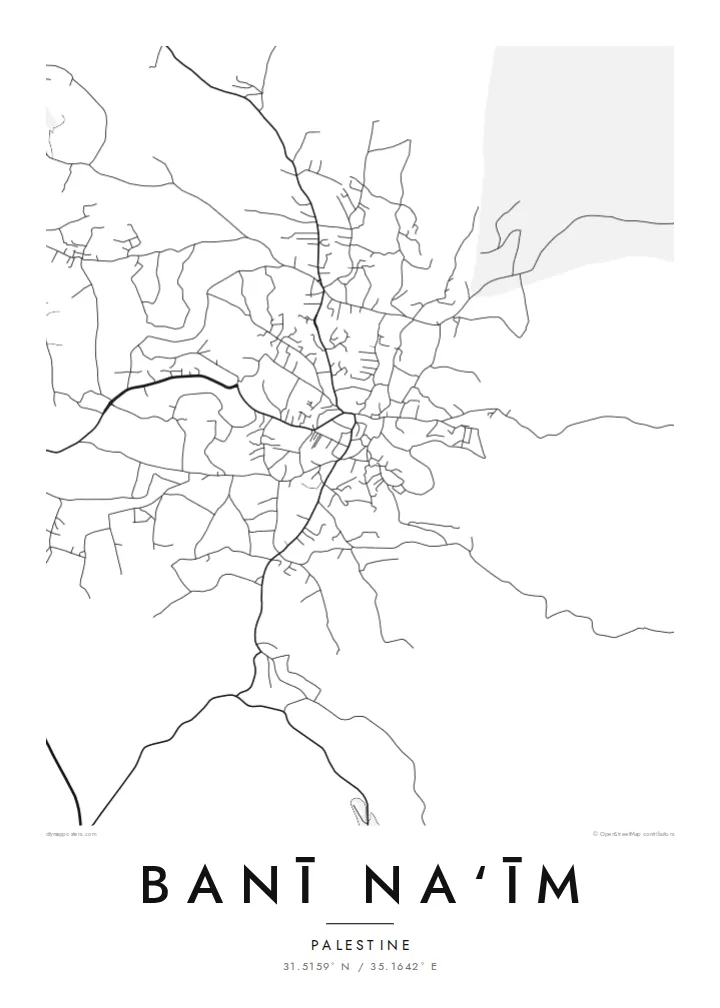
Roads follow the tops and flanks of the hills, bending with the terrain. From above they form a loose, branching pattern instead of a grid.
Posta faʻafanua faigofie · Palestinian Territories
31.5159° N / 35.1642° E
A hilltop town east of Hebron, its streets spread over ridges that fall away towards the Judean desert


Tasi le aai, lagona e lima
Tapi se sitaili e vaai ai i luga o le puipui. E tutusa uma le tau o sitaili — pe lolomiina, faapipiiina, pe avea ma faila HD.
 Pika Moni · Faila Lolomi 24 × 36″
Manino mo le lolomi
O se vaega atoa (100%) lenei mai le faila lolomi moni. O posita uma — pe lolomiina, faapipiiina pe download mai — e faia i luga o a matou server i le 300 DPI, e oo atu i le 7,200 × 10,800 pika, ina ia manino pea auala laiti i luga o se lolomiga 24 × 36″.
I luga o le puipui


Le faʻafanua
Banī Na‘īm lies on high ground east of Hebron, in the southern West Bank. From above, the town spreads across a series of hills, with streets following the ridges and curving down the slopes instead of forming a regular grid. Houses cluster densely near the older core and loosen out towards the edges. Beyond them, the land drops away eastward into increasingly dry terrain.
The town is known for a mosque traditionally associated with the tomb of the prophet Lot, which has long made it a place of local religious significance. To the east the highlands give way to the Judean desert and, further on, the Dead Sea basin. On the map this shows up as a steady thinning of roads and buildings as the land becomes more arid.
A Banī Na‘īm map poster traces how the town fits its hills: winding roads, dense clusters of houses and the open ground around them. In black and white the contours of the settlement become clear, even without drawn topography. It suits people from the town and its many families abroad, who carry a strong attachment to its streets and its view towards the desert.
Roads follow the tops and flanks of the hills, bending with the terrain. From above they form a loose, branching pattern instead of a grid.
Near the traditional centre, around the mosque associated with Lot, buildings sit closely together and lanes become shorter and denser.
Eastward, the built area thins out and roads become sparse as the highlands descend towards the Judean desert and the Dead Sea basin.
Fai mo oe
Faʻaopoopo se aso, se igoa po o sau lava upu, sui le sitaili, lapoʻa po o le itu.
O le preview e leai se totogi e maualalo le resolution ma iai se watermark. O lolomi ma faila HD e faia i le 300 DPI, e oo atu i le 7,200 × 10,800 px, e aunoa ma se watermark.
Aisea Banī Na‘īm
For families from Banī Na‘īm, near or far, a map of the town is a way to keep its streets and hills in daily view. It makes a quiet, meaningful gift for a new home or a relative abroad.
Personalise the title and subtitle with a family name or date, and keep or edit the coordinates line. Choose Classic black & white, Noir, Paper, Blueprint or Sand. Sand suits the warm stone of the landscape.
Faatau le posita Banī Na‘īm| Lapoʻa lolomi | Manino | Faila |
|---|---|---|
| 30 × 40 cm11.8 × 15.7″ | 3,543 × 4,724 px | PNG · PDF |
| 29.7 × 42 cm (A3)11.7 × 16.5″ | 3,508 × 4,961 px | PNG · PDF |
| 42 × 59.4 cm (A2)16.5 × 23.4″ | 4,961 × 7,016 px | PNG · PDF |
| 45.7 × 61 cm18 × 24″ | 5,400 × 7,200 px | PNG · PDF |
| 50 × 70 cm19.7 × 27.6″ | 5,906 × 8,268 px | PNG · PDF |
| 61 × 91.4 cm24 × 36″ | 7,200 × 10,800 px | PNG · PDF |
Ae faʻatusatusa, o le faʻataʻitaʻiga e leai se totogi e 900 px le lautele, e iai le faʻailoga vai ma e mo mata. O faila HD e oʻo atu i le 8× le manino i itu taʻitasi ma e lolomi manino i le lapoʻa atoa o le posta.
Filifili se sitaili i le pito i luga o le itulau, ona filifili lea o le Posita Lolomi — se lapopoa ma, afai e te fiafia, se faavaa — po o Faila HD Numera. E na o le tasi laasaga o le Checkout, ma o le a fesuia'i lou itulau o oka i le taimi lava e mae'a ai le totogi.
E lolomiina i luga o pepa matte maualuga le tulaga e 200 gsm, i se tasi o lapopoa e ono, mai le 30 × 40 cm i le 24 × 36″. E amata le tau o posita lolomi mai le $39, aofia ai le auina atu.
Ioe. Filifili se faavaa laau malosi i le lanu uliuli, sina, oak masani, po o le laau pogisa. E aofia ai se tioata e le gau ma ua saunia e tautau i luga. E amata le tau o posita faavaa mai le $99, aofia ai le auina atu.
E leai se totogi o le auina atu i atunuu e 60+. O pepa ata taʻitasi e lolomiina e le tasi o matou paaga lolomi e latalata mai i atunuu e 30+, ma e masani ona taunuu i le 3–7 aso faigaluega. E mafai ona e mulimulitaia le tulaga ma le sailiga i lalo o My Orders. O nisi atunuu e 2–5 vaiaso, ma i nofoaga e lei matou auina atu iai, e taʻu atu e le saite ia te oe a o lei totogi.
Auina mai se ata i totonu o le 14 aso talu ona taunuu, ma o le a matou toe lolomiina e leai se totogi po o le toe faafoi atu lau tupe.
Ioe. I totonu o le editor i lenei itulau, suia le ulutala, le ulutala laititi ma le laina o coordinates i soo se mea e te fiafia i ai, ma filifili se sitaili ma le lapopoa. O oka lolomi, faavaa ma numera e faaaoga uma lava lau mamanu.
Mo le $9 e te maua ai faila PNG 300 DPI ma PDF ua saunia mo le lolomi i lapopoa uma e ono, e aunoa ma se watermark, e mafai ona lolomi i soo se mea. Le mautinoa lava? Download muamua se preview e leai se totogi ma le watermark.
Latalata ane
