The Rupel bank
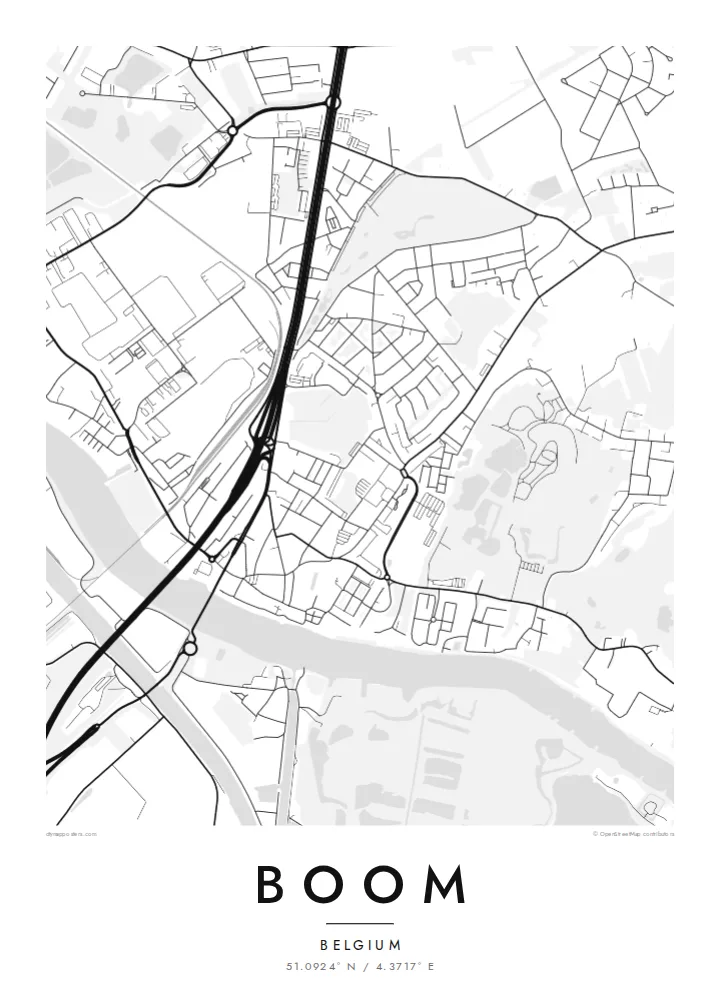
The river forms a strong, curving northern boundary. Its width and tidal character make it the heaviest line on the poster, with the town's streets meeting it at a slant.
Posta faʻafanua faigofie · Belgium
51.0924° N / 4.3717° E
A compact brick town on the south bank of the Rupel, framed by clay pits, ponds and a motorway bridge


Tasi le aai, lagona e lima
Tapi se sitaili e vaai ai i luga o le puipui. E tutusa uma le tau o sitaili — pe lolomiina, faapipiiina, pe avea ma faila HD.
 Pika Moni · Faila Lolomi 24 × 36″
Manino mo le lolomi
O se vaega atoa (100%) lenei mai le faila lolomi moni. O posita uma — pe lolomiina, faapipiiina pe download mai — e faia i luga o a matou server i le 300 DPI, e oo atu i le 7,200 × 10,800 pika, ina ia manino pea auala laiti i luga o se lolomiga 24 × 36″.
I luga o le puipui


Le faʻafanua
From above, Boom is defined by water. The Rupel runs along its northern edge, broad and tidal, and the town's streets fan out from the bank toward the south. A straight motorway line crosses the river on a long bridge, and the rest of the plan is a close weave of terraced streets, small squares and older lanes.
The town grew on clay. For generations the Rupel area supplied bricks to Antwerp and beyond, and the old extraction sites are still visible on a map as ponds and green hollows. The largest of these, the De Schorre recreation area, is known worldwide as the site of the Tomorrowland electronic music festival, which gives a small Flemish town an unusually famous address.
A Boom map poster shows that mix well in black and white: the heavy line of the river, the finer grain of brickmakers' streets, and the irregular water bodies left behind by industry. It is a map where the landscape's working past is still readable in the shapes, even without a single label on the land.
The river forms a strong, curving northern boundary. Its width and tidal character make it the heaviest line on the poster, with the town's streets meeting it at a slant.
Flooded extraction sites appear as irregular ponds and green patches south of the centre, a direct trace of the brick industry that shaped the area.
A straight motorway runs north to south across the Rupel on a long bridge, cutting cleanly through the softer pattern of local streets.
Fai mo oe
Faʻaopoopo se aso, se igoa po o sau lava upu, sui le sitaili, lapoʻa po o le itu.
O le preview e leai se totogi e maualalo le resolution ma iai se watermark. O lolomi ma faila HD e faia i le 300 DPI, e oo atu i le 7,200 × 10,800 px, e aunoa ma se watermark.
Aisea Boom
Boom means different things to different people: a riverside home town, a brickmaking heritage, or a few summer days at a festival. A map of it holds all of those at once, reduced to river, streets and water.
The poster can carry a personal title and subtitle, a date that matters, and the coordinates line. It comes in five styles, Classic black & white, Noir, Paper, Blueprint and Sand, so it can sit quietly in almost any room.
Faatau le posita Boom| Lapoʻa lolomi | Manino | Faila |
|---|---|---|
| 30 × 40 cm11.8 × 15.7″ | 3,543 × 4,724 px | PNG · PDF |
| 29.7 × 42 cm (A3)11.7 × 16.5″ | 3,508 × 4,961 px | PNG · PDF |
| 42 × 59.4 cm (A2)16.5 × 23.4″ | 4,961 × 7,016 px | PNG · PDF |
| 45.7 × 61 cm18 × 24″ | 5,400 × 7,200 px | PNG · PDF |
| 50 × 70 cm19.7 × 27.6″ | 5,906 × 8,268 px | PNG · PDF |
| 61 × 91.4 cm24 × 36″ | 7,200 × 10,800 px | PNG · PDF |
Ae faʻatusatusa, o le faʻataʻitaʻiga e leai se totogi e 900 px le lautele, e iai le faʻailoga vai ma e mo mata. O faila HD e oʻo atu i le 8× le manino i itu taʻitasi ma e lolomi manino i le lapoʻa atoa o le posta.
Filifili se sitaili i le pito i luga o le itulau, ona filifili lea o le Posita Lolomi — se lapopoa ma, afai e te fiafia, se faavaa — po o Faila HD Numera. E na o le tasi laasaga o le Checkout, ma o le a fesuia'i lou itulau o oka i le taimi lava e mae'a ai le totogi.
E lolomiina i luga o pepa matte maualuga le tulaga e 200 gsm, i se tasi o lapopoa e ono, mai le 30 × 40 cm i le 24 × 36″. E amata le tau o posita lolomi mai le $39, aofia ai le auina atu.
Ioe. Filifili se faavaa laau malosi i le lanu uliuli, sina, oak masani, po o le laau pogisa. E aofia ai se tioata e le gau ma ua saunia e tautau i luga. E amata le tau o posita faavaa mai le $99, aofia ai le auina atu.
E leai se totogi o le auina atu i atunuu e 60+. O pepa ata taʻitasi e lolomiina e le tasi o matou paaga lolomi e latalata mai i atunuu e 30+, ma e masani ona taunuu i le 3–7 aso faigaluega. E mafai ona e mulimulitaia le tulaga ma le sailiga i lalo o My Orders. O nisi atunuu e 2–5 vaiaso, ma i nofoaga e lei matou auina atu iai, e taʻu atu e le saite ia te oe a o lei totogi.
Auina mai se ata i totonu o le 14 aso talu ona taunuu, ma o le a matou toe lolomiina e leai se totogi po o le toe faafoi atu lau tupe.
Ioe. I totonu o le editor i lenei itulau, suia le ulutala, le ulutala laititi ma le laina o coordinates i soo se mea e te fiafia i ai, ma filifili se sitaili ma le lapopoa. O oka lolomi, faavaa ma numera e faaaoga uma lava lau mamanu.
Mo le $9 e te maua ai faila PNG 300 DPI ma PDF ua saunia mo le lolomi i lapopoa uma e ono, e aunoa ma se watermark, e mafai ona lolomi i soo se mea. Le mautinoa lava? Download muamua se preview e leai se totogi ma le watermark.
Latalata ane
