Ice cap
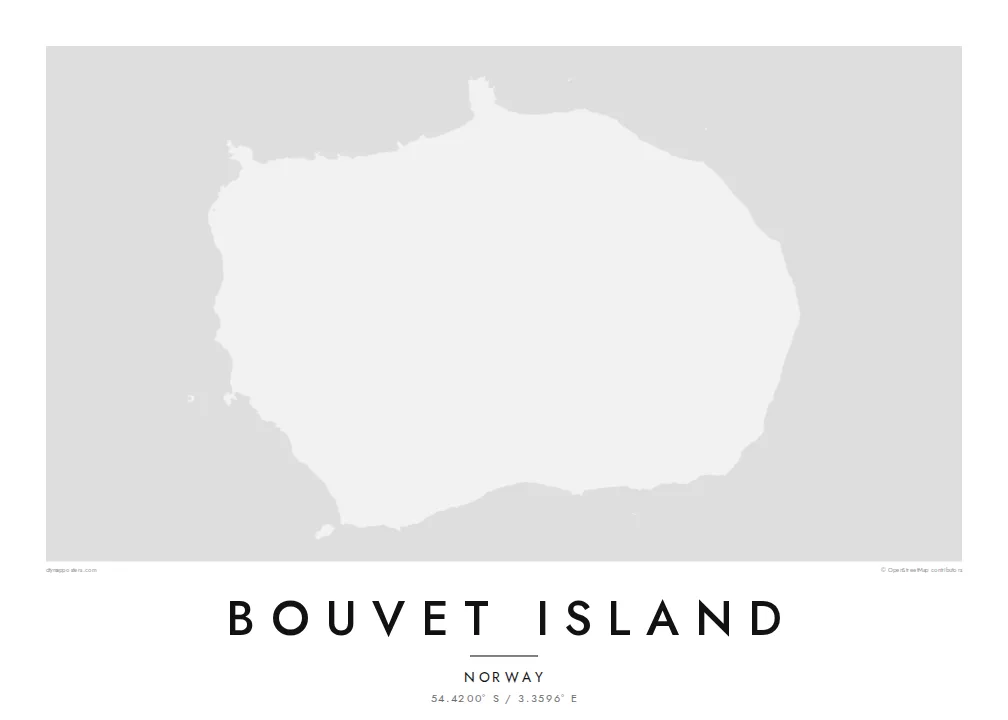
A permanent glacier covers most of the island, so the poster shows smooth, open land within the coastline, uninterrupted by roads or buildings.
Posta faʻafanua faigofie · Norway
54.4200° S / 3.3596° E
A small, rounded island almost entirely buried under ice, rising from the South Atlantic far from any other land.
Tasi le aai, lagona e lima
Tapi se sitaili e vaai ai i luga o le puipui. E tutusa uma le tau o sitaili — pe lolomiina, faapipiiina, pe avea ma faila HD.
 Pika Moni · Faila Lolomi 24 × 36″
Manino mo le lolomi
O se vaega atoa (100%) lenei mai le faila lolomi moni. O posita uma — pe lolomiina, faapipiiina pe download mai — e faia i luga o a matou server i le 300 DPI, e oo atu i le 7,200 × 10,800 pika, ina ia manino pea auala laiti i luga o se lolomiga 24 × 36″.
I luga o le puipui


Le faʻafanua
Bouvet Island is a Norwegian dependency in the South Atlantic, often described as the most remote island in the world. It lies roughly between South Africa and Antarctica, and the nearest land is the Antarctic coast, some 1,700 kilometres away. The island is the top of a volcano, and most of its surface is covered by a permanent ice cap.
There are no roads, towns or permanent inhabitants. The coast is formed mostly of ice cliffs and steep rock, with very few places where a landing is possible. A Bouvet Island map poster is therefore an outline and little else: a compact, rounded shape surrounded by ocean, closer to a cartographer's study than to a street map.
The island has been a nature reserve since 1971, and seals and seabirds use its few ice-free patches. Norway maintains an automated weather station there, and scientific expeditions arrive only occasionally. Its isolation has made it a small legend among people who follow remote places, and the map carries that sense of distance.
A permanent glacier covers most of the island, so the poster shows smooth, open land within the coastline, uninterrupted by roads or buildings.
The island is roughly oval and under ten kilometres across, a clean shape that stands out clearly at any print size, with the ocean framing it on all sides.
Ice cliffs and rock walls meet the sea along most of the shore. The few small headlands and inlets are the only irregularities in an otherwise simple outline.
Fai mo oe
Faʻaopoopo se aso, se igoa po o sau lava upu, sui le sitaili, lapoʻa po o le itu.
O le preview e leai se totogi e maualalo le resolution ma iai se watermark. O lolomi ma faila HD e faia i le 300 DPI, e oo atu i le 7,200 × 10,800 px, e aunoa ma se watermark.
Aisea Bouvet Island
Bouvet Island attracts collectors of remote places, polar enthusiasts and anyone who likes the idea of a map with nothing on it but land and sea. The poster is minimal by nature, a quiet object for a study, a bookshelf wall or a gift.
Personalise the title and subtitle, and keep or edit the coordinates line, which here points to one of the loneliest positions on the globe. Noir and Blueprint suit the ice, alongside the other three styles, Classic, Paper and Sand. HD files cost $9 and have no watermark.
Faatau le posita Bouvet Island| Lapoʻa lolomi | Manino | Faila |
|---|---|---|
| 30 × 40 cm11.8 × 15.7″ | 3,543 × 4,724 px | PNG · PDF |
| 29.7 × 42 cm (A3)11.7 × 16.5″ | 3,508 × 4,961 px | PNG · PDF |
| 42 × 59.4 cm (A2)16.5 × 23.4″ | 4,961 × 7,016 px | PNG · PDF |
| 45.7 × 61 cm18 × 24″ | 5,400 × 7,200 px | PNG · PDF |
| 50 × 70 cm19.7 × 27.6″ | 5,906 × 8,268 px | PNG · PDF |
| 61 × 91.4 cm24 × 36″ | 7,200 × 10,800 px | PNG · PDF |
Ae faʻatusatusa, o le faʻataʻitaʻiga e leai se totogi e 900 px le lautele, e iai le faʻailoga vai ma e mo mata. O faila HD e oʻo atu i le 8× le manino i itu taʻitasi ma e lolomi manino i le lapoʻa atoa o le posta.
Filifili se sitaili i le pito i luga o le itulau, ona filifili lea o le Posita Lolomi — se lapopoa ma, afai e te fiafia, se faavaa — po o Faila HD Numera. E na o le tasi laasaga o le Checkout, ma o le a fesuia'i lou itulau o oka i le taimi lava e mae'a ai le totogi.
E lolomiina i luga o pepa matte maualuga le tulaga e 200 gsm, i se tasi o lapopoa e ono, mai le 30 × 40 cm i le 24 × 36″. E amata le tau o posita lolomi mai le $39, aofia ai le auina atu.
Ioe. Filifili se faavaa laau malosi i le lanu uliuli, sina, oak masani, po o le laau pogisa. E aofia ai se tioata e le gau ma ua saunia e tautau i luga. E amata le tau o posita faavaa mai le $99, aofia ai le auina atu.
E leai se totogi o le auina atu i atunuu e 60+. O pepa ata taʻitasi e lolomiina e le tasi o matou paaga lolomi e latalata mai i atunuu e 30+, ma e masani ona taunuu i le 3–7 aso faigaluega. E mafai ona e mulimulitaia le tulaga ma le sailiga i lalo o My Orders. O nisi atunuu e 2–5 vaiaso, ma i nofoaga e lei matou auina atu iai, e taʻu atu e le saite ia te oe a o lei totogi.
Auina mai se ata i totonu o le 14 aso talu ona taunuu, ma o le a matou toe lolomiina e leai se totogi po o le toe faafoi atu lau tupe.
Ioe. I totonu o le editor i lenei itulau, suia le ulutala, le ulutala laititi ma le laina o coordinates i soo se mea e te fiafia i ai, ma filifili se sitaili ma le lapopoa. O oka lolomi, faavaa ma numera e faaaoga uma lava lau mamanu.
Mo le $9 e te maua ai faila PNG 300 DPI ma PDF ua saunia mo le lolomi i lapopoa uma e ono, e aunoa ma se watermark, e mafai ona lolomi i soo se mea. Le mautinoa lava? Download muamua se preview e leai se totogi ma le watermark.
Latalata ane
