The Reggia's park
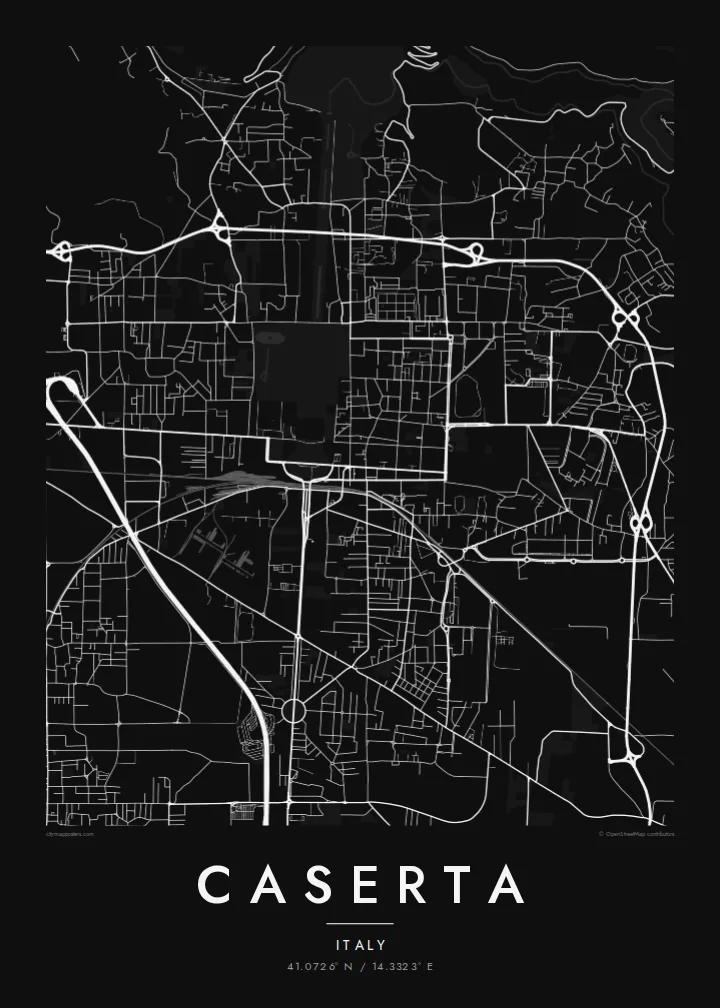
A single straight axis of basins, fountains and cascades runs from the palace to the hillside. It is one of the most striking straight lines on any Italian city map.
Posta faʻafanua faigofie · Italy
41.0726° N / 14.3323° E
A city organised around a royal axis, with the Reggia's vast park running straight toward the hills of Campania.

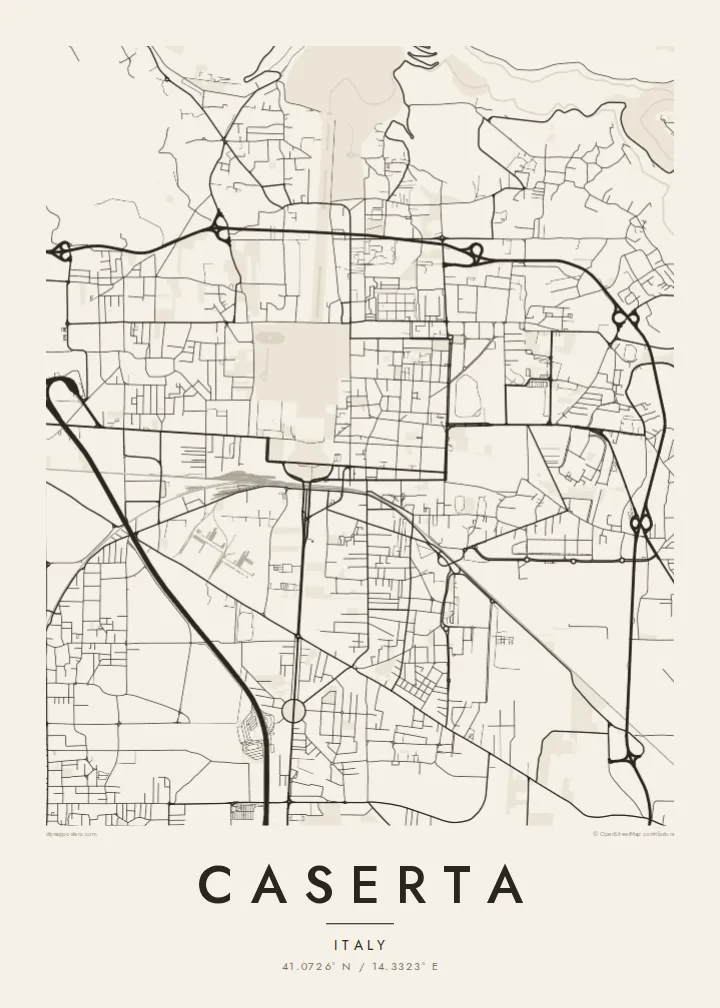


Tasi le aai, lagona e lima
Tapi se sitaili e vaai ai i luga o le puipui. E tutusa uma le tau o sitaili — pe lolomiina, faapipiiina, pe avea ma faila HD.
 Pika Moni · Faila Lolomi 24 × 36″
Manino mo le lolomi
O se vaega atoa (100%) lenei mai le faila lolomi moni. O posita uma — pe lolomiina, faapipiiina pe download mai — e faia i luga o a matou server i le 300 DPI, e oo atu i le 7,200 × 10,800 pika, ina ia manino pea auala laiti i luga o se lolomiga 24 × 36″.
I luga o le puipui


Le faʻafanua
Caserta is one of the few Italian cities whose map is shaped by a single royal plan. The Reggia di Caserta, the palace built for the Bourbon kings of Naples, stands at the centre of the town. Behind it, the park runs as one long, straight line of lawns, pools and cascades for about three kilometres up toward the hills.
The town's streets and avenues line up with the palace. A broad forecourt opens toward the railway and the modern centre, so the monument and the everyday city form one composition. Around this axis the streets become denser and more ordinary, then spread out across the Campanian plain. To the north, the land climbs to the wooded slopes of the Tifatini hills.
Luigi Vanvitelli began the palace in 1752. Together with the Carolino Aqueduct and the silk complex of San Leucio, it is a UNESCO World Heritage Site. On a hill above the city is Casertavecchia, the older medieval village. A Caserta map poster shows how clearly an eighteenth-century plan still shapes a working modern city.
A single straight axis of basins, fountains and cascades runs from the palace to the hillside. It is one of the most striking straight lines on any Italian city map.
The large open space in front of the Reggia connects the palace with the modern centre and the station. It is the point where the royal plan meets the working town.
The medieval village sits on the hills north-east of the city. Its small cluster of lanes is a clear contrast to the geometry of the plain below.
Fai mo oe
Faʻaopoopo se aso, se igoa po o sau lava upu, sui le sitaili, lapoʻa po o le itu.
O le preview e leai se totogi e maualalo le resolution ma iai se watermark. O lolomi ma faila HD e faia i le 300 DPI, e oo atu i le 7,200 × 10,800 px, e aunoa ma se watermark.
Aisea Caserta
People who studied, married or grew up near the Reggia often want a map of Caserta. The palace axis gives the print a strong, symmetrical structure that works well on a large wall.
You can add names, a wedding date or a personal line to the title, subtitle and coordinates line. Then choose Classic black & white, Noir, Paper, Blueprint or Sand to match your space.
Faatau le posita Caserta| Lapoʻa lolomi | Manino | Faila |
|---|---|---|
| 30 × 40 cm (11.8 × 15.7″) | 3,543 × 4,724 px | PNG · PDF |
| 29.7 × 42 cm (A3, 11.7 × 16.5″) | 3,508 × 4,961 px | PNG · PDF |
| 42 × 59.4 cm (A2, 16.5 × 23.4″) | 4,961 × 7,016 px | PNG · PDF |
| 45.7 × 61 cm (18 × 24″) | 5,400 × 7,200 px | PNG · PDF |
| 50 × 70 cm (19.7 × 27.6″) | 5,906 × 8,268 px | PNG · PDF |
| 61 × 91.4 cm (24 × 36″) | 7,200 × 10,800 px | PNG · PDF |
Ae faʻatusatusa, o le faʻataʻitaʻiga e leai se totogi e 900 px le lautele, e iai le faʻailoga vai ma e mo mata. O faila HD e oʻo atu i le 8× le manino i itu taʻitasi ma e lolomi manino i le lapoʻa atoa o le posta.
Filifili se sitaili i le pito i luga o le itulau, ona filifili lea o le Posita Lolomi — se lapopoa ma, afai e te fiafia, se faavaa — po o Faila HD Numera. E na o le tasi laasaga o le Checkout, ma o le a fesuia'i lou itulau o oka i le taimi lava e mae'a ai le totogi.
E lolomiina i luga o pepa matte maualuga le tulaga e 200 gsm, i se tasi o lapopoa e ono, mai le 30 × 40 cm i le 24 × 36″. E amata le tau o posita lolomi mai le $39, aofia ai le auina atu.
Ioe. Filifili se faavaa laau malosi i le lanu uliuli, sina, oak masani, po o le laau pogisa. E aofia ai se tioata e le gau ma ua saunia e tautau i luga. E amata le tau o posita faavaa mai le $99, aofia ai le auina atu.
E leai se totogi mo le uta i le lalolagi atoa. O poster ta'itasi e lolomi e le paaga lolomi e latalata mai i matou i atunuu e 30+, ma e masani ona taunuu i aso faigaluega e 3–7. E mafai ona e mulimuli i le tulaga ma le tracking i le "Aʻu Oka". O nisi atunuu e 2–5 vaiaso, ma i atunuu matou te lei tuuina atu ai, e taʻu atu e le saite iā te oe ae e te leʻi totogiina.
Auina mai se ata i totonu o le 14 aso talu ona taunuu, ma o le a matou toe lolomiina e leai se totogi po o le toe faafoi atu lau tupe.
Ioe. I totonu o le editor i lenei itulau, suia le ulutala, le ulutala laititi ma le laina o coordinates i soo se mea e te fiafia i ai, ma filifili se sitaili ma le lapopoa. O oka lolomi, faavaa ma numera e faaaoga uma lava lau mamanu.
Mo le $9 e te maua ai faila PNG 300 DPI ma PDF ua saunia mo le lolomi i lapopoa uma e ono, e aunoa ma se watermark, e mafai ona lolomi i soo se mea. Le mautinoa lava? Download muamua se preview e leai se totogi ma le watermark.
