Sarmiento railway
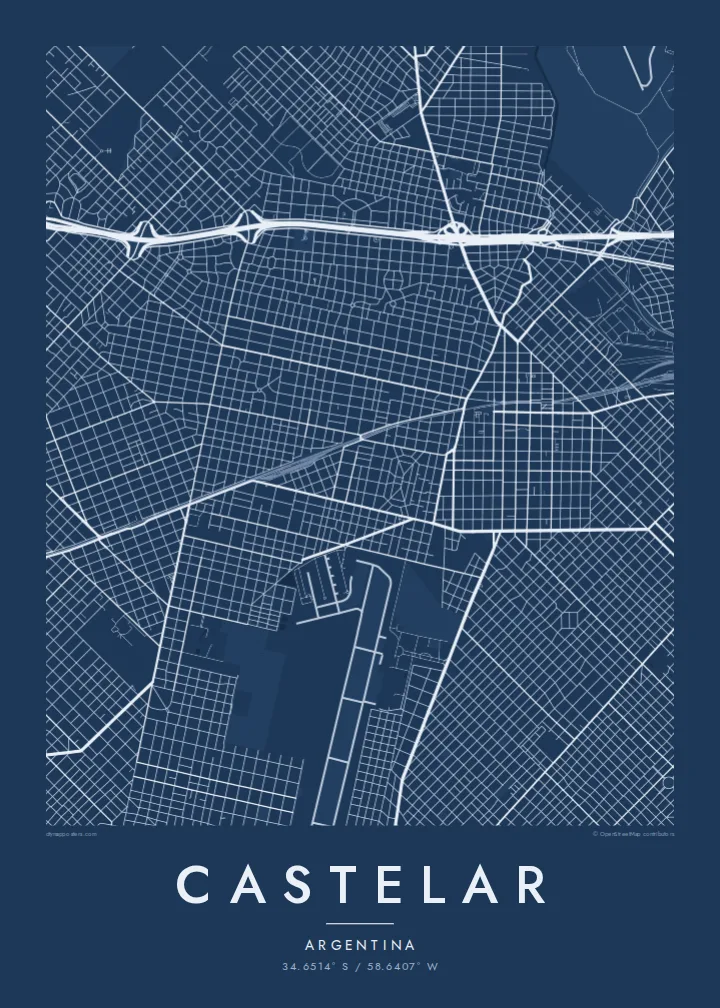
The rail line cuts straight through Castelar with the station at its centre, splitting the town into two halves that are joined by a handful of crossings.
Posta faʻafanua faigofie · Argentina
34.6514° S / 58.6407° W
A leafy suburban grid west of Buenos Aires, divided cleanly in two by the straight line of the Sarmiento railway.



Tasi le aai, lagona e lima
Tapi se sitaili e vaai ai i luga o le puipui. E tutusa uma le tau o sitaili — pe lolomiina, faapipiiina, pe avea ma faila HD.
 Pika Moni · Faila Lolomi 24 × 36″
Manino mo le lolomi
O se vaega atoa (100%) lenei mai le faila lolomi moni. O posita uma — pe lolomiina, faapipiiina pe download mai — e faia i luga o a matou server i le 300 DPI, e oo atu i le 7,200 × 10,800 pika, ina ia manino pea auala laiti i luga o se lolomiga 24 × 36″.
I luga o le puipui


Le faʻafanua
Castelar is a residential town in Morón Partido, in the western part of Greater Buenos Aires. On a map it looks like much of the surrounding conurbation: a steady grid of square blocks stretching in every direction. What sets it apart is the railway, which runs straight through the centre and splits the town into two halves that meet at the station.
The Sarmiento line connects Castelar with central Buenos Aires, and the area around the station has long been the local commercial heart. Further out the streets become quieter and more residential, with tree-lined blocks and houses on individual lots, a pattern typical of the older western suburbs.
A Castelar map poster turns that regular grid into something graphic and calm. The repeating blocks give the design texture, the rail line adds one strong, uninterrupted stroke, and the larger avenues frame the neighbourhood. Anyone who grew up in the western suburbs will recognise the pattern immediately.
The rail line cuts straight through Castelar with the station at its centre, splitting the town into two halves that are joined by a handful of crossings.
Square blocks repeat almost uniformly across the map, forming a fine, even texture that is especially striking at large print sizes such as 50×70 cm or 24×36″.
Wider avenues run through the grid and around the town, giving the repetitive street pattern a few firm lines that organise the composition.
Fai mo oe
Faʻaopoopo se aso, se igoa po o sau lava upu, sui le sitaili, lapoʻa po o le itu.
O le preview e leai se totogi e maualalo le resolution ma iai se watermark. O lolomi ma faila HD e faia i le 300 DPI, e oo atu i le 7,200 × 10,800 px, e aunoa ma se watermark.
Aisea Castelar
Castelar is the kind of place people carry with them: a childhood neighbourhood, a first home, or the stop where a daily commute began. A map of its streets makes a personal gift for anyone from the western suburbs, including those now living abroad.
Add a title, subtitle and coordinates line of your choice, and pick from five styles, from Classic black & white to the warmer Sand. Printed posters ship from partners in more than 30 countries, so a framed copy can reach family wherever they are.
Faatau le posita Castelar| Lapoʻa lolomi | Manino | Faila |
|---|---|---|
| 30 × 40 cm11.8 × 15.7″ | 3,543 × 4,724 px | PNG · PDF |
| 29.7 × 42 cm (A3)11.7 × 16.5″ | 3,508 × 4,961 px | PNG · PDF |
| 42 × 59.4 cm (A2)16.5 × 23.4″ | 4,961 × 7,016 px | PNG · PDF |
| 45.7 × 61 cm18 × 24″ | 5,400 × 7,200 px | PNG · PDF |
| 50 × 70 cm19.7 × 27.6″ | 5,906 × 8,268 px | PNG · PDF |
| 61 × 91.4 cm24 × 36″ | 7,200 × 10,800 px | PNG · PDF |
Ae faʻatusatusa, o le faʻataʻitaʻiga e leai se totogi e 900 px le lautele, e iai le faʻailoga vai ma e mo mata. O faila HD e oʻo atu i le 8× le manino i itu taʻitasi ma e lolomi manino i le lapoʻa atoa o le posta.
Filifili se sitaili i le pito i luga o le itulau, ona filifili lea o le Posita Lolomi — se lapopoa ma, afai e te fiafia, se faavaa — po o Faila HD Numera. E na o le tasi laasaga o le Checkout, ma o le a fesuia'i lou itulau o oka i le taimi lava e mae'a ai le totogi.
E lolomiina i luga o pepa matte maualuga le tulaga e 200 gsm, i se tasi o lapopoa e ono, mai le 30 × 40 cm i le 24 × 36″. E amata le tau o posita lolomi mai le $39, aofia ai le auina atu.
Ioe. Filifili se faavaa laau malosi i le lanu uliuli, sina, oak masani, po o le laau pogisa. E aofia ai se tioata e le gau ma ua saunia e tautau i luga. E amata le tau o posita faavaa mai le $99, aofia ai le auina atu.
E leai se totogi o le auina atu i atunuu e 60+. O pepa ata taʻitasi e lolomiina e le tasi o matou paaga lolomi e latalata mai i atunuu e 30+, ma e masani ona taunuu i le 3–7 aso faigaluega. E mafai ona e mulimulitaia le tulaga ma le sailiga i lalo o My Orders. O nisi atunuu e 2–5 vaiaso, ma i nofoaga e lei matou auina atu iai, e taʻu atu e le saite ia te oe a o lei totogi.
Auina mai se ata i totonu o le 14 aso talu ona taunuu, ma o le a matou toe lolomiina e leai se totogi po o le toe faafoi atu lau tupe.
Ioe. I totonu o le editor i lenei itulau, suia le ulutala, le ulutala laititi ma le laina o coordinates i soo se mea e te fiafia i ai, ma filifili se sitaili ma le lapopoa. O oka lolomi, faavaa ma numera e faaaoga uma lava lau mamanu.
Mo le $9 e te maua ai faila PNG 300 DPI ma PDF ua saunia mo le lolomi i lapopoa uma e ono, e aunoa ma se watermark, e mafai ona lolomi i soo se mea. Le mautinoa lava? Download muamua se preview e leai se totogi ma le watermark.
