Colliery landscape
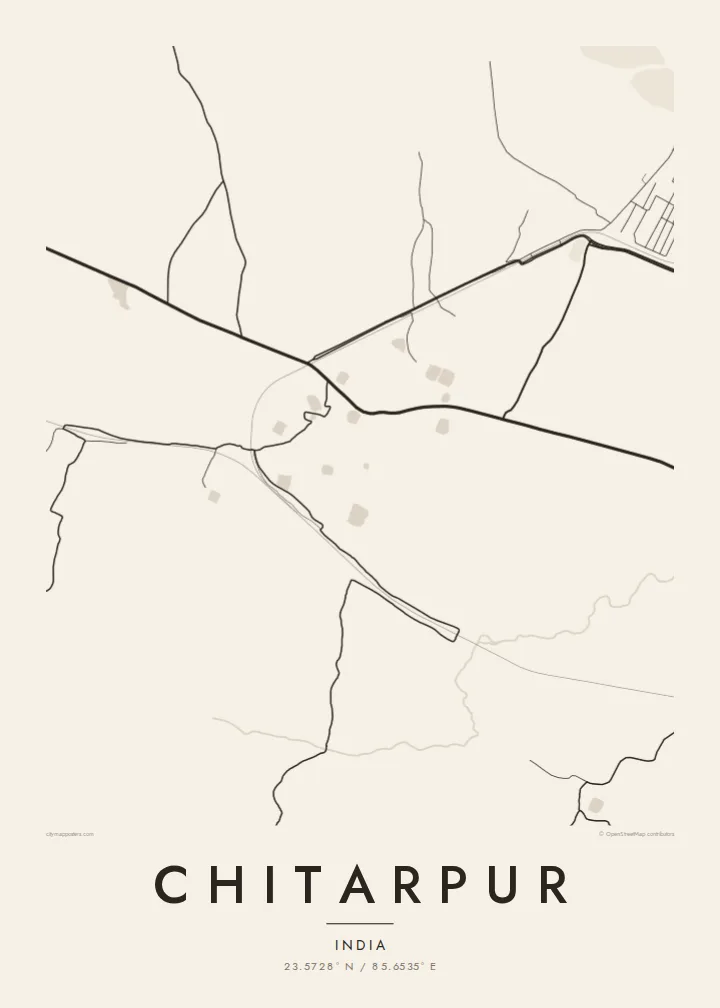
Mining areas leave large irregular shapes around the town, which contrast with the finer housing streets. The map shows how work and settlement grew up side by side.
Posta faʻafanua faigofie · India
23.5728° N / 85.6535° E
A mining-belt town in the Damodar basin, its streets spreading between rail lines, coal workings and low hills




Tasi le aai, lagona e lima
Tapi se sitaili e vaai ai i luga o le puipui. E tutusa uma le tau o sitaili — pe lolomiina, faapipiiina, pe avea ma faila HD.
 Pika Moni · Faila Lolomi 24 × 36″
Manino mo le lolomi
O se vaega atoa (100%) lenei mai le faila lolomi moni. O posita uma — pe lolomiina, faapipiiina pe download mai — e faia i luga o a matou server i le 300 DPI, e oo atu i le 7,200 × 10,800 pika, ina ia manino pea auala laiti i luga o se lolomiga 24 × 36″.
I luga o le puipui


Le faʻafanua
Chitarpur is a town in Ramgarh district, Jharkhand, in a part of the Chota Nagpur plateau shaped by coal. From above, the layout follows function more than design. Clusters of housing sit near roads and rail links, open ground separates the neighbourhoods, and the large scars of mining activity lie around the edges.
The Damodar river system drains this region. Its broad channels and tributaries loop across the plateau, and settlements along them grew as coal extraction expanded through the twentieth century. On a map the rivers give a sense of order to a landscape that otherwise breaks into fragments: villages, colliery townships, fields and patches of scrub.
The temple at Rajrappa, at the meeting of the Damodar and Bhairavi rivers, lies in the same district and draws pilgrims from across the state. A Chitarpur map poster sets the town within that wider plateau setting: roads leading to the mines and markets, a railway line cutting across, and the river country close by.
Mining areas leave large irregular shapes around the town, which contrast with the finer housing streets. The map shows how work and settlement grew up side by side.
A railway and main roads cross the area in long lines that connect Chitarpur to the rest of the coalfield and to the wider Jharkhand network.
Rivers and their broad sandy beds wind through the district, adding sweeping curves to a map otherwise made up of scattered, angular settlements.
Fai mo oe
Faʻaopoopo se aso, se igoa po o sau lava upu, sui le sitaili, lapoʻa po o le itu.
O le preview e leai se totogi e maualalo le resolution ma iai se watermark. O lolomi ma faila HD e faia i le 300 DPI, e oo atu i le 7,200 × 10,800 px, e aunoa ma se watermark.
Aisea Chitarpur
Families tied to Jharkhand's coal towns often move far from home, and a map is a direct way to keep the place in view. Chitarpur's pattern of roads, mines and river country makes a distinctive, graphic image.
Add your own title and a subtitle, perhaps a family name or a year, and choose from five styles. The $9 digital files come in six print sizes, and printed posters on matte paper can be ordered with or without a wooden frame.
Faatau le posita Chitarpur| Lapoʻa lolomi | Manino | Faila |
|---|---|---|
| 30 × 40 cm11.8 × 15.7″ | 3,543 × 4,724 px | PNG · PDF |
| 29.7 × 42 cm (A3)11.7 × 16.5″ | 3,508 × 4,961 px | PNG · PDF |
| 42 × 59.4 cm (A2)16.5 × 23.4″ | 4,961 × 7,016 px | PNG · PDF |
| 45.7 × 61 cm18 × 24″ | 5,400 × 7,200 px | PNG · PDF |
| 50 × 70 cm19.7 × 27.6″ | 5,906 × 8,268 px | PNG · PDF |
| 61 × 91.4 cm24 × 36″ | 7,200 × 10,800 px | PNG · PDF |
Ae faʻatusatusa, o le faʻataʻitaʻiga e leai se totogi e 900 px le lautele, e iai le faʻailoga vai ma e mo mata. O faila HD e oʻo atu i le 8× le manino i itu taʻitasi ma e lolomi manino i le lapoʻa atoa o le posta.
Filifili se sitaili i le pito i luga o le itulau, ona filifili lea o le Posita Lolomi — se lapopoa ma, afai e te fiafia, se faavaa — po o Faila HD Numera. E na o le tasi laasaga o le Checkout, ma o le a fesuia'i lou itulau o oka i le taimi lava e mae'a ai le totogi.
E lolomiina i luga o pepa matte maualuga le tulaga e 200 gsm, i se tasi o lapopoa e ono, mai le 30 × 40 cm i le 24 × 36″. E amata le tau o posita lolomi mai le $39, aofia ai le auina atu.
Ioe. Filifili se faavaa laau malosi i le lanu uliuli, sina, oak masani, po o le laau pogisa. E aofia ai se tioata e le gau ma ua saunia e tautau i luga. E amata le tau o posita faavaa mai le $99, aofia ai le auina atu.
E leai se totogi o le auina atu i atunuu e 60+. O pepa ata taʻitasi e lolomiina e le tasi o matou paaga lolomi e latalata mai i atunuu e 30+, ma e masani ona taunuu i le 3–7 aso faigaluega. E mafai ona e mulimulitaia le tulaga ma le sailiga i lalo o My Orders. O nisi atunuu e 2–5 vaiaso, ma i nofoaga e lei matou auina atu iai, e taʻu atu e le saite ia te oe a o lei totogi.
Auina mai se ata i totonu o le 14 aso talu ona taunuu, ma o le a matou toe lolomiina e leai se totogi po o le toe faafoi atu lau tupe.
Ioe. I totonu o le editor i lenei itulau, suia le ulutala, le ulutala laititi ma le laina o coordinates i soo se mea e te fiafia i ai, ma filifili se sitaili ma le lapopoa. O oka lolomi, faavaa ma numera e faaaoga uma lava lau mamanu.
Mo le $9 e te maua ai faila PNG 300 DPI ma PDF ua saunia mo le lolomi i lapopoa uma e ono, e aunoa ma se watermark, e mafai ona lolomi i soo se mea. Le mautinoa lava? Download muamua se preview e leai se totogi ma le watermark.
Latalata ane
