Streets over hills
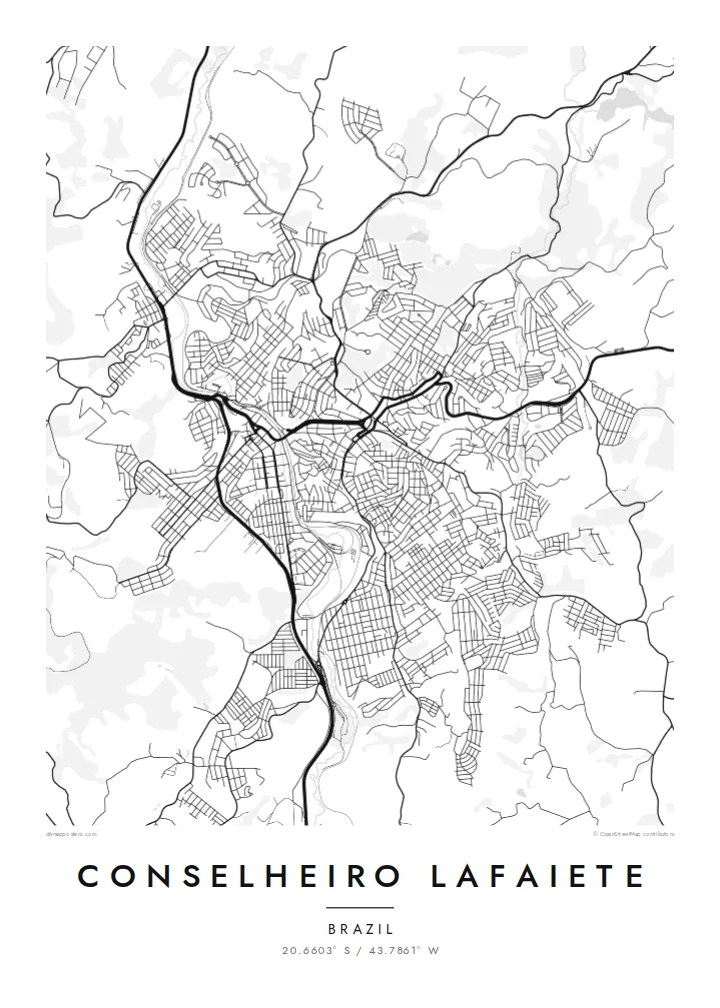
Roads bend with the contours instead of crossing them, producing a web of curves and short dead ends that reads almost like the veins of a leaf.
Posta faʻafanua faigofie · Brazil
20.6603° S / 43.7861° W
A hilly Minas Gerais city whose streets curve and fold around valleys on the route between Belo Horizonte and Rio.


Tasi le aai, lagona e lima
Tapi se sitaili e vaai ai i luga o le puipui. E tutusa uma le tau o sitaili — pe lolomiina, faapipiiina, pe avea ma faila HD.
 Pika Moni · Faila Lolomi 24 × 36″
Manino mo le lolomi
O se vaega atoa (100%) lenei mai le faila lolomi moni. O posita uma — pe lolomiina, faapipiiina pe download mai — e faia i luga o a matou server i le 300 DPI, e oo atu i le 7,200 × 10,800 pika, ina ia manino pea auala laiti i luga o se lolomiga 24 × 36″.
I luga o le puipui


Le faʻafanua
Conselheiro Lafaiete sits in the highlands of Minas Gerais, south of Belo Horizonte, along the corridor that leads toward Rio de Janeiro. The terrain is uneven, and the street plan shows it: roads curve along ridges and dip into valleys rather than holding to a straight grid. Seen from above, the city looks like a network of branches spreading over the hills.
The town was long known as Queluz and later took the name of Lafayette Rodrigues Pereira, a nineteenth-century jurist and statesman born there; Conselheiro refers to his title as a counsellor of the Empire. The surrounding region has a long mining history, and railway lines still trace the lower ground through town, adding long curves to the plan.
A Conselheiro Lafaiete map poster turns that uneven ground into a dense, organic drawing. There is no single axis to follow; instead the eye moves along winding streets that meet at irregular junctions, with neighbourhoods clustered wherever the land allowed them to settle. It is a good example of how topography writes itself into a city plan.
Roads bend with the contours instead of crossing them, producing a web of curves and short dead ends that reads almost like the veins of a leaf.
Rail lines keep to the lower, flatter ground, giving the map a few long and steady curves among the more restless street pattern.
The main road between Belo Horizonte and Rio passes the city, a straighter line at the edge of the composition that sets off the organic centre.
Fai mo oe
Faʻaopoopo se aso, se igoa po o sau lava upu, sui le sitaili, lapoʻa po o le itu.
O le preview e leai se totogi e maualalo le resolution ma iai se watermark. O lolomi ma faila HD e faia i le 300 DPI, e oo atu i le 7,200 × 10,800 px, e aunoa ma se watermark.
Aisea Conselheiro Lafaiete
Many who hang this map know Lafaiete through family, or passed through on the way between Minas and Rio and stayed. The drawing reflects what it feels like to walk there: always a slope, always a turn, and a view opening wherever a street reaches a ridge.
Add a title such as the old name Queluz, a date, or a family surname, and adjust the coordinates line underneath. Pick one of five styles: Classic black & white, Noir, Paper, Blueprint or Sand. The digital files cover six print sizes, each as a 300 DPI PNG and PDF.
Faatau le posita Conselheiro Lafaiete| Lapoʻa lolomi | Manino | Faila |
|---|---|---|
| 30 × 40 cm11.8 × 15.7″ | 3,543 × 4,724 px | PNG · PDF |
| 29.7 × 42 cm (A3)11.7 × 16.5″ | 3,508 × 4,961 px | PNG · PDF |
| 42 × 59.4 cm (A2)16.5 × 23.4″ | 4,961 × 7,016 px | PNG · PDF |
| 45.7 × 61 cm18 × 24″ | 5,400 × 7,200 px | PNG · PDF |
| 50 × 70 cm19.7 × 27.6″ | 5,906 × 8,268 px | PNG · PDF |
| 61 × 91.4 cm24 × 36″ | 7,200 × 10,800 px | PNG · PDF |
Ae faʻatusatusa, o le faʻataʻitaʻiga e leai se totogi e 900 px le lautele, e iai le faʻailoga vai ma e mo mata. O faila HD e oʻo atu i le 8× le manino i itu taʻitasi ma e lolomi manino i le lapoʻa atoa o le posta.
Filifili se sitaili i le pito i luga o le itulau, ona filifili lea o le Posita Lolomi — se lapopoa ma, afai e te fiafia, se faavaa — po o Faila HD Numera. E na o le tasi laasaga o le Checkout, ma o le a fesuia'i lou itulau o oka i le taimi lava e mae'a ai le totogi.
E lolomiina i luga o pepa matte maualuga le tulaga e 200 gsm, i se tasi o lapopoa e ono, mai le 30 × 40 cm i le 24 × 36″. E amata le tau o posita lolomi mai le $39, aofia ai le auina atu.
Ioe. Filifili se faavaa laau malosi i le lanu uliuli, sina, oak masani, po o le laau pogisa. E aofia ai se tioata e le gau ma ua saunia e tautau i luga. E amata le tau o posita faavaa mai le $99, aofia ai le auina atu.
E leai se totogi o le auina atu i atunuu e 60+. O pepa ata taʻitasi e lolomiina e le tasi o matou paaga lolomi e latalata mai i atunuu e 30+, ma e masani ona taunuu i le 3–7 aso faigaluega. E mafai ona e mulimulitaia le tulaga ma le sailiga i lalo o My Orders. O nisi atunuu e 2–5 vaiaso, ma i nofoaga e lei matou auina atu iai, e taʻu atu e le saite ia te oe a o lei totogi.
Auina mai se ata i totonu o le 14 aso talu ona taunuu, ma o le a matou toe lolomiina e leai se totogi po o le toe faafoi atu lau tupe.
Ioe. I totonu o le editor i lenei itulau, suia le ulutala, le ulutala laititi ma le laina o coordinates i soo se mea e te fiafia i ai, ma filifili se sitaili ma le lapopoa. O oka lolomi, faavaa ma numera e faaaoga uma lava lau mamanu.
Mo le $9 e te maua ai faila PNG 300 DPI ma PDF ua saunia mo le lolomi i lapopoa uma e ono, e aunoa ma se watermark, e mafai ona lolomi i soo se mea. Le mautinoa lava? Download muamua se preview e leai se totogi ma le watermark.
Latalata ane
