Palace on the rise
The Bundela-era palace stands on raised rocky ground at the edge of the old town, where the dense lanes give way to the palace's large, open footprint.
Posta faʻafanua faigofie · India
25.6731° N / 78.4591° E
A compact old town of lanes and water tanks, overlooked by a seven-storey palace on a rocky rise



Tasi le aai, lagona e lima
Tapi se sitaili e vaai ai i luga o le puipui. E tutusa uma le tau o sitaili — pe lolomiina, faapipiiina, pe avea ma faila HD.
 Pika Moni · Faila Lolomi 24 × 36″
Manino mo le lolomi
O se vaega atoa (100%) lenei mai le faila lolomi moni. O posita uma — pe lolomiina, faapipiiina pe download mai — e faia i luga o a matou server i le 300 DPI, e oo atu i le 7,200 × 10,800 pika, ina ia manino pea auala laiti i luga o se lolomiga 24 × 36″.
I luga o le puipui


Le faʻafanua
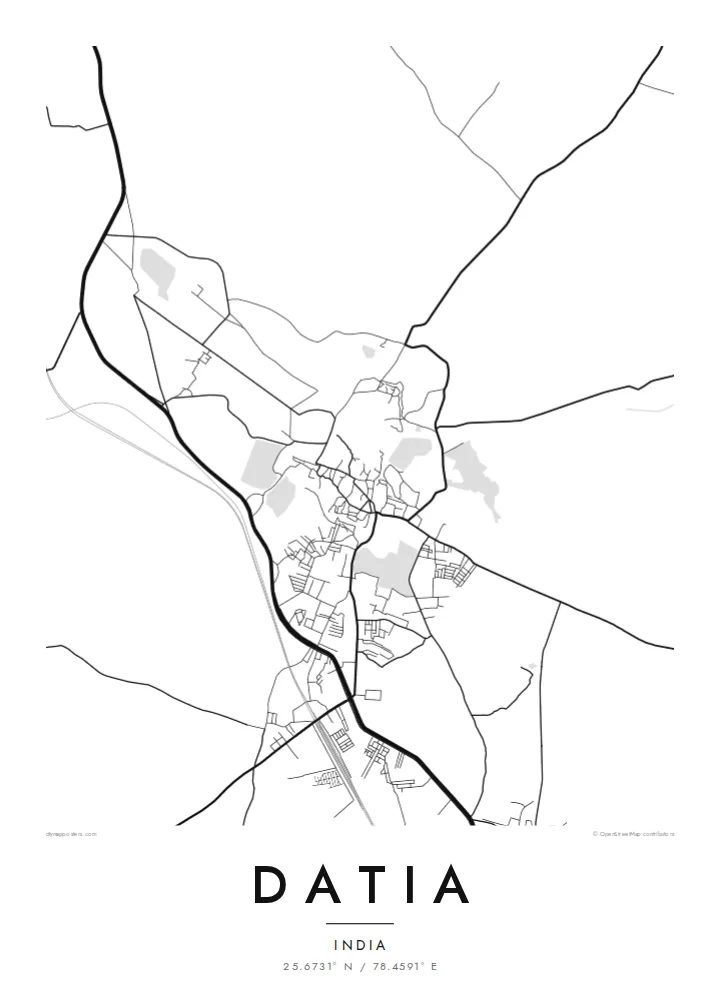
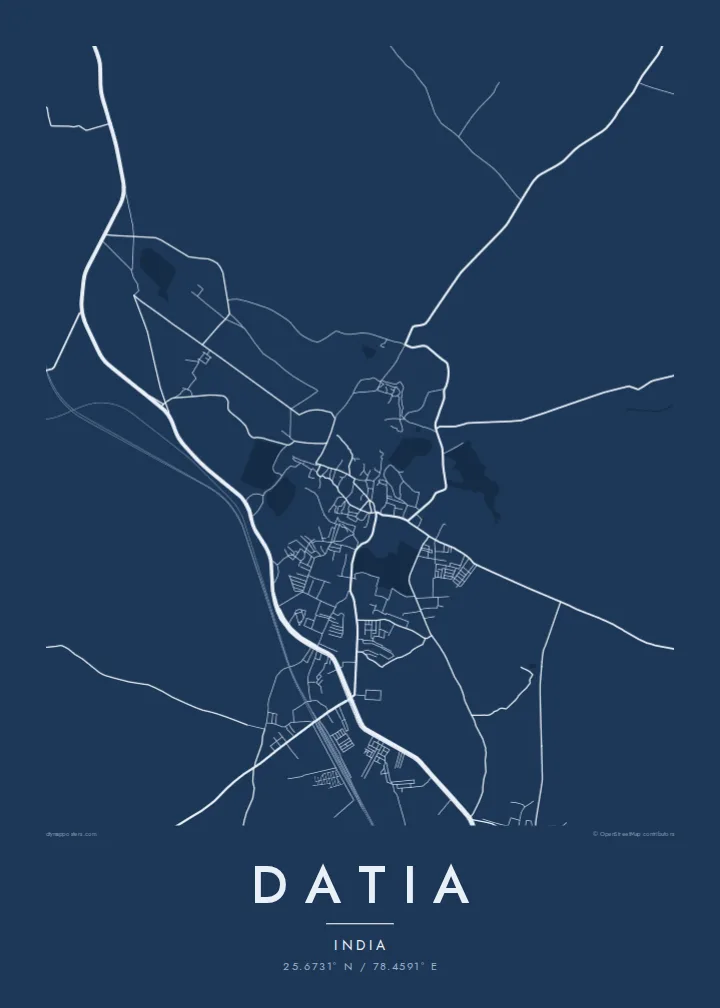
Datia lies in the Bundelkhand region of northern Madhya Pradesh, close to the border with Uttar Pradesh and the city of Jhansi. From above, the older core is a dense knot of narrow, irregular lanes. Newer roads and the railway run around its edges. Water tanks and open ground break up the built area, and farmland spreads out beyond the town on all sides.
The town is best known for its palace, a seven-storey structure built in the early seventeenth century under the Bundela ruler Bir Singh Deo, which stands on a rocky outcrop above the lanes. Datia was once the seat of a princely state. Today it draws pilgrims to the Pitambara Peeth temple complex, one of the most visited shrines in the region.
A Datia map poster captures the contrast between the tight, historic centre and the looser grid of later growth. On paper the old town shows up as a fine, almost woven texture of streets. Wider roads cut past it towards the highway and the station, and the surrounding fields leave plenty of calm space around the drawing.
The Bundela-era palace stands on raised rocky ground at the edge of the old town, where the dense lanes give way to the palace's large, open footprint.
The historic centre is a close web of short, winding streets with few straight lines, very different from the more regular blocks that grew up later.
Reservoirs and open plots appear as calm blank shapes within and around the town, giving the dense street pattern natural pauses.
Fai mo oe
Faʻaopoopo se aso, se igoa po o sau lava upu, sui le sitaili, lapoʻa po o le itu.
O le preview e leai se totogi e maualalo le resolution ma iai se watermark. O lolomi ma faila HD e faia i le 300 DPI, e oo atu i le 7,200 × 10,800 px, e aunoa ma se watermark.
Aisea Datia
For families with roots in Bundelkhand, or anyone who has visited the palace or the temple, Datia is a very specific place. A map print keeps that connection on the wall without needing a photograph. The winding lanes alone are enough to make it recognisable.
The poster can carry a family name, a date or a short line of your own, along with the coordinates. Choose from Classic black & white, Noir, Paper, Blueprint or Sand, depending on whether you want a formal print or something warmer.
Faatau le posita Datia| Lapoʻa lolomi | Manino | Faila |
|---|---|---|
| 30 × 40 cm (11.8 × 15.7″) | 3,543 × 4,724 px | PNG · PDF |
| 29.7 × 42 cm (A3, 11.7 × 16.5″) | 3,508 × 4,961 px | PNG · PDF |
| 42 × 59.4 cm (A2, 16.5 × 23.4″) | 4,961 × 7,016 px | PNG · PDF |
| 45.7 × 61 cm (18 × 24″) | 5,400 × 7,200 px | PNG · PDF |
| 50 × 70 cm (19.7 × 27.6″) | 5,906 × 8,268 px | PNG · PDF |
| 61 × 91.4 cm (24 × 36″) | 7,200 × 10,800 px | PNG · PDF |
Ae faʻatusatusa, o le faʻataʻitaʻiga e leai se totogi e 900 px le lautele, e iai le faʻailoga vai ma e mo mata. O faila HD e oʻo atu i le 8× le manino i itu taʻitasi ma e lolomi manino i le lapoʻa atoa o le posta.
Filifili se sitaili i le pito i luga o le itulau, ona filifili lea o le Posita Lolomi — se lapopoa ma, afai e te fiafia, se faavaa — po o Faila HD Numera. E na o le tasi laasaga o le Checkout, ma o le a fesuia'i lou itulau o oka i le taimi lava e mae'a ai le totogi.
E lolomiina i luga o pepa matte maualuga le tulaga e 200 gsm, i se tasi o lapopoa e ono, mai le 30 × 40 cm i le 24 × 36″. E amata le tau o posita lolomi mai le {printFrom}, aofia ai le auina atu.
Ioe. Filifili se faavaa laau malosi i le lanu uliuli, sina, oak masani, po o le laau pogisa. E aofia ai se tioata e le gau ma ua saunia e tautau i luga. E amata le tau o posita faavaa mai le {framedFrom}, aofia ai le auina atu.
E leai se totogi mo le uta i le lalolagi atoa. O poster ta'itasi e lolomi e le paaga lolomi e latalata mai i matou i atunuu e 30+, ma e masani ona taunuu i aso faigaluega e 3–7. E mafai ona e mulimuli i le tulaga ma le tracking i le "Aʻu Oka". O nisi atunuu e 2–5 vaiaso, ma i atunuu matou te lei tuuina atu ai, e taʻu atu e le saite iā te oe ae e te leʻi totogiina.
Auina mai se ata i totonu o le 14 aso talu ona taunuu, ma o le a matou toe lolomiina e leai se totogi po o le toe faafoi atu lau tupe.
Ioe. I totonu o le editor i lenei itulau, suia le ulutala, le ulutala laititi ma le laina o coordinates i soo se mea e te fiafia i ai, ma filifili se sitaili ma le lapopoa. O oka lolomi, faavaa ma numera e faaaoga uma lava lau mamanu.
Mo le $9 e te maua ai faila PNG 300 DPI ma PDF ua saunia mo le lolomi i lapopoa uma e ono, e aunoa ma se watermark, e mafai ona lolomi i soo se mea. Le mautinoa lava? Download muamua se preview e leai se totogi ma le watermark.
Latalata ane
