City walls
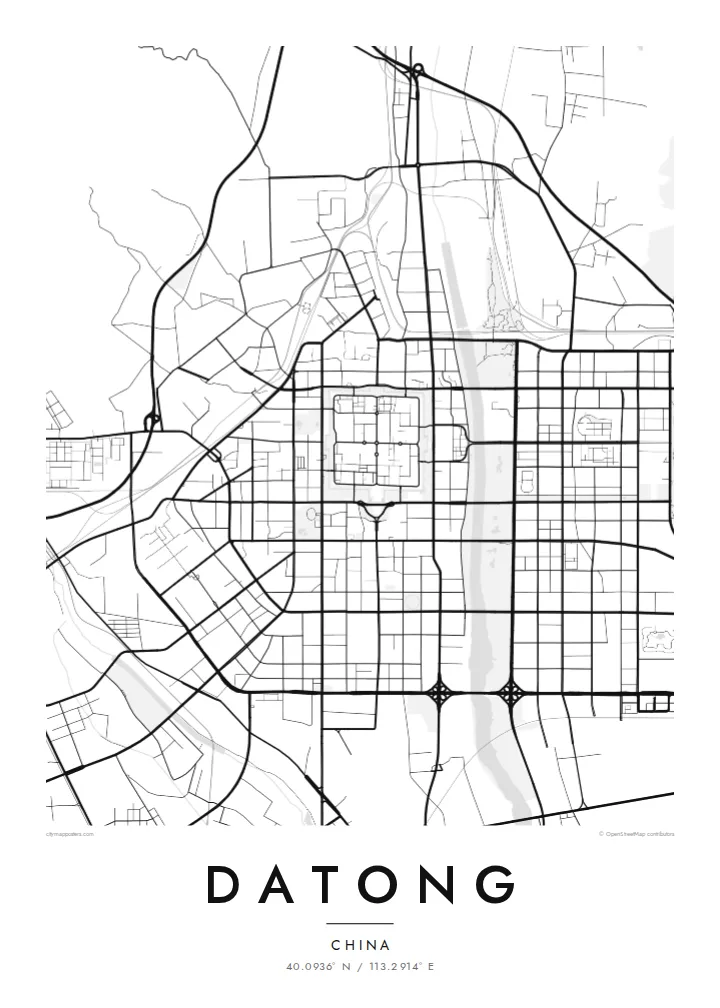
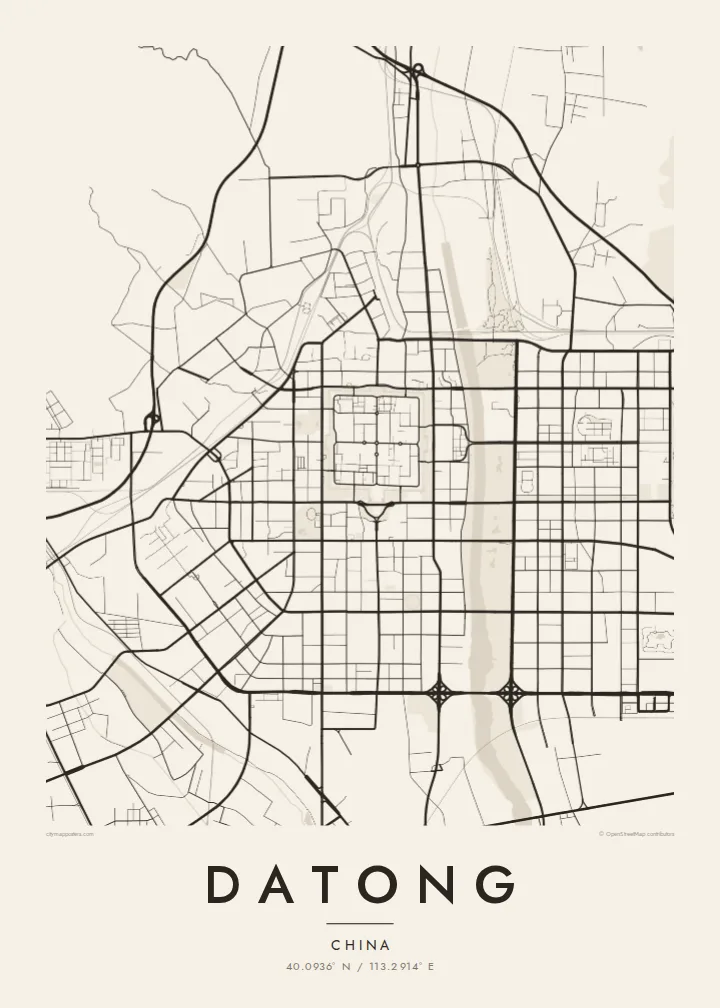
The restored ramparts enclose an almost square old town. The crisp outline anchors the whole map and makes the historic centre instantly recognisable.
Posta faʻafanua faigofie · China
40.0936° N / 113.2914° E
A walled city on a northern plain, its square old town enclosed by restored ramparts, with the Yungang cliffs to the west.



Tasi le aai, lagona e lima
Tapi se sitaili e vaai ai i luga o le puipui. E tutusa uma le tau o sitaili — pe lolomiina, faapipiiina, pe avea ma faila HD.
 Pika Moni · Faila Lolomi 24 × 36″
Manino mo le lolomi
O se vaega atoa (100%) lenei mai le faila lolomi moni. O posita uma — pe lolomiina, faapipiiina pe download mai — e faia i luga o a matou server i le 300 DPI, e oo atu i le 7,200 × 10,800 pika, ina ia manino pea auala laiti i luga o se lolomiga 24 × 36″.
I luga o le puipui


Le faʻafanua
Datong lies in the far north of Shanxi, close to the Great Wall, on a high plain beside the Yu River. Its historic centre is one of the clearest shapes on any Chinese city map. Restored city walls form a near-square enclosure, straight streets divide it into quarters, and the modern city spreads out beyond it in every direction.
From the late fourth century the city was Pingcheng, capital of the Northern Wei dynasty. Its importance in that period explains the Yungang Grottoes, a UNESCO World Heritage Site of Buddhist cave temples carved into sandstone cliffs west of the city. Inside the walls, the Nine-Dragon Screen, a large glazed-tile wall, and Huayan Monastery date from later dynasties.
Datong has long been a coal city, and mines and rail yards still shape its surroundings. Within the wider municipality, the Hanging Temple clings to a cliff face near Mount Heng. A Datong map poster focuses on the city itself. The square walled town sits at the centre like a compass rose within a wider grid of modern streets.
The restored ramparts enclose an almost square old town. The crisp outline anchors the whole map and makes the historic centre instantly recognisable.
Inside the walls, main streets divide the old town into quarters, and finer lanes fill each section. This classic northern Chinese plan is clearly readable from above.
The river runs along the eastern side of the city, with parks along its banks and newer districts extending to the opposite shore.
Fai mo oe
Faʻaopoopo se aso, se igoa po o sau lava upu, sui le sitaili, lapoʻa po o le itu.
O le preview e leai se totogi e maualalo le resolution ma iai se watermark. O lolomi ma faila HD e faia i le 300 DPI, e oo atu i le 7,200 × 10,800 px, e aunoa ma se watermark.
Aisea Datong
Datong appeals to anyone with ties to northern Shanxi and to people interested in Chinese architecture and city planning. The squared old town is graphic enough to work as a design piece, even for someone who has never visited.
Edit the title, subtitle and coordinates to suit the room or the occasion. Paper and Sand bring out the old-town feel, Classic black & white and Noir keep it sharp, and Blueprint rounds out the five styles. Try the free watermarked preview before you buy.
Faatau le posita Datong| Lapoʻa lolomi | Manino | Faila |
|---|---|---|
| 30 × 40 cm (11.8 × 15.7″) | 3,543 × 4,724 px | PNG · PDF |
| 29.7 × 42 cm (A3, 11.7 × 16.5″) | 3,508 × 4,961 px | PNG · PDF |
| 42 × 59.4 cm (A2, 16.5 × 23.4″) | 4,961 × 7,016 px | PNG · PDF |
| 45.7 × 61 cm (18 × 24″) | 5,400 × 7,200 px | PNG · PDF |
| 50 × 70 cm (19.7 × 27.6″) | 5,906 × 8,268 px | PNG · PDF |
| 61 × 91.4 cm (24 × 36″) | 7,200 × 10,800 px | PNG · PDF |
Ae faʻatusatusa, o le faʻataʻitaʻiga e leai se totogi e 900 px le lautele, e iai le faʻailoga vai ma e mo mata. O faila HD e oʻo atu i le 8× le manino i itu taʻitasi ma e lolomi manino i le lapoʻa atoa o le posta.
Filifili se sitaili i le pito i luga o le itulau, ona filifili lea o le Posita Lolomi — se lapopoa ma, afai e te fiafia, se faavaa — po o Faila HD Numera. E na o le tasi laasaga o le Checkout, ma o le a fesuia'i lou itulau o oka i le taimi lava e mae'a ai le totogi.
E lolomiina i luga o pepa matte maualuga le tulaga e 200 gsm, i se tasi o lapopoa e ono, mai le 30 × 40 cm i le 24 × 36″. E amata le tau o posita lolomi mai le $39, aofia ai le auina atu.
Ioe. Filifili se faavaa laau malosi i le lanu uliuli, sina, oak masani, po o le laau pogisa. E aofia ai se tioata e le gau ma ua saunia e tautau i luga. E amata le tau o posita faavaa mai le $99, aofia ai le auina atu.
E leai se totogi mo le uta i le lalolagi atoa. O poster ta'itasi e lolomi e le paaga lolomi e latalata mai i matou i atunuu e 30+, ma e masani ona taunuu i aso faigaluega e 3–7. E mafai ona e mulimuli i le tulaga ma le tracking i le "Aʻu Oka". O nisi atunuu e 2–5 vaiaso, ma i atunuu matou te lei tuuina atu ai, e taʻu atu e le saite iā te oe ae e te leʻi totogiina.
Auina mai se ata i totonu o le 14 aso talu ona taunuu, ma o le a matou toe lolomiina e leai se totogi po o le toe faafoi atu lau tupe.
Ioe. I totonu o le editor i lenei itulau, suia le ulutala, le ulutala laititi ma le laina o coordinates i soo se mea e te fiafia i ai, ma filifili se sitaili ma le lapopoa. O oka lolomi, faavaa ma numera e faaaoga uma lava lau mamanu.
Mo le $9 e te maua ai faila PNG 300 DPI ma PDF ua saunia mo le lolomi i lapopoa uma e ono, e aunoa ma se watermark, e mafai ona lolomi i soo se mea. Le mautinoa lava? Download muamua se preview e leai se totogi ma le watermark.
