Davao Gulf coast
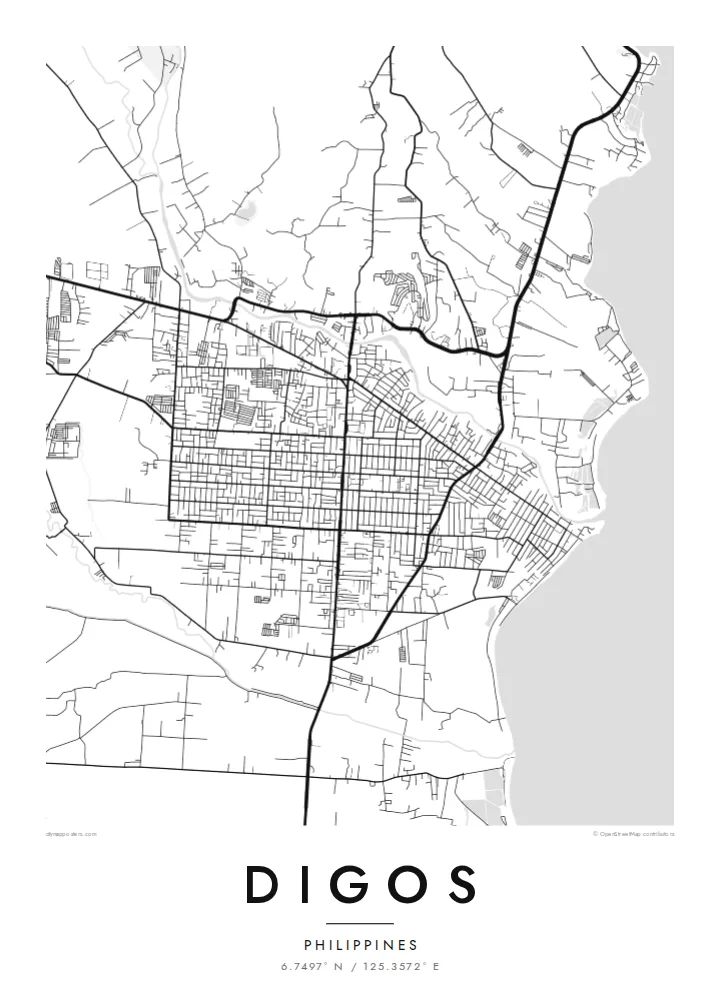
The eastern side of the map is defined by the shoreline of Davao Gulf, a long, calm edge where streets end and the print gives way to open water.
Posta faʻafanua faigofie · Philippines
6.7497° N / 125.3572° E
A provincial capital spread across the plain between Davao Gulf and the rising foothills of Mount Apo, with roads fanning inland.



Tasi le aai, lagona e lima
Tapi se sitaili e vaai ai i luga o le puipui. E tutusa uma le tau o sitaili — pe lolomiina, faapipiiina, pe avea ma faila HD.
 Pika Moni · Faila Lolomi 24 × 36″
Manino mo le lolomi
O se vaega atoa (100%) lenei mai le faila lolomi moni. O posita uma — pe lolomiina, faapipiiina pe download mai — e faia i luga o a matou server i le 300 DPI, e oo atu i le 7,200 × 10,800 pika, ina ia manino pea auala laiti i luga o se lolomiga 24 × 36″.
I luga o le puipui


Le faʻafanua
Digos is the capital of Davao del Sur on the island of Mindanao. It occupies low ground on the western side of Davao Gulf, where the coast meets broad lowlands that climb gradually toward Mount Apo, the highest mountain in the Philippines. From above, the city is a compact grid around its centre, with neighbourhoods strung out along the main roads.
The highway running along the gulf passes through Digos, which has long made the city a junction for travel between Davao City and the southern provinces. Away from the centre, the street network opens up into farmland, orchards and barangays linked by thinner roads, and agriculture shapes most of the land visible at the edges of the map.
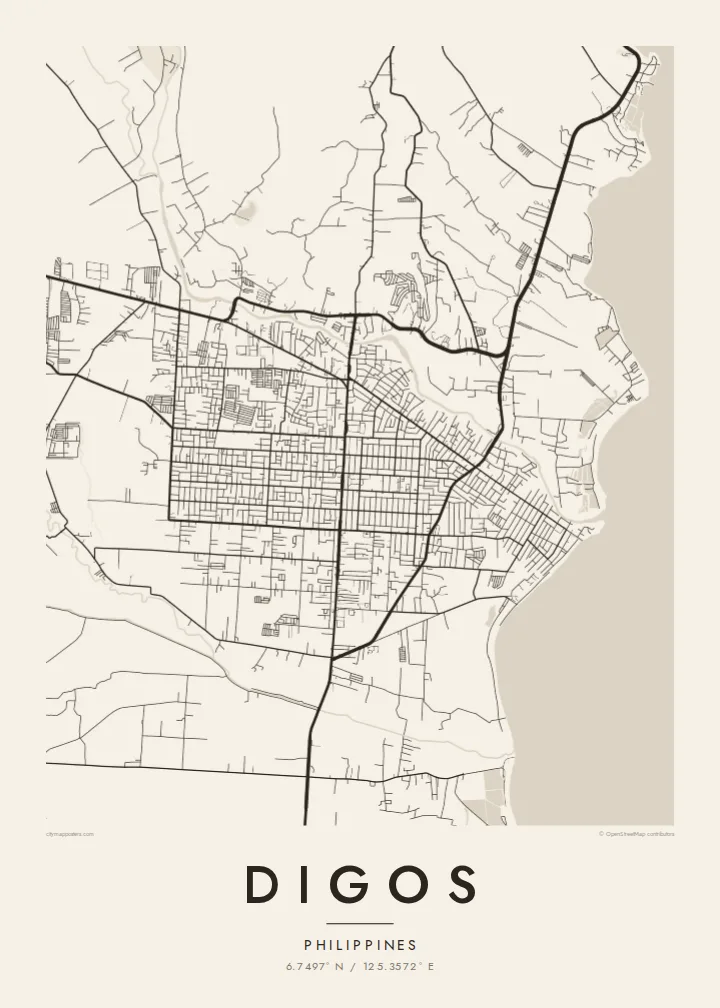
A Digos map poster frames that transition from a dense town centre to open coastal plain. The gulf coastline to the east gives the composition a firm edge, while the lines thinning toward the mountains suggest the landscape beyond the frame, even in the pared-back black and white of the Classic style.
The eastern side of the map is defined by the shoreline of Davao Gulf, a long, calm edge where streets end and the print gives way to open water.
Major roads meet in Digos on their way north to Davao City and south along the gulf, forming the strongest lines crossing the town centre.
West of the city, the land rises toward Mount Apo. On the poster this reads as a gradual thinning of streets into scattered rural roads.
Fai mo oe
Faʻaopoopo se aso, se igoa po o sau lava upu, sui le sitaili, lapoʻa po o le itu.
O le preview e leai se totogi e maualalo le resolution ma iai se watermark. O lolomi ma faila HD e faia i le 300 DPI, e oo atu i le 7,200 × 10,800 px, e aunoa ma se watermark.
Aisea Digos
Digos is the kind of place people carry with them after moving to Davao City, Manila or abroad. A map of the town, its gulf and its roads, is a quiet reminder of home that fits a bedroom or a family room without needing explanation.
You can set the title, subtitle and coordinates to mark a barangay, a wedding or a homecoming date, then choose Classic black & white, Noir, Paper, Blueprint or Sand. Download the files for $9 or order a matte print, framed or unframed.
Faatau le posita Digos| Lapoʻa lolomi | Manino | Faila |
|---|---|---|
| 30 × 40 cm (11.8 × 15.7″) | 3,543 × 4,724 px | PNG · PDF |
| 29.7 × 42 cm (A3, 11.7 × 16.5″) | 3,508 × 4,961 px | PNG · PDF |
| 42 × 59.4 cm (A2, 16.5 × 23.4″) | 4,961 × 7,016 px | PNG · PDF |
| 45.7 × 61 cm (18 × 24″) | 5,400 × 7,200 px | PNG · PDF |
| 50 × 70 cm (19.7 × 27.6″) | 5,906 × 8,268 px | PNG · PDF |
| 61 × 91.4 cm (24 × 36″) | 7,200 × 10,800 px | PNG · PDF |
Ae faʻatusatusa, o le faʻataʻitaʻiga e leai se totogi e 900 px le lautele, e iai le faʻailoga vai ma e mo mata. O faila HD e oʻo atu i le 8× le manino i itu taʻitasi ma e lolomi manino i le lapoʻa atoa o le posta.
Filifili se sitaili i le pito i luga o le itulau, ona filifili lea o le Posita Lolomi — se lapopoa ma, afai e te fiafia, se faavaa — po o Faila HD Numera. E na o le tasi laasaga o le Checkout, ma o le a fesuia'i lou itulau o oka i le taimi lava e mae'a ai le totogi.
E lolomiina i luga o pepa matte maualuga le tulaga e 200 gsm, i se tasi o lapopoa e ono, mai le 30 × 40 cm i le 24 × 36″. E amata le tau o posita lolomi mai le {printFrom}, aofia ai le auina atu.
Ioe. Filifili se faavaa laau malosi i le lanu uliuli, sina, oak masani, po o le laau pogisa. E aofia ai se tioata e le gau ma ua saunia e tautau i luga. E amata le tau o posita faavaa mai le {framedFrom}, aofia ai le auina atu.
E leai se totogi mo le uta i le lalolagi atoa. O poster ta'itasi e lolomi e le paaga lolomi e latalata mai i matou i atunuu e 30+, ma e masani ona taunuu i aso faigaluega e 3–7. E mafai ona e mulimuli i le tulaga ma le tracking i le "Aʻu Oka". O nisi atunuu e 2–5 vaiaso, ma i atunuu matou te lei tuuina atu ai, e taʻu atu e le saite iā te oe ae e te leʻi totogiina.
Auina mai se ata i totonu o le 14 aso talu ona taunuu, ma o le a matou toe lolomiina e leai se totogi po o le toe faafoi atu lau tupe.
Ioe. I totonu o le editor i lenei itulau, suia le ulutala, le ulutala laititi ma le laina o coordinates i soo se mea e te fiafia i ai, ma filifili se sitaili ma le lapopoa. O oka lolomi, faavaa ma numera e faaaoga uma lava lau mamanu.
Mo le $9 e te maua ai faila PNG 300 DPI ma PDF ua saunia mo le lolomi i lapopoa uma e ono, e aunoa ma se watermark, e mafai ona lolomi i soo se mea. Le mautinoa lava? Download muamua se preview e leai se totogi ma le watermark.
