The Ego valley
The river runs through the bottom of the valley, largely hidden beneath the town in places, and sets the long, thin axis along which all of Eibar is built.
Posta faʻafanua faigofie · Spain
43.1849° N / 2.4716° W
A dense industrial town packed into a steep Basque valley, streets stacked up the slopes on both sides



Tasi le aai, lagona e lima
Tapi se sitaili e vaai ai i luga o le puipui. E tutusa uma le tau o sitaili — pe lolomiina, faapipiiina, pe avea ma faila HD.
 Pika Moni · Faila Lolomi 24 × 36″
Manino mo le lolomi
O se vaega atoa (100%) lenei mai le faila lolomi moni. O posita uma — pe lolomiina, faapipiiina pe download mai — e faia i luga o a matou server i le 300 DPI, e oo atu i le 7,200 × 10,800 pika, ina ia manino pea auala laiti i luga o se lolomiga 24 × 36″.
I luga o le puipui


Le faʻafanua
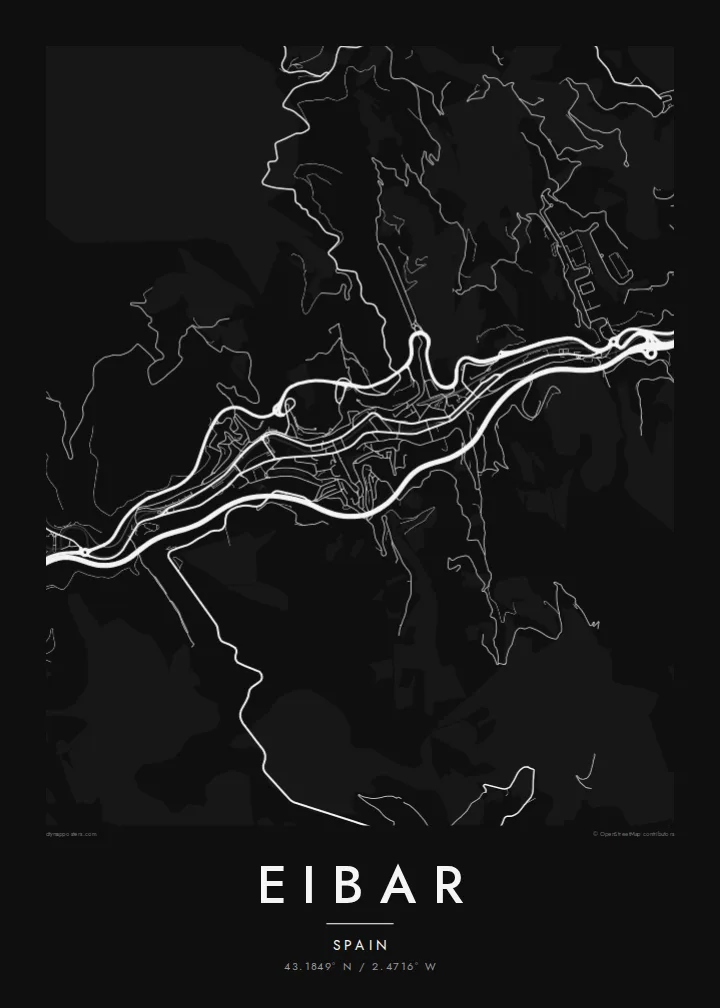
Eibar fills the narrow valley of the Ego river in Gipuzkoa, in the Basque Country. There is very little flat land, so the town is long and tight, with apartment blocks lining the valley floor and streets climbing the hillsides in terraces. Public escalators and lifts help residents move between levels, a sign of how steep the ground is.
The town has a long industrial history built on metalwork, first gunsmithing and later sewing machines, bicycles and tools. That legacy shows in the factory buildings squeezed into the valley. Eibar is also known for SD Eibar, whose small Ipurua stadium has hosted top-flight Spanish football, fitted into the urban fabric like everything else here.
An Eibar map poster captures a town shaped entirely by topography. The dense core follows the river and the valley road, and the edges break into winding lanes and the green, wooded slopes of the surrounding mountains. In monochrome the compression of the place is striking, a narrow band of streets held between steep ground.
The river runs through the bottom of the valley, largely hidden beneath the town in places, and sets the long, thin axis along which all of Eibar is built.
Residential streets climb the slopes in tight switchbacks and terraces, a dense layered pattern that shows how the town grows upward rather than outward.
SD Eibar's compact stadium sits inside the urban fabric on the valley side, a small rectangle among the apartment blocks that locals will recognise immediately.
Fai mo oe
Faʻaopoopo se aso, se igoa po o sau lava upu, sui le sitaili, lapoʻa po o le itu.
O le preview e leai se totogi e maualalo le resolution ma iai se watermark. O lolomi ma faila HD e faia i le 300 DPI, e oo atu i le 7,200 × 10,800 px, e aunoa ma se watermark.
Aisea Eibar
Eibar has a strong identity built on work, football and a demanding landscape. For people from the town or supporters of the club, a map of its crowded valley is a meaningful piece to hang at home.
You can name the poster, add a subtitle such as a birth year and set the coordinates line, choosing among five styles. Noir suits the industrial character, while Paper softens the steep streets into something gentler.
Faatau le posita Eibar| Lapoʻa lolomi | Manino | Faila |
|---|---|---|
| 30 × 40 cm (11.8 × 15.7″) | 3,543 × 4,724 px | PNG · PDF |
| 29.7 × 42 cm (A3, 11.7 × 16.5″) | 3,508 × 4,961 px | PNG · PDF |
| 42 × 59.4 cm (A2, 16.5 × 23.4″) | 4,961 × 7,016 px | PNG · PDF |
| 45.7 × 61 cm (18 × 24″) | 5,400 × 7,200 px | PNG · PDF |
| 50 × 70 cm (19.7 × 27.6″) | 5,906 × 8,268 px | PNG · PDF |
| 61 × 91.4 cm (24 × 36″) | 7,200 × 10,800 px | PNG · PDF |
Ae faʻatusatusa, o le faʻataʻitaʻiga e leai se totogi e 900 px le lautele, e iai le faʻailoga vai ma e mo mata. O faila HD e oʻo atu i le 8× le manino i itu taʻitasi ma e lolomi manino i le lapoʻa atoa o le posta.
Filifili se sitaili i le pito i luga o le itulau, ona filifili lea o le Posita Lolomi — se lapopoa ma, afai e te fiafia, se faavaa — po o Faila HD Numera. E na o le tasi laasaga o le Checkout, ma o le a fesuia'i lou itulau o oka i le taimi lava e mae'a ai le totogi.
E lolomiina i luga o pepa matte maualuga le tulaga e 200 gsm, i se tasi o lapopoa e ono, mai le 30 × 40 cm i le 24 × 36″. E amata le tau o posita lolomi mai le $39, aofia ai le auina atu.
Ioe. Filifili se faavaa laau malosi i le lanu uliuli, sina, oak masani, po o le laau pogisa. E aofia ai se tioata e le gau ma ua saunia e tautau i luga. E amata le tau o posita faavaa mai le $99, aofia ai le auina atu.
E leai se totogi mo le uta i le lalolagi atoa. O poster ta'itasi e lolomi e le paaga lolomi e latalata mai i matou i atunuu e 30+, ma e masani ona taunuu i aso faigaluega e 3–7. E mafai ona e mulimuli i le tulaga ma le tracking i le "Aʻu Oka". O nisi atunuu e 2–5 vaiaso, ma i atunuu matou te lei tuuina atu ai, e taʻu atu e le saite iā te oe ae e te leʻi totogiina.
Auina mai se ata i totonu o le 14 aso talu ona taunuu, ma o le a matou toe lolomiina e leai se totogi po o le toe faafoi atu lau tupe.
Ioe. I totonu o le editor i lenei itulau, suia le ulutala, le ulutala laititi ma le laina o coordinates i soo se mea e te fiafia i ai, ma filifili se sitaili ma le lapopoa. O oka lolomi, faavaa ma numera e faaaoga uma lava lau mamanu.
Mo le $9 e te maua ai faila PNG 300 DPI ma PDF ua saunia mo le lolomi i lapopoa uma e ono, e aunoa ma se watermark, e mafai ona lolomi i soo se mea. Le mautinoa lava? Download muamua se preview e leai se totogi ma le watermark.
