Vinalopó ravine
The river runs through a deep channel in the heart of the city and divides east from west. A series of bridges, both old and new, cross it at short intervals.
Posta faʻafanua faigofie · Spain
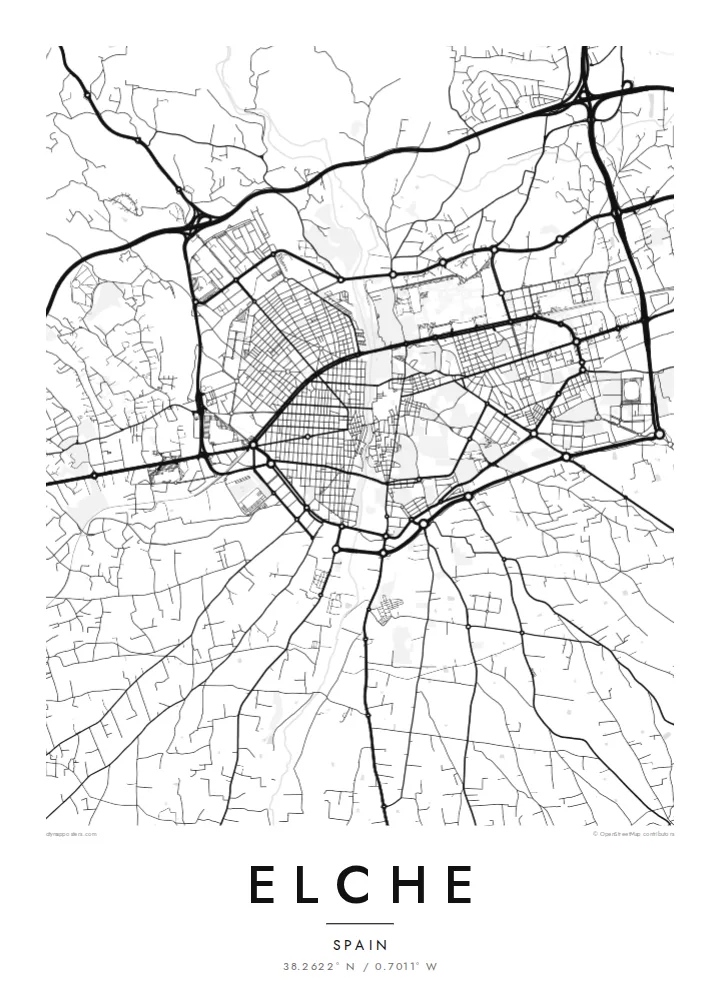
38.2622° N / 0.7011° W
A city divided by the deep ravine of the Vinalopó, its centre framed by bridges and walled groves of date palms.


Tasi le aai, lagona e lima
Tapi se sitaili e vaai ai i luga o le puipui. E tutusa uma le tau o sitaili — pe lolomiina, faapipiiina, pe avea ma faila HD.
 Pika Moni · Faila Lolomi 24 × 36″
Manino mo le lolomi
O se vaega atoa (100%) lenei mai le faila lolomi moni. O posita uma — pe lolomiina, faapipiiina pe download mai — e faia i luga o a matou server i le 300 DPI, e oo atu i le 7,200 × 10,800 pika, ina ia manino pea auala laiti i luga o se lolomiga 24 × 36″.
I luga o le puipui


Le faʻafanua
Elche lies inland from Alicante on the plains of southern Valencia. The Vinalopó River divides the city, running through a deep, mostly dry ravine crossed by several bridges. The old town sits on the east bank and newer districts spread to the west. Walled plots of date palms stand in and around the city, making green patches unlike anything else on a Spanish city map.
The Palm Grove of Elche is a UNESCO World Heritage Site, with tens of thousands of trees in irrigated orchards first laid out in the Islamic period. The Misteri d'Elx, a medieval sacred drama performed every August in the Basilica of Santa María, is recognised by UNESCO as intangible heritage. Elche is also known for its footwear industry and for the Lady of Elche, an Iberian stone bust found nearby in 1897.
An Elche map poster turns these features into a clear design. The Vinalopó ravine draws a strong line through the centre, bridges stitch the two halves together, and the palm orchards appear as calm blocks among the streets. Few Spanish cities have such a distinctive plan. In black and white it looks almost like an architectural drawing.
The river runs through a deep channel in the heart of the city and divides east from west. A series of bridges, both old and new, cross it at short intervals.
Walled groves of date palms, part of the UNESCO-listed Palm Grove, sit among the streets and around the centre. They form distinctive open blocks within the urban grid.
On the eastern bank, the compact historic quarter gathers around the Basilica of Santa María and the Altamira palace in a dense knot of narrow streets.
Fai mo oe
Faʻaopoopo se aso, se igoa po o sau lava upu, sui le sitaili, lapoʻa po o le itu.
O le preview e leai se totogi e maualalo le resolution ma iai se watermark. O lolomi ma faila HD e faia i le 300 DPI, e oo atu i le 7,200 × 10,800 px, e aunoa ma se watermark.
Aisea Elche
People hold on to Elche: families from the shoe workshops, students from the university and visitors who came for the Misteri in August. A map of its ravine, palms and old streets is a thoughtful keepsake or a gift for someone far from home.
Personalise the title, subtitle and coordinates line in Spanish or Valencian, and choose Classic black & white, Noir, Paper, Blueprint or Sand. Printed posters come on matte paper with an optional wooden frame, and the HD files cost $9.
Faatau le posita Elche| Lapoʻa lolomi | Manino | Faila |
|---|---|---|
| 30 × 40 cm (11.8 × 15.7″) | 3,543 × 4,724 px | PNG · PDF |
| 29.7 × 42 cm (A3, 11.7 × 16.5″) | 3,508 × 4,961 px | PNG · PDF |
| 42 × 59.4 cm (A2, 16.5 × 23.4″) | 4,961 × 7,016 px | PNG · PDF |
| 45.7 × 61 cm (18 × 24″) | 5,400 × 7,200 px | PNG · PDF |
| 50 × 70 cm (19.7 × 27.6″) | 5,906 × 8,268 px | PNG · PDF |
| 61 × 91.4 cm (24 × 36″) | 7,200 × 10,800 px | PNG · PDF |
Ae faʻatusatusa, o le faʻataʻitaʻiga e leai se totogi e 900 px le lautele, e iai le faʻailoga vai ma e mo mata. O faila HD e oʻo atu i le 8× le manino i itu taʻitasi ma e lolomi manino i le lapoʻa atoa o le posta.
Filifili se sitaili i le pito i luga o le itulau, ona filifili lea o le Posita Lolomi — se lapopoa ma, afai e te fiafia, se faavaa — po o Faila HD Numera. E na o le tasi laasaga o le Checkout, ma o le a fesuia'i lou itulau o oka i le taimi lava e mae'a ai le totogi.
E lolomiina i luga o pepa matte maualuga le tulaga e 200 gsm, i se tasi o lapopoa e ono, mai le 30 × 40 cm i le 24 × 36″. E amata le tau o posita lolomi mai le {printFrom}, aofia ai le auina atu.
Ioe. Filifili se faavaa laau malosi i le lanu uliuli, sina, oak masani, po o le laau pogisa. E aofia ai se tioata e le gau ma ua saunia e tautau i luga. E amata le tau o posita faavaa mai le {framedFrom}, aofia ai le auina atu.
E leai se totogi mo le uta i le lalolagi atoa. O poster ta'itasi e lolomi e le paaga lolomi e latalata mai i matou i atunuu e 30+, ma e masani ona taunuu i aso faigaluega e 3–7. E mafai ona e mulimuli i le tulaga ma le tracking i le "Aʻu Oka". O nisi atunuu e 2–5 vaiaso, ma i atunuu matou te lei tuuina atu ai, e taʻu atu e le saite iā te oe ae e te leʻi totogiina.
Auina mai se ata i totonu o le 14 aso talu ona taunuu, ma o le a matou toe lolomiina e leai se totogi po o le toe faafoi atu lau tupe.
Ioe. I totonu o le editor i lenei itulau, suia le ulutala, le ulutala laititi ma le laina o coordinates i soo se mea e te fiafia i ai, ma filifili se sitaili ma le lapopoa. O oka lolomi, faavaa ma numera e faaaoga uma lava lau mamanu.
Mo le $9 e te maua ai faila PNG 300 DPI ma PDF ua saunia mo le lolomi i lapopoa uma e ono, e aunoa ma se watermark, e mafai ona lolomi i soo se mea. Le mautinoa lava? Download muamua se preview e leai se totogi ma le watermark.
