Ancestral Temple
The Zumiao temple complex in Chancheng, with its courtyards and ceremonial halls. It sits within a compact grid of older streets, a quieter pocket inside the wider city.
Posta faʻafanua faigofie · China
23.0268° N / 113.1315° E
A river-laced city beside Guangzhou, where delta channels thread between old temple streets, ceramics quarters and dense new grids.
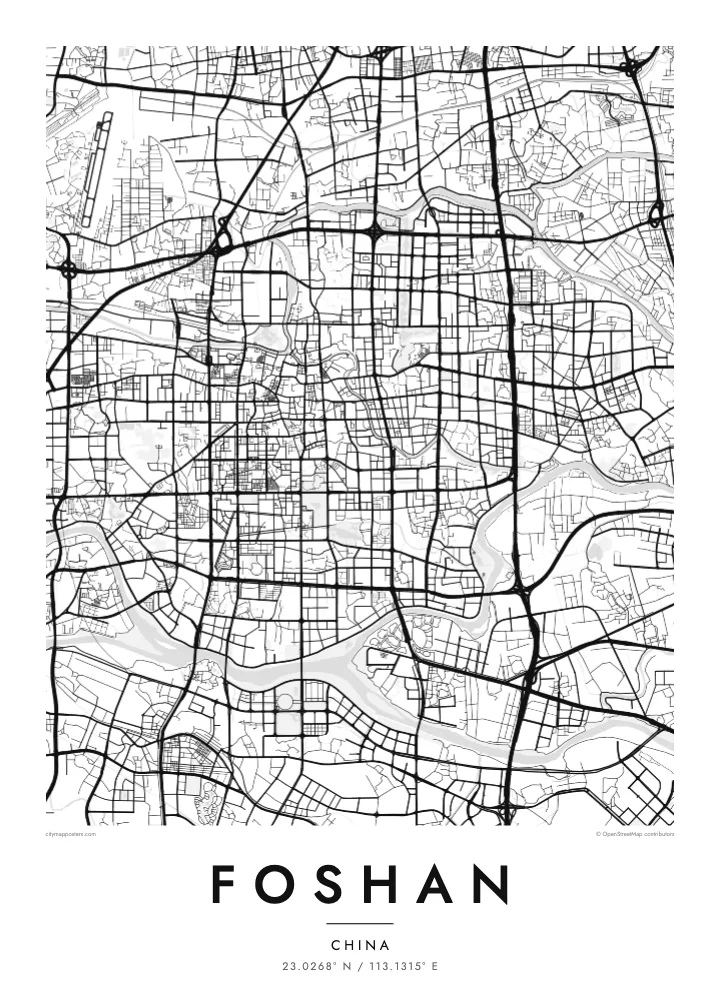
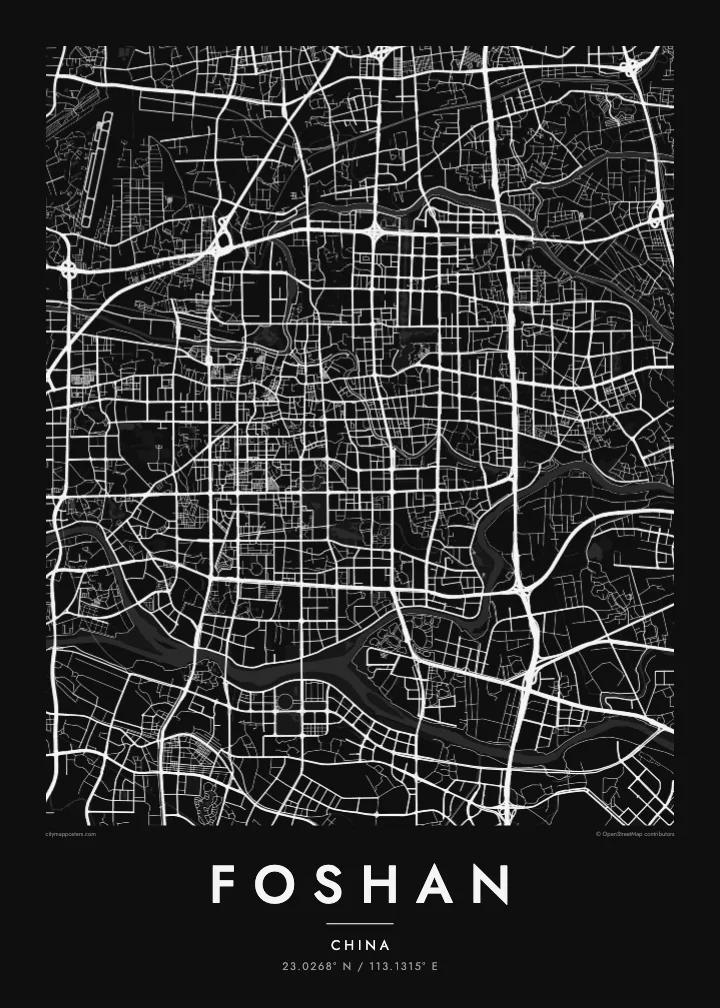
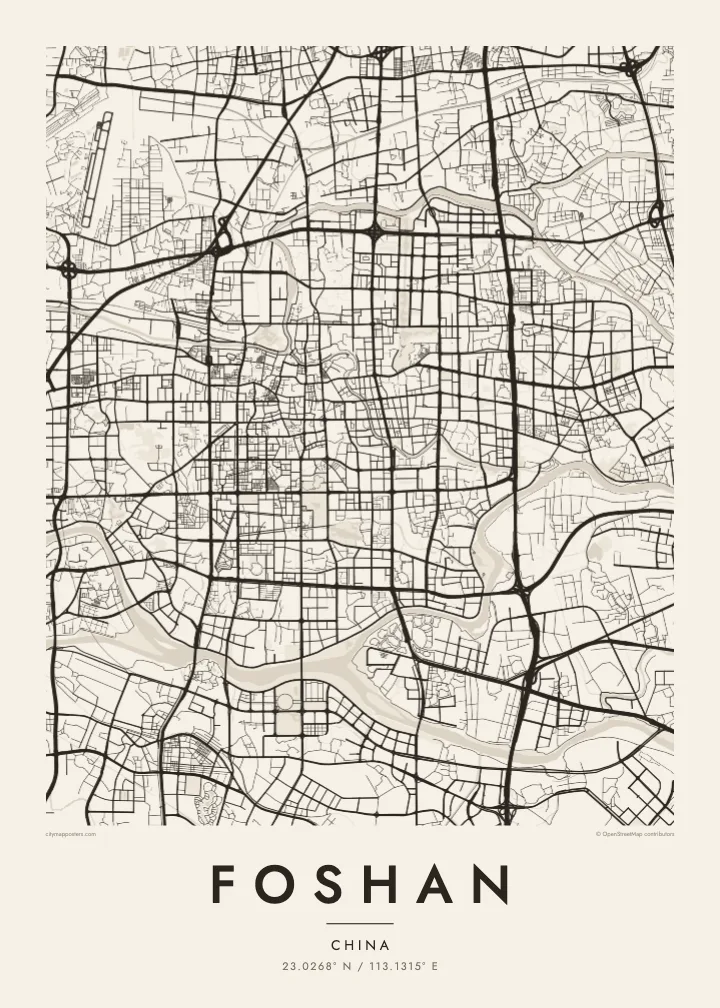

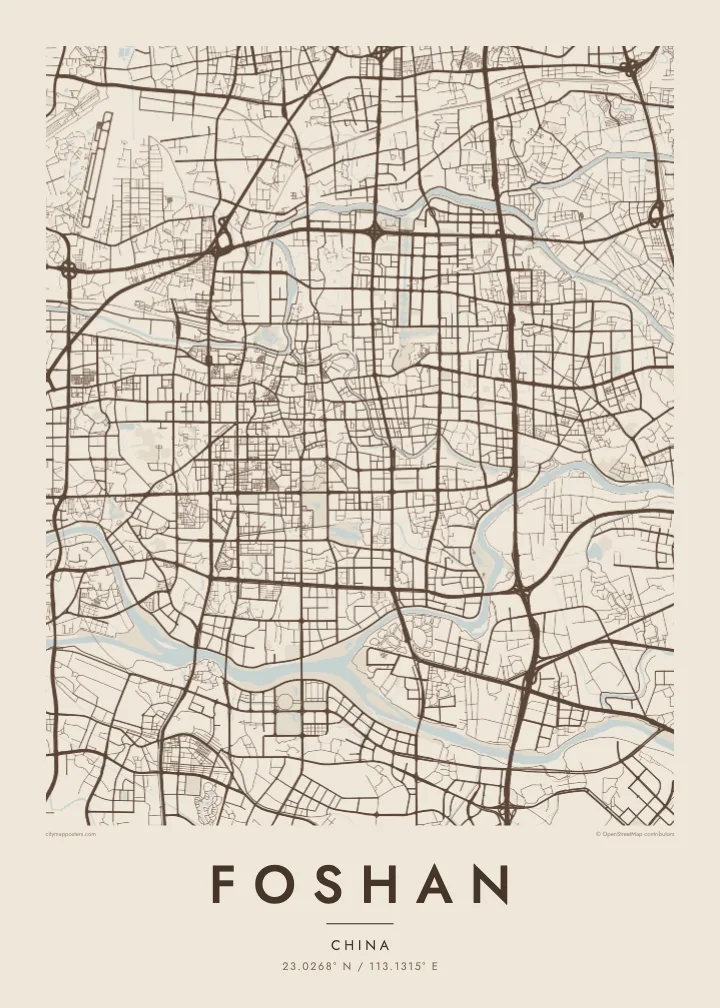
Tasi le aai, lagona e lima
Tapi se sitaili e vaai ai i luga o le puipui. E tutusa uma le tau o sitaili — pe lolomiina, faapipiiina, pe avea ma faila HD.
 Pika Moni · Faila Lolomi 24 × 36″
Manino mo le lolomi
O se vaega atoa (100%) lenei mai le faila lolomi moni. O posita uma — pe lolomiina, faapipiiina pe download mai — e faia i luga o a matou server i le 300 DPI, e oo atu i le 7,200 × 10,800 pika, ina ia manino pea auala laiti i luga o se lolomiga 24 × 36″.
I luga o le puipui


Le faʻafanua
Foshan lies immediately west and southwest of Guangzhou in the Pearl River Delta, and on the map the two cities run into each other with no visible break. The land is laced with water: branches of the Xi and Bei rivers, smaller channels and fish ponds break the street pattern into islands and peninsulas, especially in the southern districts toward Shunde.
The old centre of Chancheng is organised around the Foshan Ancestral Temple, a Taoist temple complex first built in the Song dynasty and rebuilt many times since. Nearby, the Shiwan area has made ceramics for centuries. The city is also closely linked with martial arts; Wong Fei-hung and Ip Man were both born here, and a Foshan map poster covers the ground where both grew up.
Foshan's urban area is in fact several districts joined together, Chancheng, Nanhai, Shunde and others, each with its own centre. The Guangfo metro line, opened in 2010, was one of the first in China to link two cities directly. From above, the effect is a continuous, dense fabric divided mainly by water, which suits a monochrome print particularly well.
The Zumiao temple complex in Chancheng, with its courtyards and ceremonial halls. It sits within a compact grid of older streets, a quieter pocket inside the wider city.
River branches and man-made channels split the southern districts into separate pieces, and many small ponds survive between buildings, creating a fragmented, island-like pattern across the lower part of the map.
Foshan's eastern side meets Guangzhou without a visible boundary. A wider frame shows the two cities merging, joined by bridges, rail lines and continuous streets.
Fai mo oe
Faʻaopoopo se aso, se igoa po o sau lava upu, sui le sitaili, lapoʻa po o le itu.
O le preview e leai se totogi e maualalo le resolution ma iai se watermark. O lolomi ma faila HD e faia i le 300 DPI, e oo atu i le 7,200 × 10,800 px, e aunoa ma se watermark.
Aisea Foshan
Foshan is known for its food, its kung fu schools and its craftsmanship, and many people from Shunde or Nanhai keep a strong sense of home. A map of the city shows where that sense comes from: water, old temples and close streets.
Personalise the title with your district, a family name or a date, and pick one of five styles. Paper suits the ceramic and craft associations; Noir gives the channels a dark, graphic weight. Download HD files in six sizes, or order a framed print.
Faatau le posita Foshan| Lapoʻa lolomi | Manino | Faila |
|---|---|---|
| 30 × 40 cm (11.8 × 15.7″) | 3,543 × 4,724 px | PNG · PDF |
| 29.7 × 42 cm (A3, 11.7 × 16.5″) | 3,508 × 4,961 px | PNG · PDF |
| 42 × 59.4 cm (A2, 16.5 × 23.4″) | 4,961 × 7,016 px | PNG · PDF |
| 45.7 × 61 cm (18 × 24″) | 5,400 × 7,200 px | PNG · PDF |
| 50 × 70 cm (19.7 × 27.6″) | 5,906 × 8,268 px | PNG · PDF |
| 61 × 91.4 cm (24 × 36″) | 7,200 × 10,800 px | PNG · PDF |
Ae faʻatusatusa, o le faʻataʻitaʻiga e leai se totogi e 900 px le lautele, e iai le faʻailoga vai ma e mo mata. O faila HD e oʻo atu i le 8× le manino i itu taʻitasi ma e lolomi manino i le lapoʻa atoa o le posta.
Filifili se sitaili i le pito i luga o le itulau, ona filifili lea o le Posita Lolomi — se lapopoa ma, afai e te fiafia, se faavaa — po o Faila HD Numera. E na o le tasi laasaga o le Checkout, ma o le a fesuia'i lou itulau o oka i le taimi lava e mae'a ai le totogi.
E lolomiina i luga o pepa matte maualuga le tulaga e 200 gsm, i se tasi o lapopoa e ono, mai le 30 × 40 cm i le 24 × 36″. E amata le tau o posita lolomi mai le $39, aofia ai le auina atu.
Ioe. Filifili se faavaa laau malosi i le lanu uliuli, sina, oak masani, po o le laau pogisa. E aofia ai se tioata e le gau ma ua saunia e tautau i luga. E amata le tau o posita faavaa mai le $99, aofia ai le auina atu.
E leai se totogi mo le uta i le lalolagi atoa. O poster ta'itasi e lolomi e le paaga lolomi e latalata mai i matou i atunuu e 30+, ma e masani ona taunuu i aso faigaluega e 3–7. E mafai ona e mulimuli i le tulaga ma le tracking i le "Aʻu Oka". O nisi atunuu e 2–5 vaiaso, ma i atunuu matou te lei tuuina atu ai, e taʻu atu e le saite iā te oe ae e te leʻi totogiina.
Auina mai se ata i totonu o le 14 aso talu ona taunuu, ma o le a matou toe lolomiina e leai se totogi po o le toe faafoi atu lau tupe.
Ioe. I totonu o le editor i lenei itulau, suia le ulutala, le ulutala laititi ma le laina o coordinates i soo se mea e te fiafia i ai, ma filifili se sitaili ma le lapopoa. O oka lolomi, faavaa ma numera e faaaoga uma lava lau mamanu.
Mo le $9 e te maua ai faila PNG 300 DPI ma PDF ua saunia mo le lolomi i lapopoa uma e ono, e aunoa ma se watermark, e mafai ona lolomi i soo se mea. Le mautinoa lava? Download muamua se preview e leai se totogi ma le watermark.
Latalata ane
