Suruga Bay shore
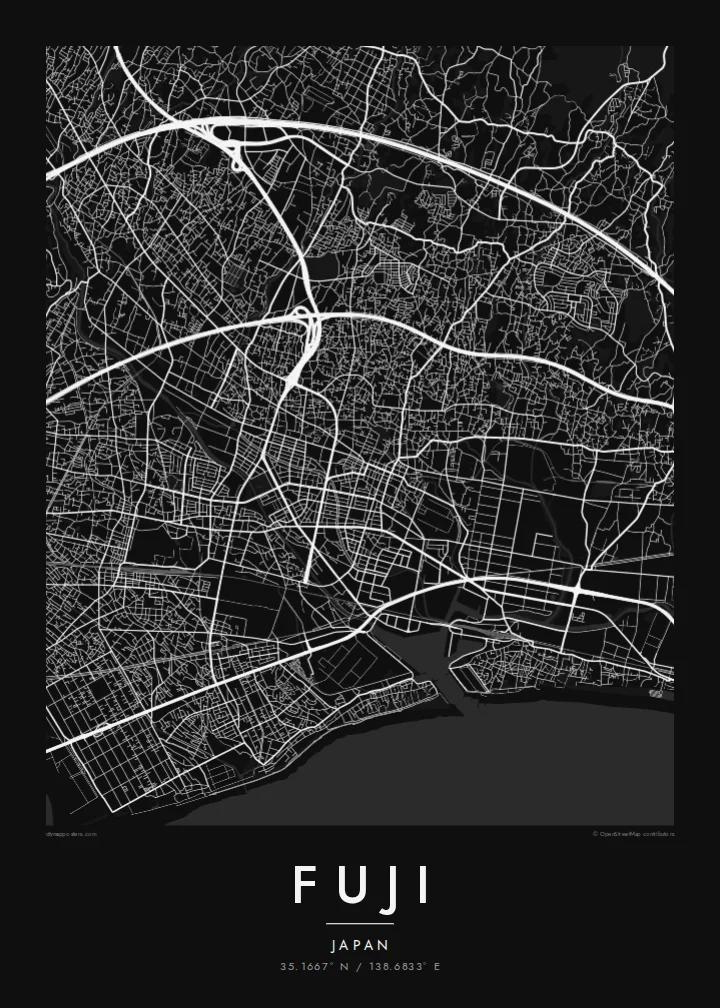
A long, nearly straight coastline closes the southern edge of the city, giving the map a firm baseline against the open water of the bay.
Posta faʻafanua faigofie · Japan
35.1667° N / 138.6833° E
An industrial city spreading from the shore of Suruga Bay toward the lower slopes of Mount Fuji.



Tasi le aai, lagona e lima
Tapi se sitaili e vaai ai i luga o le puipui. E tutusa uma le tau o sitaili — pe lolomiina, faapipiiina, pe avea ma faila HD.
 Pika Moni · Faila Lolomi 24 × 36″
Manino mo le lolomi
O se vaega atoa (100%) lenei mai le faila lolomi moni. O posita uma — pe lolomiina, faapipiiina pe download mai — e faia i luga o a matou server i le 300 DPI, e oo atu i le 7,200 × 10,800 pika, ina ia manino pea auala laiti i luga o se lolomiga 24 × 36″.
I luga o le puipui


Le faʻafanua
Fuji lies in eastern Shizuoka Prefecture, on the coastal plain between Suruga Bay and the southern foot of Mount Fuji. On a map the city appears as a broad band of development stretching inland from the sea, its streets climbing gently as the ground rises toward the mountain. The Fuji River, known as one of Japan's fastest-flowing rivers, forms a wide channel on the western side.
Fuji has long been a major centre of paper production, supplied by plentiful groundwater from the mountain, and large mills with tall chimneys are a familiar sight. From above they appear as big industrial blocks near the coast and along the rail lines. The Tōkaidō Shinkansen and the main Tōkaidō line both cross the city from east to west.
Beyond the built-up area, fields and tea plantations extend up the slopes, and on clear days the mountain dominates the view north. A Fuji map poster centres on the city's dense core while hinting at the land rising toward Japan's highest peak. The mix of coastline, industry and rising ground gives the print an unusual sense of direction.
A long, nearly straight coastline closes the southern edge of the city, giving the map a firm baseline against the open water of the bay.
The wide riverbed on the western side carries water from the mountains down to the sea. It is one of the most prominent natural lines on the print.
Large industrial sites linked to the paper industry sit near the coast and the rail lines, forming broad geometric blocks among the residential streets.
Fai mo oe
Faʻaopoopo se aso, se igoa po o sau lava upu, sui le sitaili, lapoʻa po o le itu.
O le preview e leai se totogi e maualalo le resolution ma iai se watermark. O lolomi ma faila HD e faia i le 300 DPI, e oo atu i le 7,200 × 10,800 px, e aunoa ma se watermark.
Aisea Fuji
Fuji suits anyone with ties to Shizuoka, people fascinated by Japan's most famous mountain and those who have watched it from the city's streets. The print is quieter than a mountain photograph, but just as closely tied to the place.
Personalise the title, subtitle and coordinates line, perhaps with the name in Japanese or the date of a visit. Choose Classic black & white, Noir, Paper, Blueprint or Sand. Noir gives the coastline a particularly striking contrast.
Faatau le posita Fuji| Lapoʻa lolomi | Manino | Faila |
|---|---|---|
| 30 × 40 cm (11.8 × 15.7″) | 3,543 × 4,724 px | PNG · PDF |
| 29.7 × 42 cm (A3, 11.7 × 16.5″) | 3,508 × 4,961 px | PNG · PDF |
| 42 × 59.4 cm (A2, 16.5 × 23.4″) | 4,961 × 7,016 px | PNG · PDF |
| 45.7 × 61 cm (18 × 24″) | 5,400 × 7,200 px | PNG · PDF |
| 50 × 70 cm (19.7 × 27.6″) | 5,906 × 8,268 px | PNG · PDF |
| 61 × 91.4 cm (24 × 36″) | 7,200 × 10,800 px | PNG · PDF |
Ae faʻatusatusa, o le faʻataʻitaʻiga e leai se totogi e 900 px le lautele, e iai le faʻailoga vai ma e mo mata. O faila HD e oʻo atu i le 8× le manino i itu taʻitasi ma e lolomi manino i le lapoʻa atoa o le posta.
Filifili se sitaili i le pito i luga o le itulau, ona filifili lea o le Posita Lolomi — se lapopoa ma, afai e te fiafia, se faavaa — po o Faila HD Numera. E na o le tasi laasaga o le Checkout, ma o le a fesuia'i lou itulau o oka i le taimi lava e mae'a ai le totogi.
E lolomiina i luga o pepa matte maualuga le tulaga e 200 gsm, i se tasi o lapopoa e ono, mai le 30 × 40 cm i le 24 × 36″. E amata le tau o posita lolomi mai le $39, aofia ai le auina atu.
Ioe. Filifili se faavaa laau malosi i le lanu uliuli, sina, oak masani, po o le laau pogisa. E aofia ai se tioata e le gau ma ua saunia e tautau i luga. E amata le tau o posita faavaa mai le $99, aofia ai le auina atu.
E leai se totogi mo le uta i le lalolagi atoa. O poster ta'itasi e lolomi e le paaga lolomi e latalata mai i matou i atunuu e 30+, ma e masani ona taunuu i aso faigaluega e 3–7. E mafai ona e mulimuli i le tulaga ma le tracking i le "Aʻu Oka". O nisi atunuu e 2–5 vaiaso, ma i atunuu matou te lei tuuina atu ai, e taʻu atu e le saite iā te oe ae e te leʻi totogiina.
Auina mai se ata i totonu o le 14 aso talu ona taunuu, ma o le a matou toe lolomiina e leai se totogi po o le toe faafoi atu lau tupe.
Ioe. I totonu o le editor i lenei itulau, suia le ulutala, le ulutala laititi ma le laina o coordinates i soo se mea e te fiafia i ai, ma filifili se sitaili ma le lapopoa. O oka lolomi, faavaa ma numera e faaaoga uma lava lau mamanu.
Mo le $9 e te maua ai faila PNG 300 DPI ma PDF ua saunia mo le lolomi i lapopoa uma e ono, e aunoa ma se watermark, e mafai ona lolomi i soo se mea. Le mautinoa lava? Download muamua se preview e leai se totogi ma le watermark.
Latalata ane
